Botrytis cinerea remains one of the most limiting pathogens in greenhouse strawberry systems, particularly under high humidity and dense canopy conditions. In intensive production environments, chemical control alone may be insufficient over time.
Agricultural engineers Birgül and Samet Albayrak note that although chemical control against Botrytis cinerea can provide effective short-term results in greenhouse strawberry production, it creates a risk of residues on the fruit and may increase the likelihood of the pathogen developing resistance to fungicides over time. Especially in intensive production systems, this becomes an important issue in terms of both product quality and sustainable production.
For this reason, biological control methods are becoming more prominent as an alternative to chemical treatments. The use of beneficial microorganisms such as Bacillus spp. helps reduce disease pressure while also supporting sustainable agriculture. Through this approach, residue and resistance problems can be minimized.
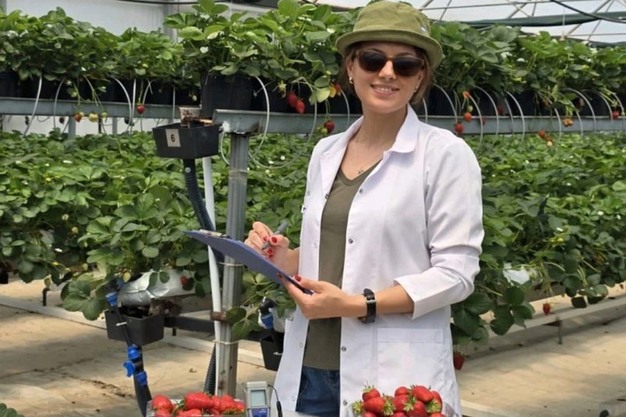
"Bacillus species exhibit a multi-mechanistic effect against Botrytis cinerea, combining biochemical antagonism with ecological competition", Birgül says.
 © ALBAYRAK
These mechanisms include the production of lipopeptides, enzymes, and antimicrobial metabolites that inhibit spore germination and restrict mycelial development.
Samet highlights that these metabolites act early in the infection cycle, reducing pathogen establishment before visible symptoms appear.
 © ALBAYRAK
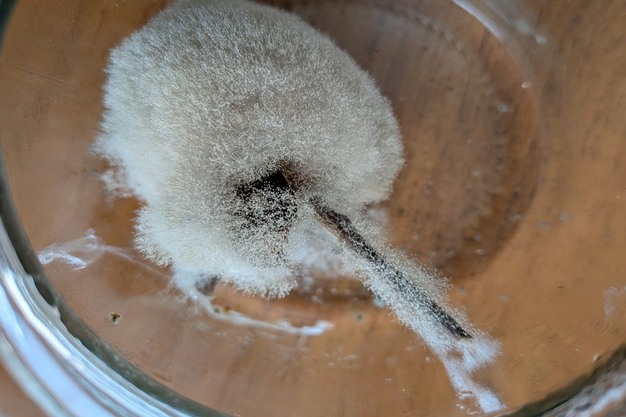
Controlled-condition propagated Botrytis on strawberry plants
Surface colonization and competitive exclusion
Beyond biochemical activity, Bacillus spp. contribute to disease suppression through rapid colonization of plant surfaces. This limits available space and resources for pathogen establishment in the phyllosphere.
"Early colonization, particularly during flowering, is critical in preventing infection initiation under greenhouse conditions," Birgül explains. In several observations, biofilm-like structures were also noted, enhancing surface persistence and protective capacity.
"This competitive exclusion mechanism creates a stable microbial barrier that reduces the ability of Botrytis spores to attach and germinate," Samet adds.
 © ALBAYRAK
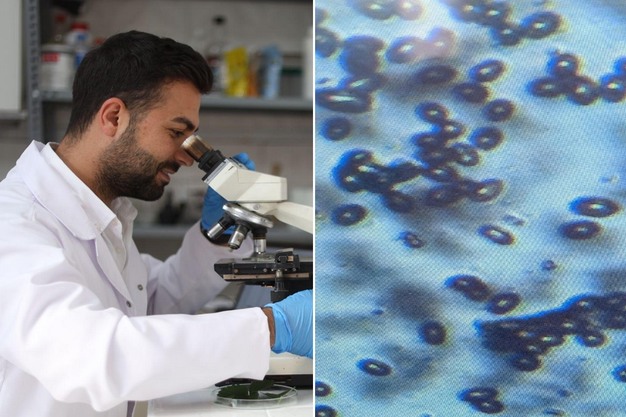
Microscopic image of Botrytis on strawberry plants
Induced plant defense and physiological response
Another important effect observed in trials is the stimulation of plant defense responses. Bacillus applications were associated with improved stress tolerance and more balanced vegetative development under disease pressure.
"We observed increased plant resilience that we associate with induced systemic resistance mechanisms and improved physiological stability." This dual effect supports both disease suppression and overall crop performance in soilless systems.
 © ALBAYRAK
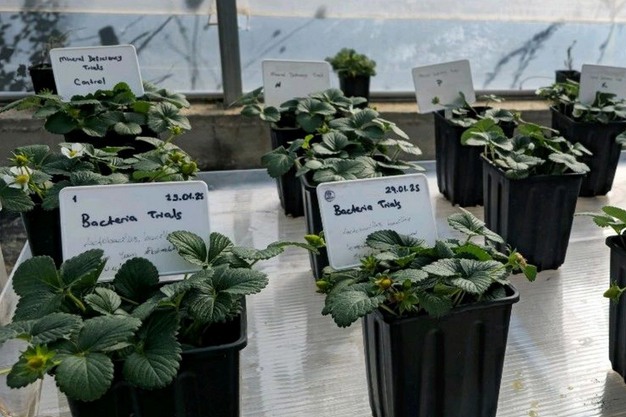
Comparative experimental trials using different doses and multiple Bacillus species
Greenhouse validation in soilless strawberry systems
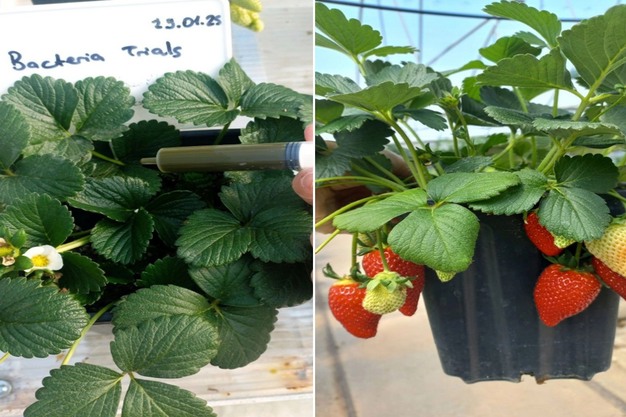
Field validation was carried out in cocopeat-based soilless strawberry production systems using both foliar and root-zone Bacillus applications under controlled dosage programs.
"Even under prolonged high humidity conditions, the need for chemical fungicide applications was significantly reduced, and during peak pressure periods no chemical interventions were required," he reports.
Across production cycles, consistent improvements in plant vigor, canopy health, and disease incidence were jointly recorded by the researchers.
Comparative trials with different Bacillus species and dose ranges further confirmed that the application strategy plays a decisive role in efficacy.
Post-harvest quality and shelf life effects
The benefits of Bacillus applications extended beyond the production phase. By stabilizing fruit surface microbiota, reductions in post-harvest decay were observed.
"Improved microbial stability on the fruit surface translated into longer shelf life, which is particularly important for cold chain logistics and fresh market supply chains," Birgül says.
 © ALBAYRAK
Integrated use in sustainable disease management
The findings from joint trials and commercial applications suggest that Bacillus spp. represent a viable, residue-free biological tool for managing gray mold in greenhouse strawberries.
"The highest level of effectiveness is achieved not through a standalone application, but within an integrated disease management program," she adds. "This approach has been recommended to many growers with whom we work and provide technical support, and is considered a strong biological alternative for operations aiming to reduce chemical inputs and transition toward more sustainable production systems."
For more information:
Birgül Albayrak, Agricultural Engineer / Soilless Strawberry R&D Specialist
[email protected]
linkedin.com/birgul-albayrak
Samet Albayrak
Agricultural Engineer / Consultant for soilless strawberry production
[email protected]
linkedin.com/samet-albayrak