Eggplant color is more than a matter of appearance. It shapes consumer preference, market value, and breeding goals, while also offering a window into how plants control pigment production. This study identifies a previously unknown genetic mechanism behind nonphotosensitive purple-black eggplant fruit, in which anthocyanins accumulate even without light. Researchers traced the trait to a major locus, SmNPS10.1, and pinpointed SmMYB113 as the key gene. Most strikingly, they discovered that a 725-bp repeated sequence in the gene's promoter acts like a built-in switch, allowing pigment formation under dark conditions and opening new possibilities for precision breeding.
Fruit coloration in eggplant is usually shaped by chlorophyll and anthocyanins, and anthocyanin production is often strongly influenced by light. In many crops, insufficient light weakens pigmentation and reduces visual quality, which can limit market appeal. Eggplant is especially useful for studying this problem because its fruit colors are highly diverse, yet the genetic basis of nonphotosensitive purple fruit has remained unclear. Earlier studies had identified genes tied to green or photosensitive purple fruit, but they could not fully explain why some eggplants stay richly pigmented even in darkness. Based on these challenges, deeper research was needed on the genetic regulation of light-independent anthocyanin biosynthesis in eggplant.
A team from South China Agricultural University, working with Yuelushan Laboratory, Hunan Vegetable Research Institute, and the University of Kentucky, reported (DOI: 10.1093/hr/uhaf319) on November 21, 2025, in Horticulture Research that a quadruple 725-bp repeat in the promoter of SmMYB113 is associated with light-independent anthocyanin regulation in eggplant and can be used to support marker-assisted breeding for fruit color.
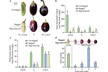
The story began with two contrasting eggplant lines: one green and one nonphotosensitive purple-black. In bagging experiments, the purple-black line kept accumulating anthocyanins even when light was blocked, showing that the trait was genetically controlled rather than environmentally induced. Genetic analysis of the F2 population suggested a single dominant factor, and QTL-seq mapped that factor to chromosome 10, where the team narrowed SmNPS10.1 to just 33.58 kb. Within that interval, only one compelling candidate remained: SmMYB113. The researchers then found a striking structural difference in its promoter. The nonphotosensitive line carried four copies of a 725-bp repeat unit, while photosensitive lines carried only one. Expression tests showed SmMYB113 stayed active in dark-grown fruit peel, unlike in photosensitive eggplants. Transgenic assays in tomato and eggplant confirmed the effect: the promoter from the nonphotosensitive line drove stronger pigmentation under light-deficient conditions, while markers linked to the trait showed high accuracy across breeding populations and natural cultivars.
The study presents this repeat-rich promoter as a new kind of pigmentation control element. Rather than changing the protein itself, the repeated DNA appears to reshape when and how SmMYB113 is turned on. In practical terms, that means purple coloration can persist even when fruit is shielded from light. The researchers also show that this discovery is not just mechanistic but usable: linked KASP markers tracked purple and nonphotosensitive fruit color with high consistency, making the finding immediately relevant to breeding.
The implications extend beyond eggplant skin color. For breeders, the work offers reliable molecular tools to select for fruit appearance more efficiently and to design varieties that maintain attractive pigmentation under variable growing conditions. For plant biology, it highlights how structural variation in promoter regions can reshape visible traits by rewiring gene expression. That insight may help explain similar color differences in other horticultural crops and guide future efforts to improve quality, uniformity, and consumer appeal through marker-assisted selection and deeper study of regulatory DNA.
Source: www.eurekalert.org