Leaders in California's processing tomato industry, for the first time during the 2025 harvest season, agreed to voluntary equipment cleaning and notification guidelines to prevent the spread of a pernicious weed that threatens the industry: Branched broomrape makes sweet lavender flowers, but it's a parasitic weed that attaches to plants' roots and sucks out key nutrients.
The weed's tiny seeds can be smaller than finely ground spices, survive dormant in soils for decades and be carried by wind, footwear and other methods. Its resurgence in 2017 in Yolo County – a historic center for growing processing tomatoes – threatens the productivity of this industry that brought in $1.6 billion in 2024.
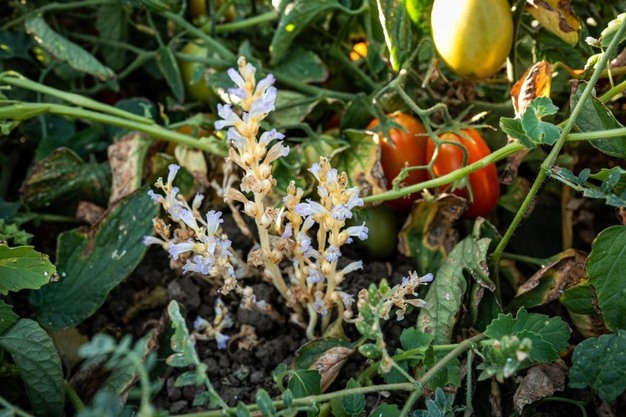 © Jael Mackendorf/UC DavisBranched broomrape growing among tomatoes in a research field
Among those leading the way is Brad Hanson, a professor of Cooperative Extension in the University of California, Davis, Department of Plant Sciences. He's also an ad hoc member of the Broomrape Control Board.
Hanson calls his colleagues in this effort "the Clean Machine project team," made of several researchers from UC Davis and University of California Agriculture and Natural Resources, plus key partners in the tomato industry.
"For several years, we have been addressing research and outreach goals related to reducing the risk of branched broomrape in processing tomato," Hanson said. "This has been really productive and has led directly to research-based recommendations to growers and regulatory agencies that will help protect key specialty crops in California, not just tomatoes."
Team members have developed in-field sanitation guidelines for tomato harvesters and other field equipment. Researchers across campus also are evaluating herbicide treatments, weeding methods, ways to detect the weed and disrupt its ability to affect crops.
"It's been really gratifying to be a part of a multidisciplinary team doing work that spans ag production to policy," Hanson added.
Under former state quarantine rules, any broomrape detection would require a field be destroyed before harvest. With the new guidelines, growers may harvest if they adhere to certain management practices, including equipment cleaning standards developed by the California Broomrape Board, formed in 2024 to advise the California Department of Food and Agriculture.
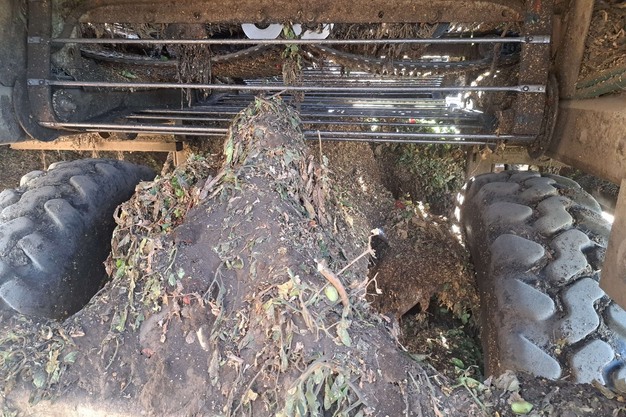 © UC DavisDirt, mud and plant debris found on a tomato harvester show how easy it is for tiny broomrape seeds to travel from an infected field and contaminate a clean one
A better picture
Before the broomrape compliance agreements, it was difficult to determine how many of the 185,000 to 250,000 tomato production acres might be infected. For affected farmers, reporting would mean losing a crop and the money they had invested in planting, irrigation and other efforts with no hope of insurance covering the loss.
The new agreements have changed that, Hanson said.
"With the risk of crop quarantine off the table for growers under the compliance agreements, we can talk about the problem out in the open," Hanson said. "The daylighting part of this has been really helpful because, for the last five years, we've been really in the dark."