Plant-based agriculture is changing with the introduction of new engineering, technology, and information tools. Camilo Villouta, an assistant professor in the University of Rhode Island's Plant Sciences department, not only has a green thumb, he brings a sophisticated command of modern tools to his position at the University. Now he's taking his plant engineer mindset to new research growing hydroponic vegetables.
Backed by a recent U.S. Department of Agriculture (USDA) award, Villouta has received a competitive food research grant from the department's National Institute of Food and Agriculture to conduct research connected to controlled environment agriculture. The two-year project is already underway and will conclude in 2028.
The rising demand for locally sourced, fresh produce available year-round has led to the rapid growth of controlled environment agriculture in urban areas, including in Providence where growing national producer Gotham Greens opened its only New England location.
Villouta serves as the controlled environment agriculture specialist at URI, focusing on hydroponic and greenhouse production systems.
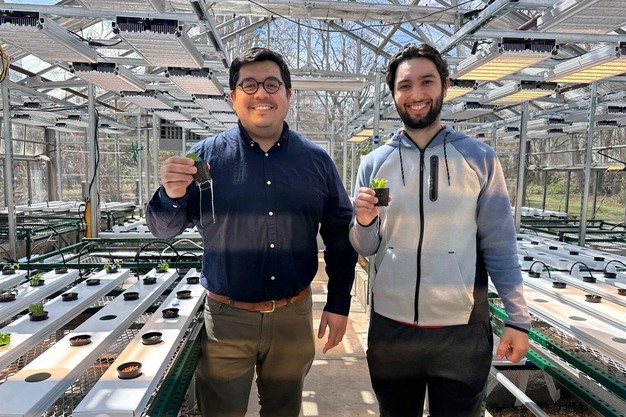 © URI Photos / Shalyne ScottURI Assistant Professor Camilo Villouta, left, and Ph.D. student Deniz Camli-Saunders are conducting new research growing hydroponic vegetables
"My research has always been strongly applied and connected to real-world production systems," said Villouta. "I work closely with growers to understand and address the challenges they face, particularly in controlled environment agriculture. My approach is to study plant physiology in detail and translate that knowledge into practical solutions that improve production outcomes."
Controlled environment agriculture, particularly in urban settings, offers a sustainable alternative to traditional open-field farming by allowing precise control over environmental variables. However, as the adoption of controlled systems, including hydroponics, becomes more widespread, optimizing the growing conditions for crops like spinach remains a significant challenge.
"We are focusing on spinach because it has strong potential for greenhouse and controlled environment production but still presents unresolved challenges," he said. "Lettuce is also temperature sensitive, but many of its production challenges have already been addressed, allowing for consistently high yields. Tomatoes are another example of a temperature-sensitive crop that is now well-optimized for controlled environment production."
Villouta's award will address a key priority area in the program and position the University as a leader in the region: URI was the only institution selected for funding in the Northeast out of 10 research projects selected for funding nationwide.
Getting to the root of the matter
A native of Chile, Villouta began his career path as an "agronomic engineer" and has taken a similar engineering mindset to his work in horticulture in the U.S., helping to improve the growing of such iconic American staple plants as cranberries and strawberries. Now his research and passion in advancing sustainable crop production is focusing on the role of root system development in hydroponic and controlled environment agriculture systems.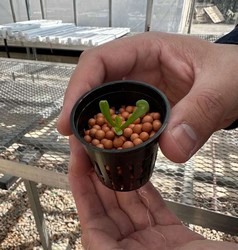 © URI Photos / Shalyne Scott
Indoor vertical growing systems provide an ideal environment for cultivating high-value crops like spinach. However, optimizing the plant's root conditions remains a challenge to improving crop productivity and quality. Compared to other hydroponically grown leafy greens like lettuce, spinach has been less attractive to farmers due to its lower yields in hydroponic systems. Many of the plant's specific components have been understudied in indoor growing.
Villouta aims to address these gaps by examining how the plant's root systems influence its production and overall health. With this funding, he'll explore the mechanisms by which temperature variations affect spinach growth in hydroponic environments. The results could significantly improve the plant's viability in controlled systems and also inform best practices for other temperature-sensitive crops in controlled environments.
A particular focus of his work on spinach is studying the plant's root exudates. Plant roots produce a wide range of these substances, including organic acids, amino acids, sugars, proteins, and other metabolites. These compounds are released whether plants are grown in soil, substrates, or water. What is not yet well understood is how the production and composition of these exudates change under hydroponic conditions.
Villouta's research aims to characterize these exudates, compare their composition between soil- and water-grown systems, and evaluate how factors such as temperature influence their production. This work is an important first step in understanding whether these compounds contribute to plant stress or reduced productivity in hydroponic systems, he said. Villouta hopes his research offers new insight into ways to improve hydroponic growing overall.
He's also teaching URI students about this "growing" growing method. In addition to teaching Greenhouse Management at URI, this fall he'll be teaching a new course in Advanced Hydroponics and says he is excited about the class: "This course is highly practical and quantitative, focusing on calculations and decision-making tools that help students solve real production challenges."
And while Villouta is studying spinach in his lab, the produce powerhouse can also be found on his plate. "I love baby spinach in a fresh, crisp salad," he said. "Texture is key—the leaves should be tender but still have a bite."
Source: The University of Rhode Island