For decades, Henk Koot gave horticultural advice and visited many growers. First in government service, then on behalf of Vortus, a Dutch consultancy firm that he set up with Siem Voogt.
Henk has been retired since 2008. Since then, 'the real fanaticism has gone', he says during a visit to his home. However, when he takes us back in time for the series Horti History, it becomes clear that Henk still has the stories from those days at his fingertips. And that his grapevine is still well maintained. "I've just trimmed the growing tips."
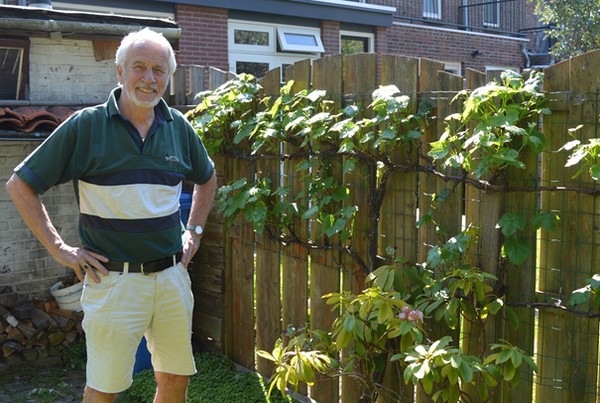
Henk at home with his grapevine
Two chimneys, twelve children
Henk, 78, was born into a family of twelve. A family of growers in Berkel en Rodenrijs. His father had a vegetable growing company together with his brother, Gebroeders Koot. This was where Henk experienced the cultivation of tomatoes and cucumbers, among other things. "I experienced the time of growing under flat glass".
Together with his younger brother, he was the only one of twelve children who was allowed to continue studying. Henk did so at the Mulo in Pijnacker. He also enlisted, as was the style at the time. "After that I worked for a few months in the family business. Our company had two hectares of glass, which was big in those days. We had two chimneys, as they used to say in the Westland in those days."
Colleagues, not competitors
Henk's career as a consultant began in 1964. October 1st to be precise. "I applied for a job as an assistant at the time at the Naaldwijk Research Station. That was a semi-governmental institution. I became a civil servant there and had to do a trial run first."
On 1 September 1965 Henk then became an consultant. He was assigned to the Rotterdam-East district. "I succeeded Ser Kamerling there. Our task as consultants in a region was to bring the knowledge from the Research Station into practice, to the growers."
Each region had a study club, which is where knowledge was transferred. "Evenings were organized where we, a consultants, shared information about variety trials that we carried out ourselves, about cultivation techniques, and also organized lectures to which we invited specialists. At that time, growers were still really colleagues and not competitors. It was here that the foundations of the success of Dutch greenhouse horticulture were laid."
The information service originated from the Marshall Aid set up after the Second World War. The money from the extensive aid plan initiated by the Americans was used to (partially) fund the service. "Growers could then call on us free of charge. They would call us and we would go there and try to solve their problems. If that didn't work, we would call in the specialist from Naaldwijk. That's how it went."
Sweating bullets
Henk still remembers his first lecture as a consultant well. "It was about lettuce varieties. I got to tell eighty people which varieties were good and what our test results were. You can be sure that I was sweating bullets."
Just as exciting were the first visits to growers in his district. "One of them, at the time a salad grower from Nieuwerkerk aan den IJssel, asked me almost as soon as I arrived: 'Can you cut lettuce?' I had to change my clothes and start working immediately. After twenty minutes of cutting lettuce, it was time for coffee. The grower had seen enough. I had shown I could do it. I was lucky that I had learned it at home. My father had also grown lettuce. Later, Ser told me that when he went to introduce himself to this grower, he had to help mow purslane. That is much more difficult and I could never have done it. That's how it was back then. You were tested, but after that the ice was broken."
Economic work
Until the mid-seventies Henk was, to his complete satisfaction, fully engaged in cultivation techniques. That changed with the advent of the interest subsidy scheme. "Growers then had to have an investment plan, in which they could demonstrate that they were going to make a profit. If the plan was good and was approved, the grower's mortgage interest burden could be cut in half."
As a result of this regulation, Henk had to make a lot of investment plans and screening reports of companies from then on. "The government required us to put much more emphasis on the economy. We also had to hold more and more meetings. I felt this was a shame. I much preferred working with the cultivation."
In 1980 Henk stopped working as a consultant in government service. He went to work for supplier Codrie, a company owned by Cor van Driel in Bleiswijk. That same year, that company was taken over by Brinkman. This was where Henk met Siem Voogt again.
He had already met him before, at the testing station in Naaldwijk. "Siem was a researcher there. I was taught by him. He was a specialist in nutritional schemes, and with the switch from soil cultivation to substrate cultivation this became increasingly important."
The face of consultancy work
Henk did not stay with Brinkman for very long. "I soon found out that I'm no salesman, but I am good at selling knowledge." An example comes to mind. "At the time, I worked as a consultant for Brinkman and visited a grower in his greenhouse. The greenhouse was full of weeds, because the soil disinfection with methyl bromide had failed. He asked me what I thought about that. I agreed with him. In my role as Brinkman's representative, it was not 'convenient', as I now understand."
It was the time in which there were many problems concerning soil decontamination. "Cultivation had to be done out of the ground, on substrate, and they needed watering systems for this. There was a lot of demand for this at the time and the supply could not keep up with the rapidly increasing demand. More was sold than could be installed. I therefore became the messenger of 'bad' news and 'delay news'. I was fed up with that. I was less technically involved and growers began to doubt me, even though I had built up a reputation as a consultant."
Together with Siem, a separate consultancy service was set up within Brinkman in 1981, the predecessor of the current Vortus Greenhouse Consultancy. "In this way, we gave our consultancy work a face." One year later, Siem took over Vortus from Brinkman. "He became the director and I started working with him. Siem knew everything about food and water, and I had knowledge and experience of varieties, cultivation and climate control. That turned out to be a good combination."
It was, as mentioned, the time of the switch to substrate. "There were three options at the time, so people thought. Rock wool, peat bales or running water. Researchers first thought it was going to be running water that came out on top, but it turned out to be rockwool."
Another development was the emergence of climate computers. "This meant the computer-controlled the climate. But as a grower, it was still important to keep checking the state of the crop to see whether everything was going well. That still required professional skill."
It was also the time of discussion about the pre-night reduction. "There were heated discussions about this at the time. The advance of climate computers made it an issue. In order to achieve the light-dependent 24-hour temperature, it was possible to reduce the pre-night temperature. For us, it was a foregone conclusion that this was good for the crop."
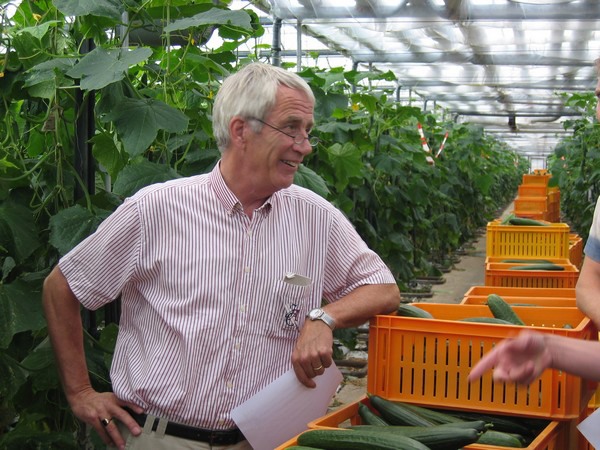
Henk liked to keep in close contact with his growers. "If I had been to a grower and something was wrong, I wanted to be able to go back three days later to have another look. That wasn't possible internationally."
Black-on-white report
In the first five years, the team of advisors grew from two to seven people. Henk points to a crucial moment. "In those early days of cultivation on rock wool, there was a pepper grower in Bleiswijk who had problems with his crop. Halfway through the season, his wife phoned us. Her husband was becoming stressed because the cultivation was not going well. Advice had been sought from all sorts of quarters, but they couldn't get things working.
Then Siem and I went to visit and we got things moving. Among other things, the pH was far too high and the unit the grower was using was not being used properly. From the moment the grower was up and running again, it was the signal to the world that you could always come to Vortus for the cultivation of fruit vegetables on substrate.
In 2008 Henk stopped working as an advisor. November 1st was his official retirement date. Growers were becoming more and more managerial, greenhouses were getting bigger, and so 'the simple contact with the grower' – the very thing that had attracted Henk so much to his job – was disappearing.
He still remembers the one time he was in Canada. "I was there visiting a tomato grower with my colleague Tineke Goebertus. It was the beginning of the millennium. Whilst there we talked to the grower, as you see more and more nowadays, but also with the director and the manager. The latter also talked about the cultivation, but had, at least in my opinion, not enough understanding of it. The management's focus is on money, on finance."
As always after a visit, a black-on-white report was made. "A month and a half later, the grower in question turned out to have problems. Our advice had been ignored. The grower was blamed for that. I didn't think that was right."
Little international, not digital
Henk's visit to Canada was an exception. Unlike Siem, for example, who was often to be found in North America, Henk did not travel much. At least, not beyond his own country's borders. "I regularly visited Belgium, just over the border, but I was mainly based in the Netherlands. I wanted to keep a close eye on my growers. If I had been there and something was wrong, I wanted to be able to go back three days later and have another look. That wasn't possible internationally. Luckily, Siem liked to travel and found it easier than I did, so that was ideal."
Today, Vortus operates mainly internationally. And that increasingly involves giving digital advice. Henk has never really had much to do with it "Once a grower asked me what I thought of a plant during a video session. 'Nothing', was my short answer. I could not do anything with it digitally. At school, I learned from Isak Baalde that when you enter a greenhouse, you first have to let your senses do the work for five minutes. You have to feel the greenhouse climate. Your glasses should fog up when you enter. That's a good sign. And if the crop is growing well, you can smell it.
That, together with the foundation I laid in Naaldwijk, has helped me throughout my career. The opportunity to learn first, without having to make an immediate profit, is something I think consultants nowadays hardly get, if at all. A pity, because that is how you lay the foundation. And that foundation is and always will be cultivation."
As Henk pointed out, the fanaticism of those days is gone nowadays. "I stopped all at once. I didn't want to continue advising one grower and not another. I didn't think that was fair. I didn't want to favor anyone. I only visit a customer once in a while for a few cucumbers or to borrow a trailer."
And every now and again Henk pays a visit to Vortus, which will celebrate its 40th anniversary next year. "I was there last month. It is nice to hear how things are going. For example, with new systems such as vertical farming. Or, well, 'new', I vaguely remember a grower in Limburg who was already growing plants in vertical towers when we started."
Horti History
This was part 18 in the series 'Horti History'. A series in which various 'old hands in the trade' look back and forward. And in which we examine what their work has meant for today's horticultural sector.
Tips for the series are welcome and can be e-mailed to: [email protected]. Below are all the parts so far.
- Part 1: Piet Bom - Will your next greenhouse be made of Fiberglass?
- Part 2: Henry van der Lans - We slept in the same little hotel...
- Part 3: Rob Grootscholten – 42 years of greenhouse construction...
- Part 4: Peter Stuyt – As a Dutch American, I like to combine...
- Part 5: Leo Alsemgeest - Bit by bit a step back
- Part 6: Harry Dullemans – Never say you are not there...
- Part 7: Kees de Groot - We must make something different than...
- Part 8: Leo Alleblas – The urge for adventure is in our blood
- Part 9: Carel Zwinkels - “A grower needs to keep on developing in order to stay afloat in this market”
- Part 10: Willem van Dorssen - "Willem, watch out for your shiny shoes!"
- Part 11: Cees and Leo van der Lans - "If you want to do everything yourself, you will get nowhere"
- Part 12: Marten Barel - "The transition that horticulture has seen is truly impressive"
- Part 13: Hans Zeeman - Grateful that our family name still...
- Part 14: Johan de Hoog - "When a storm hits, we pick up the pieces of glass together"
- Part 15: Ton van der Kooij - For one night only I transformed myself...
- Part 16: Cees Overgaauw - Without a guardian angel, I would still be...
- Part 17: Bram van den Ende - Bram's adventures at home and abroad
For more information:
Henk Koot
[email protected]