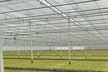
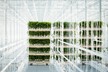
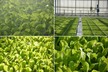
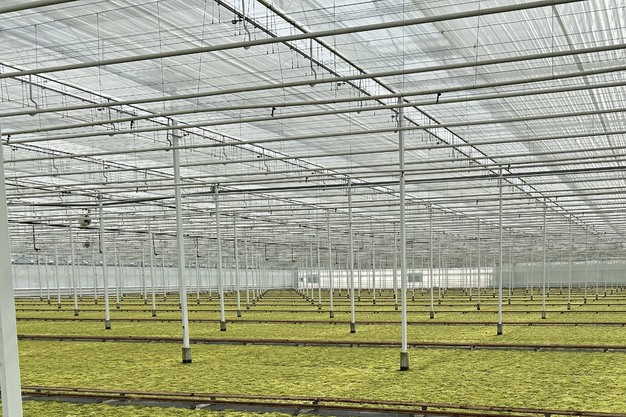
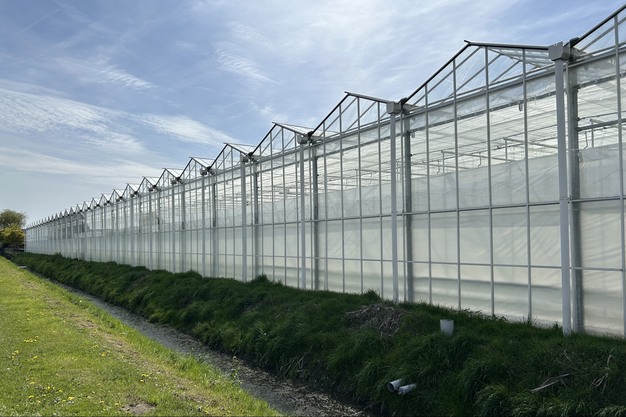
Klasmann-Deilmann has taken a further step in scaling up production of its cultivated sphagnum product, Sphaxx®, with the opening of a new production site in Bergschenhoek, in the Netherlands. The facility, a former sweet pepper greenhouse of approximately six hectares, has been fully converted for sphagnum cultivation. The first three hectares became operational on 1 March, with the remaining half following on 1 May.
A notable feature of the site is that the first section of the greenhouse is around 25 years old. By choosing an existing structure rather than building new, Klasmann-Deilmann reinforces the sustainability credentials of the product. The greenhouse has been technically adapted to meet the specific requirements of Sphaxx cultivation, including new floor systems and a modified irrigation setup. Production at the site is carried out without supplementary heating.
 © Klasmann-Deilmann Group
Combination of production and research strengthens innovative capacity
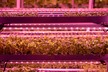
In addition to its production role, the Bergschenhoek site will also serve as a research centre. Work there will focus on optimising cultivation methods, product quality, and the scalability of Sphaxx. By combining production and research at a single location, Klasmann-Deilmann aims to respond more effectively to market developments and the practical needs of growers. This approach aligns with the company's broader strategy around product availability, cultivation reliability, and continuous innovation.
The expanded capacity at Bergschenhoek strengthens the foundation for Sphaxx's further commercial development. The site reflects Klasmann-Deilmann's ambition to make sustainable alternatives to peat available at greater scale, without compromising on quality or consistency, in line with the company's strategic direction toward a future-proof and circular substrate sector.
 © Klasmann-Deilmann Group
Alternative to extraction in peat areas
Sphaxx is a sustainably cultivated substrate raw material developed by Klasmann-Deilmann and positioned as a controlled alternative to sphagnum harvested from peatlands. Grown in unheated greenhouses, it delivers consistent quality, high purity, and reliable availability with a low ecological footprint. The product is primarily used in the propagation of epiphytes such as Phalaenopsis and Bromeliads, where it supports uniform germination and root development. Sphaxx received RHP certification in 2026, formally confirming its quality standards.
For more information:
Klasmann-Deilmann GmbH
[email protected]
www.klasmann-deilmann.com