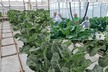
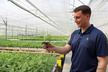
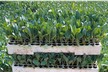
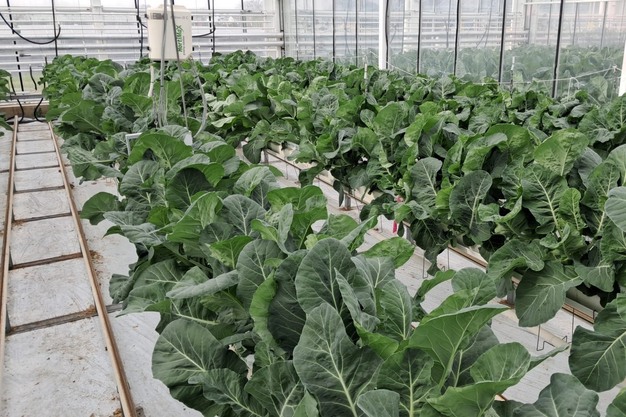
Fruit vegetable growers who do not cultivate during winter can use their spent substrate slabs to grow cauliflower. Greenhouse cauliflower production requires little energy and typically fits into the calendar just before a summer crop such as cucumber is planted. For this reason, the Research Station for Vegetable Growing (Proefstation voor de Groenteteelt) in Belgium ran a cauliflower crop in two greenhouse compartments during the past winter season. The station's extension team used the opportunity to set up a formal trial, and the results exceeded expectations.
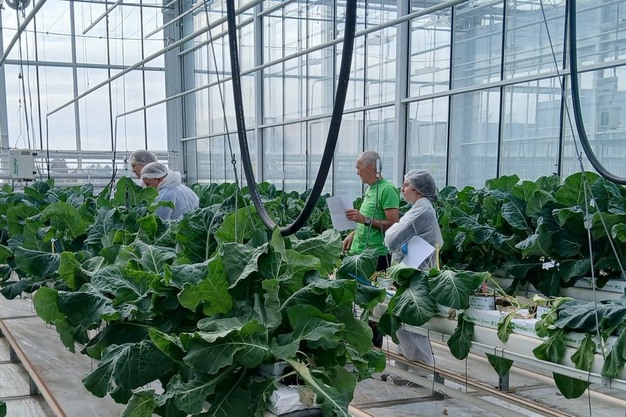
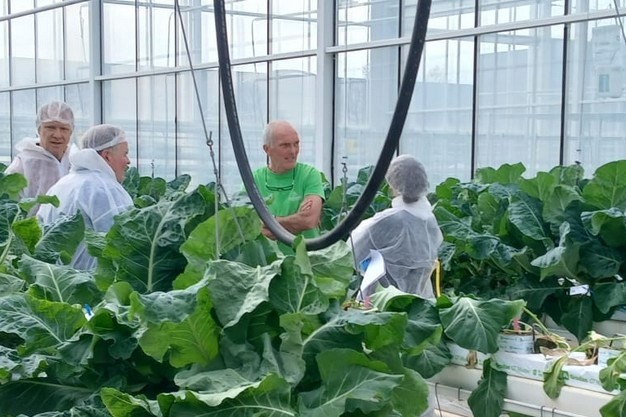
"The trial produced very good results," says extension officer Ilse Leenknegt. "That's why we decided at the last moment to organise a demonstration. It was well received by growers from both Belgium and the Netherlands."
 © Proefstation voor de Groenteteelt
The Research Station for Vegetable Growing has been conducting greenhouse cauliflower trials for many years. Traditionally, the focus has been on soil-based cultivation, but a growing number of growers are now producing cauliflower on substrate. "We see interest from cucumber growers, but increasingly from other crops as well," says Leenknegt. "Some growers are looking for an alternative because of high energy prices. Others, towards the end of their careers, are looking for a crop that is less labour-intensive."
 © Proefstation voor de Groenteteelt
Variety trials tailored to substrate cultivation
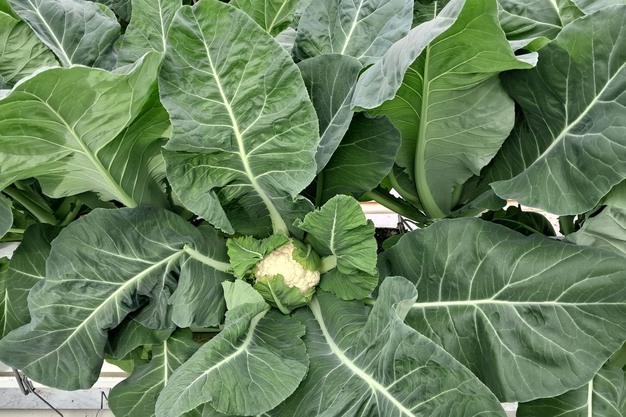
Growers who choose to cultivate cauliflower on substrate often have newer, technically more advanced greenhouses than those working with soil-based systems. "In newer greenhouses, light levels tend to be higher. Growing on substrate also creates a drier climate, everything is covered with plastic, whereas in soil-based cultivation, moisture reaches the plant more easily."
The researchers concluded that it is important to conduct variety trials specifically tailored to substrate cultivation. Growers aim for a spread harvest, and achieving that is not straightforward. "Planting every week is sometimes not enough," Leenknegt notes. "Varieties can still converge in their development, leading to production peaks, exactly what growers are trying to avoid."
 © Proefstation voor de Groenteteelt
Speeding up cultivation with limited additional energy input
The demonstration crop compared several varieties across two compartments of 150 m² each, with two different climate regimes tested alongside the variety comparison. All varieties were grown on used rockwool slabs from a previous cucumber crop.
Beyond variety differences, the trial showed that it is possible to accelerate the crop with a modest additional energy input. In the compartment maintained at a minimum night temperature of 6°C and a day temperature of 10°C, harvest was achieved one week earlier compared to the compartment kept only frost-free. This is significant for growers who need to finish harvesting before a new cucumber crop must be planted.
 © Proefstation voor de GroenteteeltDistinctive product
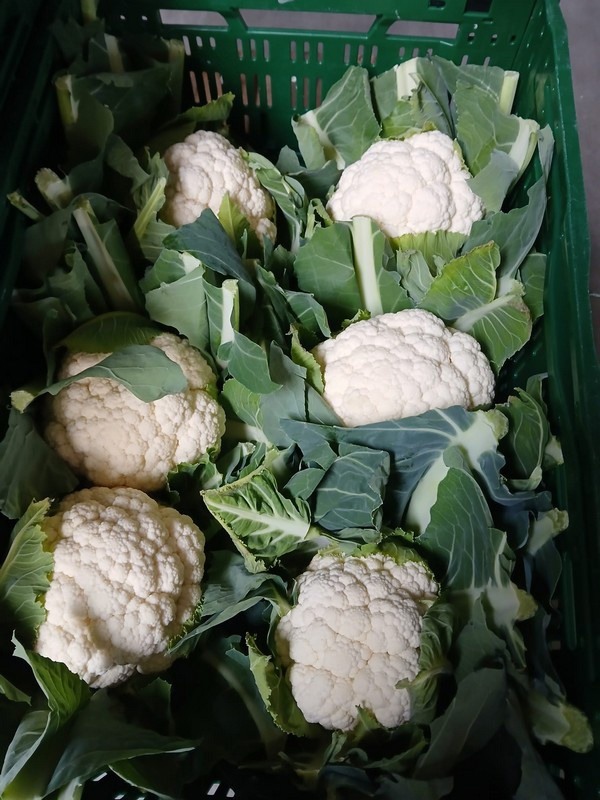
With the demonstration, the researchers aim to offer practical guidance to growers who are considering substrate-based cauliflower cultivation. A follow-up crop is being considered for the coming autumn, with the Research Station looking to start even earlier in order to be finished by the end of March, a request that came directly from growers during the farm walk.
Growers who produced greenhouse cauliflower during the past winter season achieved good prices. Leenknegt points out that price formation depends on supply from open-field production. When open-field supply is high, as it was the previous year, greenhouse cauliflower prices also come under pressure. During the most recent season, open-field supply was lower, which worked in favour of greenhouse growers.
Substrate growers have now completed their harvest. Open-field growers typically continue harvesting until mid-May. Greenhouse cauliflower, noted for its distinctive flavour, therefore has a clear window in the market.
 © Proefstation voor de Groenteteelt
For more information:
Proefstation voor de Groenteteelt
[email protected]
https://www.proefstation.be/