European intensive agriculture is under growing pressure to improve operational efficiency without sacrificing traceability or cost control, and digitalization is the answer, particularly in production systems such as soft fruit, where labor, logistics, and agronomic management are closely intertwined.
The solution presented by Agrogestia and Knitink Technology at Macfrut goes beyond the introduction of new digital tools. It represents a broader approach built around data integration as the central pillar for decision-making, an approach that, according to Eduardo Barbadilla, CEO of Agrogestia, is designed to address one of the sector's core challenges: fragmented information.
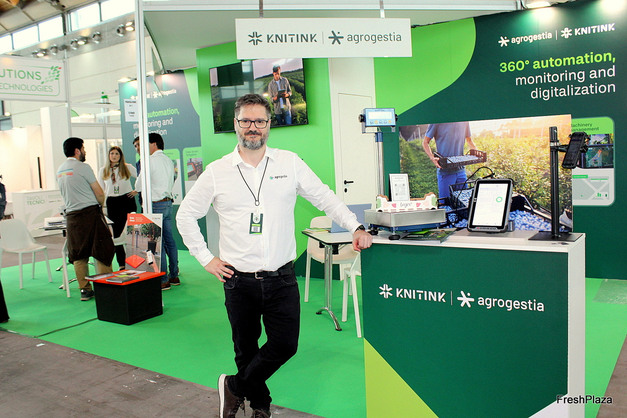
"What we are presenting here is a project that integrates two technological platforms that until now operated in different but complementary areas, and that together can deliver much greater value to the grower. On the one hand, Agrogestia works as an ERP specialized in agricultural production, capable of managing human resources, harvesting, machinery, or inventories, while Knitink Technology focuses on sensorization, irrigation, and fertigation, meaning the agronomic execution in the field."
The integration is designed as a bidirectional system in which data flows both ways, allowing information generated in the field to be analyzed from both economic and agronomic perspectives, introducing a level of analytical depth that has so far been difficult to manage efficiently. "Many growers already have solutions for specific areas, but the problem appears when they try to cross that data and make consistent decisions without a global view," he explains. "That is precisely where the system's added value lies."
Simplifying technology management without sacrificing data complexity
This integration logic becomes especially tangible in critical processes such as fertigation management, where the platform connects purchasing decisions, nutrient solution formulation, field application, and subsequent analysis of costs and yields, creating a closed loop of information that supports continuous optimization. "In practice, from our platform we can manage fertilizer stock, plan tank preparation, and send that information to the irrigation system, which executes the application in the field and returns precise data on the water and nutrients applied to each plot. That allows us to link that information directly to production and automatically calculate indicators such as water footprint or nitrate footprint," Eduardo explains.
One of Agrogestia's developments that drew the most attention during the fair is linked to harvest management, a particularly sensitive area in crops such as blueberries or raspberries, where labor accounts for the majority of production costs. The system includes an automated weighing station that records each worker's output in real time, eliminating manual errors and adding transparency to the process.
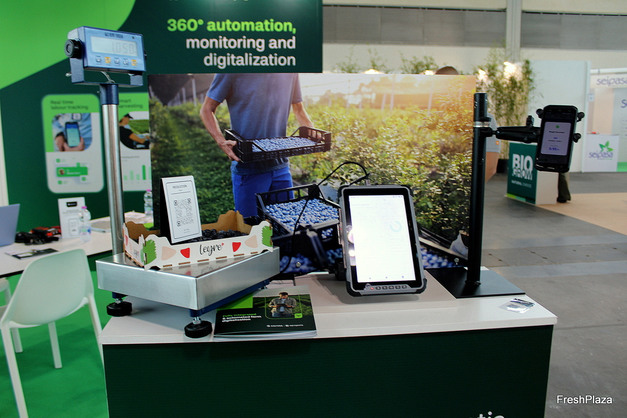
"The flow is simple but very powerful: the picker arrives, places the fruit on the scale, and the system automatically deducts the container tare, something that often causes errors when done manually. Once the worker identifies themselves using an NFC tag or QR code, the system records the weight and directly calculates their performance," he says. "This information is not only recorded, it is integrated into dashboards that allow you to track harvesting progress by the hour, compare performance between workers, and analyze productivity by plot."
This level of detail introduces a new dimension to field management, especially in companies that operate with productivity based incentive systems, as it allows precise calculation of cost per kilo produced and real time adjustment of operational decisions. "In the end, what we are offering is information that did not exist before or arrived too late, and that now makes it possible to know whether production is profitable at any given moment or whether certain operations need to be accelerated or stopped."
"At the same time, the project responds to an increasingly clear trend in the sector: the need to simplify technology management without giving up data complexity, a difficult balance when farms operate with multiple disconnected tools," Eduardo adds. "In this sense, although both platforms maintain their identity, the grower can access the information in an integrated way, choosing the environment that best fits their needs, which facilitates adoption without creating operational friction."
For more information: © CroptiqAgrogestia
C/ Mozárabes nº 7.21002. Huelva
T. +34 959 803 174
[email protected]
https://www.agrogestia.com/
 © CroptiqKnitink
Parque Huelva Empresarial, Nave 42, Huelva, 21007
T. +34 959 392 272
[email protected]
https://knitink.com/