"We are proud to present a new and unique product that does not yet exist anywhere in the world. We are experimenting with a vertical farm featuring a thermodynamic system that I would describe as the 'Egg of Columbus' for solving the heat issue." With these words, Nicola Contrisciani outlined the technological basis of his start-up, which was founded last 12 January, during a meeting at the Macfrut 2026 exhibition. The company is a deep tech engineering firm operating in the Agriculture 4.0 sector, specializing in applying energy-saving and energy-efficient technologies to farms via proprietary system architecture.
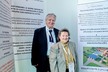
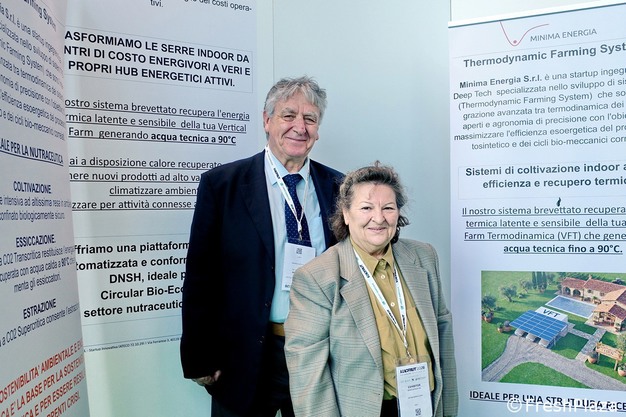 © Rossella Gigli | HortiDaily.comMinima Energia applies energy-saving and energy-efficient technologies to farms. Photo: Nicola Contrisciani and Marisa Elena Ortoni presenting the startup at Macfrut 2026
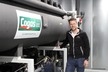
At the heart of this innovation is the Thermodynamic Farming System (TFS), which aims to maximize the exo-energy efficiency of the photosynthetic process by integrating advanced thermodynamics with precision agronomy. The physical application of this concept is VFT (Vertical Farm Thermodynamics), which uses a transcritical CO₂ cycle (R744) to convert traditional, energy-intensive indoor growing environments into active energy hubs.
The system relies on heat recovery within the cultivation environment. As Contrisciani pointed out during the exhibition, "Currently, plants absorb less than 10 percent of the energy." To address this issue, our system operates on two fronts: Management of light and humidity. It recovers waste heat from the LEDs and manages the dehumidification necessary to recover latent heat from the vapor. This patented process generates high-enthalpy technical water that reaches temperatures of up to 90°C.
The heated water is then reused in industrial processes and finds one of its main applications in the 'Washing and Regeneration Zone.' There, it powers concentrators and vacuum dryers that operate at low pressures (50–100 mbar), allowing plant materials to be dehydrated at lower temperatures (35–40°C)." This procedure preserves the nutraceutical active ingredients of the products and eliminates the need for methane gas during these operations.
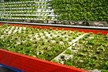
The architecture operates in a hermetic (closed-loop) environment, where water vapor resulting from leaf transpiration is condensed and collected as distilled water. This eliminates the risk of external pathogens, ensures pesticide-free production, and significantly reduces water usage. A system of artificial intelligence embedded in an IoT SCADA system supervises the entire process, optimizing fertigation and light use efficiency (LUE).
From an economic standpoint, adopting this technology guarantees significant results in the OPEX validation phase. On average, the expected cost reduction compared to a traditional vertical farm is 50%. This drastic reduction is made possible by recovering heat in the form of technical water at 90°C, which provides the plant with a second source of free energy. Converting waste heat into an energy asset creates business opportunities, such as supplying heat to third parties or powering drying processes, which would otherwise incur HVAC disposal costs. Consequently, it ensures significantly higher margins.
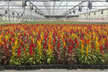
These mathematical and thermodynamic models are being validated in a Living Lab environment. Currently, they are in an experimental phase conducted in collaboration with ENEA and supervised by researcher Luca Nardi. This institutional collaboration aims to validate VFT technology in a relevant environment using representative samples of various botanical types, including microgreens, baby leaves, reflowering strawberries, echinacea, Nicotiana benthamiana, and Vinca.
Finally, with regard to business scale-up models, the zero-kilometer agri-energy module has great potential when incorporated into an existing logistics hub, such as one that serves the large-scale retail trade. Integrating VFT into these hubs allows for direct optimization of recovered energy use, maximizing their overall energy efficiency and guaranteeing an average ROI time of less than two years.
For more information:
MINIMA ENERGIA S.R.L. | Innovative Startup
Via Ferrarese, 3
40128 Bologna (BO) - Italy
[email protected]