When David Coveyou took over Coveyou Scenic Farm, which has been in his family for 150 years, he had ideas for ways to improve it. A trained electrical engineer, Coveyou wanted to create a farming business that demonstrates his family's strong commitment to people, health, and the community's food system.
He began by transitioning the farm's crops from unprofitable cereal grains to vegetables and small fruits that he sells directly to local residents, restaurants, retail stores, institutions, schools, and at his on-farm market.
Geothermally chilled produce coolers
In 2012, Coveyou had another idea. He wanted to install walk-in produce coolers to keep fruits and vegetables from his fields fresh in summer months prior to sale. When he shared his idea with other farmers, however, they warned Coveyou that running the coolers could cost as much as $1,000 a month.
 © US Department of Energy
As an alternative, Coveyou decided to install a geothermal heat pump (GHP) system to chill three walk-in coolers that store produce. The system works by transferring heat out of the coolers all summer and storing the heat in the soil under Coveyou's parking lot. This chills his coolers down to 35°F very cost-effectively. In the winter, the system switches to a low-level heating mode to keep the produce stored inside the coolers from freezing.
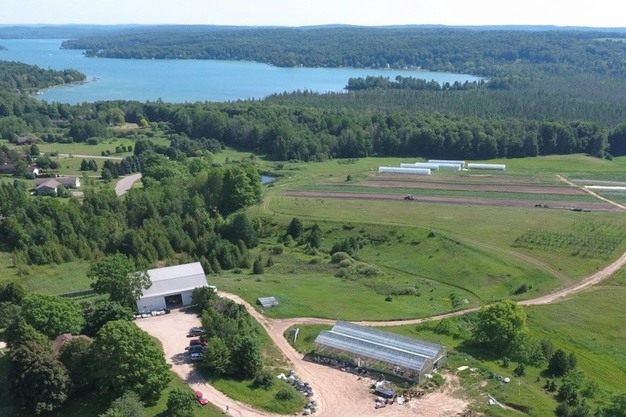
Coveyou found it would be less expensive to configure the geothermal pipes horizontally, rather than boring through the ground vertically. His installer dug five 200-foot-long trenches seven feet beneath Coveyou's customer parking lot and laid two lines of horizontal piping four feet apart. To maximize heat transfer, he then covered this system with two feet of dirt and laid a second set of horizontal piping five feet below the surface. He connected both sets of piping to create a single closed-loop system.
An energy saver
Since it was installed, the heat pump system has worked well and costs around $100 per month during even the hottest summer periods.
According to Coveyou, "The magic sauce of the energy savings is that the geothermal heat pump transfers four to five times the thermal energy compared to what it uses in electricity to run." This means that the cost of operating the farm's produce cooling system is a fraction of what a conventional system would cost to operate.
Heated greenhouse floor nurtures seedlings
During the late winter, Coveyou Scenic Farm uses a greenhouse to grow plants, which are then transplanted to the fields in the spring.
After seeing how well the geothermal heat pump system worked to chill the farm's coolers, Coveyou in 2015 installed another geothermal heat pump to heat the 5,000-square-foot propagation greenhouse concrete floor. This system has four in-floor heat zones that contain a series of plastic tubes through which heated fluid circulates to keep the floor at the desired temperature.
Heat removed from the walk-in coolers in summer is stored in the ground below the parking lot for use when the propagation greenhouse needs extra heat in the winter and spring.
Despite being made of glass and having no insulation, the greenhouse is warm enough for plants to flourish during cold Michigan winters.
"I'm a big fan of geothermal. We use geothermal heat pumps not only because they draw from an abundant renewable energy source, but because geothermal is a smart business decision: It significantly lowers our energy costs! For small farms like ours, geothermal goes a long way toward keeping our budget in the black," said David Coveyou, Owner, Coveyou Scenic Farm.
Source: US Department of Energy