In greenhouse crops, rain doesn't always translate directly into an increase in indoor humidity. Managing windows, ventilation, and climate control allows growers to mitigate some of that effect. However, when several days of rain, reduced solar radiation, and unstable external conditions occur in succession, the system faces a more demanding situation.
Climate control becomes more delicate, but so does drying capacity, management windows narrow, and the growing environment can lose uniformity precisely in an area that doesn't always receive enough attention: the base of the plant. It is there that many problems begin to silently develop.
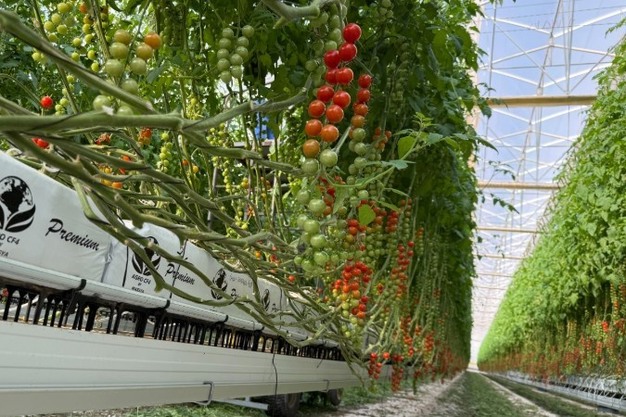 © JH Hydroponic Systems S.L.
When the bag or substrate remains in contact with the drainage, or when leachate removal is not clean and rapid enough, the root zone operates under less stable conditions.
Aeration decreases, moisture persists under the plant, and the crop becomes more susceptible to root stress and root and crown problems. In this context, the system design is not a minor detail.
Properly separating the drainage bag helps maintain a more aerated, cleaner, and more stable root zone. It also improves leaching management and reduces moisture buildup at the base of the crop, which is especially important during periods of lower sunlight, reduced drying capacity, or more closed climate management strategies.
Therefore, solutions like Spacer Premium, HS Evolution System, and HS Premium Elevated acquire clear technical value within the greenhouse. They not only support the crop but also help optimize the separation between substrate and drainage, promote better root oxygenation, and provide greater stability to the system when external conditions require fine-tuning its management.
At first glance, it might seem like a matter of support. In reality, it's a decision that influences crop uniformity, root health, and the farm's ability to better respond to increasingly variable conditions.
Because in protected horticulture, when the external climate complicates management, the difference often lies in the elements that allow the crop to remain stable from below.
For more information:
Hydroponic Systems
https://hydroponicsystems.eu/