The Cammarisano Lab of Controlled Environment Agriculture invites visitors to explore the future of indoor food production at this year's Picnic Day exhibit.
Then, take an example home with you: We have herb seedlings grown in a controlled environment on display, and they'll be given away to visitors! They're ready to enjoy fresh or can be transplanted and grown further at home, offering a hands‑on way to experience the potential of indoor agriculture long after Picnic Day ends.
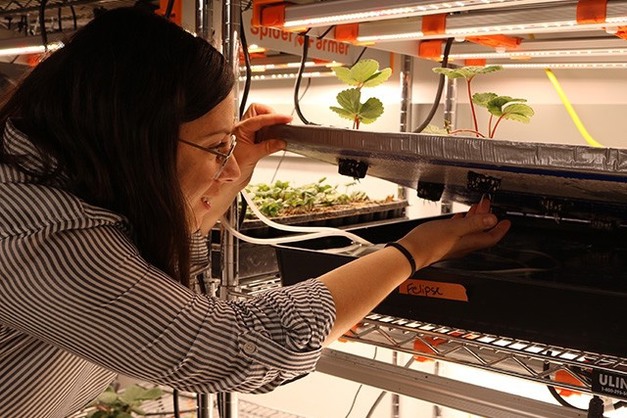 © Trina Kleist/UC DavisLaura Cammarisano checks on strawberry seedlings in her controlled environment agriculture lab on the UC Davis campus. She's an assistant professor in the Department of Plant Sciences
Our display features a vertical growing rack filled with herb seedlings, including different varieties of basil, cilantro, fennel and more. The exhibit will also include a few lettuce plants grown under different light spectra to demonstrate how light quality can shape both appearance and nutritional characteristics. Guests will see how precise management of light, water and nutrients supports strong early growth
These plants are examples of controlled environment agriculture, or CEA. They have been raised under energy‑efficient LED lighting and grown hydroponically (without soil) in plugs of peat moss. Our exhibit shows how controlled environments can produce clean, healthy crops without the need for soil.
Members of the Cammarisano Lab will be on hand to explain how controlled environment agriculture can increase sustainability, reduce resource use and enable year‑round production.
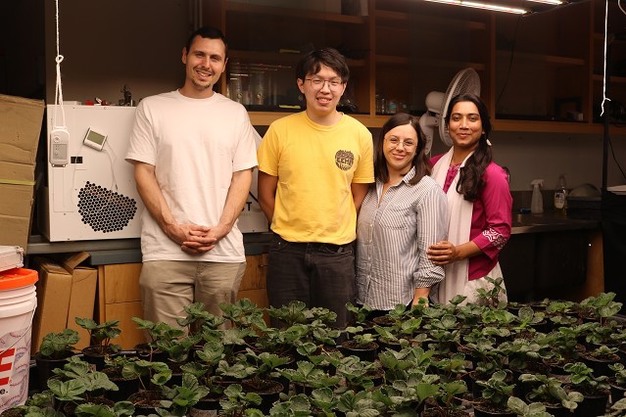 © Trina Kleist/UC DavisLaura Cammarisano, third from left, is an assistant professor in the Department of Plant Sciences and leads the research on controlled environment agriculture, or CEA
These herbs and lettuce starts are part of a nation-wide trend, and plants grown in controlled conditions are becoming more common in our grocery stores. Crops have expanded to include tomatoes, cucumbers, microgreens and berries.
Worldwide, this industry grew to more than $87 billion in 2024 and is expected to triple in the next few years, according to a market report. The United States is a world leader in the field.