With support from Hort Innovation Frontiers, a new automated platform developed at Flavorite and now commercially available through Innovatech Automation PTY LTD, is helping growers tackle labor challenges.
Hand-pollinating tomatoes in a commercial greenhouse presents some significant challenges, not least of all labour.
A new automated pollination and spray platform is offering a fresh solution. The platform is known as the RLAP (Robotic Labour Assist Platform) and was developed by technology firm FTEK in field trial partnership with Flavorite and Innovatech Automation PTY LTD.
The breakthrough development has been supported by the Australian government-funded Hort Frontiers program Growing Horticulture through Protected Cropping Innovation (AS23001). The program has provided additional funding to advance this technology, generate key data, and accelerate its path to market, ultimately supporting benefits for the broader horticulture industry.
The pollination challenge
Pollination in greenhouse tomato crops depends on moving pollen within the flower at the right stage of bloom - a process traditionally done by hand using mechanical tools. Timing is critical, with an optimal window of only 1.5 to 3 hours each day.
 © Applied Horticultural Research
In large glasshouses, this means pulling 16–18 workers from other tasks for several hours, creating major disruption.
"It's a big interruption," said Matt Patten, Crop Care Manager at Flavorite.
"Everyone has to stop what they're doing and rush to pollination - the lost time and inconsistency make it difficult to sustain."
The challenge is even greater on weekends and public holidays, when staff availability is limited but pollination can't wait. Growers are left juggling rosters or compromising on timing, both of which can affect fruit set.
A new approach
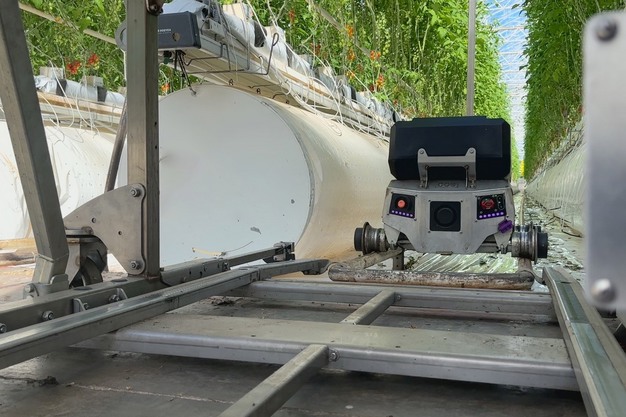
To simplify and automate pollination, Flavorite partnered with New Zealand ag-tech company FTEK to develop the Robotic Labour Assist Platform (RLAP), designed to operate along standard greenhouse pipe rails.
Each unit has six adjustable air blowers that gently disturb flowers to trigger pollination. The blowers can be fixed at specific heights and angles, ensuring a consistent result and removing the variation that occurs when many staff perform the task by hand.
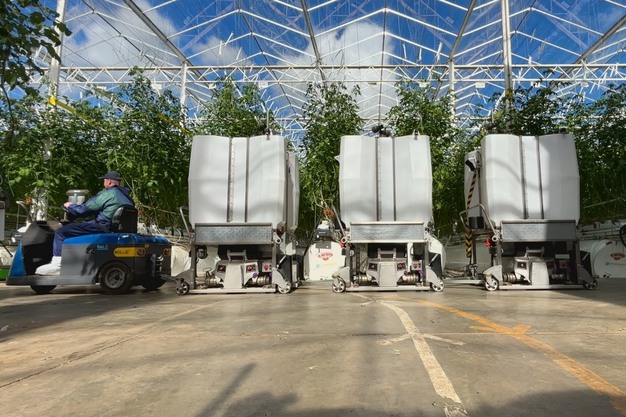
With just two operators, up to eight units can be managed at once, allowing a five-hectare greenhouse to be pollinated within the optimal time window using far less labor. The system's 'double-pass' airflow also ensures even coverage across all plants.
From prototype to large-scale trial
As development partner, Flavorite first trialed a single prototype of the RLAP with promising results. Within three months, the benefits were clear, and four more units were ordered for a larger five-hectare glasshouse trial.
 © Applied Horticultural Research
Half the crop was pollinated manually, and the other half using the automated platforms. The results showed major improvements in labor efficiency, allowing smaller teams to complete pollination on time; greater flexibility, with the ability to pollinate on weekends and holidays; and better fruit quality, with more consistent fruit set and fewer second-grade tomatoes. The system also maintained strong performance even under challenging growing conditions.
"The results were very convincing," said Matt Patten. "The labor savings alone were significant, but what really stood out was the consistency."
More consistent pollination also reduces waste; even a 1–2% decrease across a large-scale operation has meaningful financial and sustainability benefits.
The RLAP platform is versatile, available as pollination-only, spray-only, or combined systems, allowing growers to match it to their production needs. The RLAP-SPRAY version provides autonomous greenhouse spraying with precise droplet control, improved crop coverage, and more efficient use of pest, disease, and hygiene treatments, all with reduced chemical input and simplified operation.
Flavorite is now rolling out the RLAP platforms across its tomato production year-round.
"This project is more than just one company trialling a new machine," said Anita Chennell, Program Manager for Growing Horticulture through Protected Cropping Innovation. "It's about testing how automation can help the whole industry adapt to changing labor conditions — and the results so far are very promising."
For more information:
Applied Horticultural Research
Suite 340, Biomedical Building
1 Central Avenue, Australian Technology Park
www.ahr.com.au