Even with a full harvest, growers still have more plant rests in their greenhouses than peppers or strawberries. And what about leek cultivation, where 40% of the leeks that have taken so much time and energy are now 'waste'?
In January, three Dutch growers offered their 'waste' in a webinar organised by the local Horticultural Residual Flows Platform. In recent years, growers have increasingly been looking for ways to add value to the 'waste' they prefer not to call 'waste'. And slowly but surely, all sorts of possibilities are opening up, although not without a struggle.
Platform
The Horticultural Waste Streams Platform has existed since November 2020. Yesterday's webinar was the third. The platform is an initiative by the several growers' associations Fossa Eugenia, ZON, SunFresh and the interest group Limburgse Land- en Tuinbouwbond (LLTB). It is originated from the south of the Netherlands, but in order to avoid reinventing wheels, the Netherlands Foundation for Innovation in Glasshouse Horticulture (SIGN) also links up with growers in other regions who face the same challenges with respect to their residual flows.
The webinar was primarily intended to give four growers the opportunity to pitch their potentially very valuable product. Not the peppers, leeks or strawberries, but the residual flows involved in their cultivation.
Leek leaf
Leek grower Paul Janssen of Tuinderij Beegdenhof was looking for a use for his leek leaf. It is currently waste that is used to fertilize his own fields. However, there is a limit to this and it has been reached, especially now that the grower grows leeks all year round. The latter is an important plus point for the possible valorization of the residual flow because many parties consider year-round supply and availability of a raw material important to them. All kinds of ideas arose during the webinar and other growers with other products with the same 'problem' also reported in, including a radish grower. That product also has leftover foliage.
Bio-degradable horticultural yarn in peppers
Other green waste streams that were discussed were those of pepper grower Marc Litjens and strawberry grower Marcel Dings. Grower Marc discussed pepper twine, supported by supplier Mat Versleijen of Mertens. This is currently often still synthetic and that makes clearing the greenhouse and thereby separating green waste from non-green waste difficult. "Sifting all the twine out of the waste is not possible," says Mertens.
For years, therefore, there have been developments in the field of biodegradable horticultural yarn, but among other things, cultivation obstacles and higher costs often still hold growers back. Marc spoke about his experiences with biodegradable rope made from cellulose in 2020. In a small trial with 2 bulbs of twine, he put it to the test: Is the rope strong enough? It wasn't easy. The ropes did not collapse under the weight of the plant, but they did lengthen. This is bad for plant growth and makes the paths narrower during cultivation, which also makes it more difficult to drive through with tubular rail carts. Marc could also see one clear advantage: the twine composts more easily, even at 35 degrees Celsius and a little moisture.
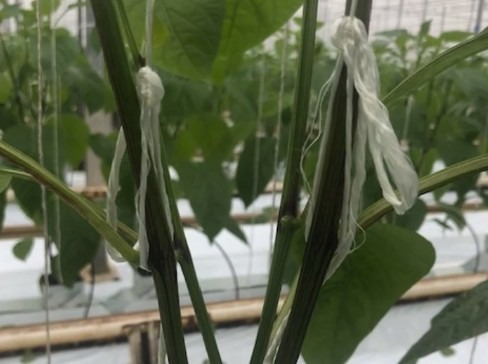
Cellulose twine in the pepper crop at Nursery Litjens. This year, the renewed rope is on trial again.
For this year's cultivation at Kwekerij Litjens, he has again started a test with an improved rope. The new Limburg governor Emile Roemer was one of the first to see it. Meanwhile, the grower, who is testing at all three locations, already has his first experiences to share.
In Meterik, the trial covers 1,200 square metres, and in the other two locations it covers 350 square metres. The grower has deliberately chosen to test the strength of the rope in the warm, damp corners of the greenhouse. It is too early to give a real answer, but Marc and his employees have already noticed that the rope uncoils from the outside, which is exactly the opposite of synthetic rope. It is more difficult to automate. The rope is also softer and frays faster when a second knot is tied.
Mat is familiar with these issues. He has years of experience with biodegradable horticultural twine, especially in Germany. In tomato, he noted, there are already about 80-100 hectares of it. A serious acreage, evidence that it is possible. Since mid-2021, the new, less long-lasting cellulose twine has been on the market. An important advantage, apart from in cultivation, is that the rope is composted after four to six weeks when it is spread over the land, without the need for industrial composting.
The first large-scale trials with the rope in cultivation are now taking place in peppers. There are also all kinds of clips and brackets available for use in cultivation, which are now also biodegradable. In this case, however, they are only made of the less easily compostable PLA. "If you were to make it from other materials, you would be making too many concessions in terms of quality", Mat said, pointing out that metal clips might 'oxidise away' during the processing of cultivation waste.
Strawberry leaf
Strawberry grower Marcel from Brookberries wanted to talk about strawberry leaf. He and the growers with whom he is involved in a project to research new profit models for new crops noted the strawberry leaf and the substances it contains. The cosmeceuticals industry, among others, is interested in these substances. The tricky word is a combination of pharmaceutical and cosmetic, without all the strict rules that apply to raw materials for medicines. This brings strawberry leaves into the picture as a raw material when making products, to use substances from them to replace synthetic or animal-based substances.
Marcel's problem is that once the strawberry leaf leaves the company, it becomes waste under the Waste Substances Act. Using the leaf on one's own farm is allowed, but otherwise there is a lot of paperwork and lots of rules. One option would be to process the leaf into semi-finished products, although Marcel does not see that happening yet. He hopes that, by sharing his story, people will come forward with creative insights to solve this 'problem'. "And I don't really mean burning waste streams, although that is tempting at the moment due to the high energy costs. Marcel also looks outside the sector. "There are undoubtedly people there who know how to take the right routes."
Processing film
The growers offered three 'green' waste streams, but also a grey waste stream. In this case by pepper grower Peter Verberne of Kwekerij Verberne. He is looking for a way to recycle the walking film from the greenhouse into granules. This is already possible and does happen, but the fact that the bottom film gets dirty is still an obstacle in practice when processing it. Cleaning the foil oneself is an obstacle for the grower, because a lot of work can go into it and well-cleaned foil yields less tonnage. This is disadvantageous in terms of cost when disposing of the crop. The more volume, the lower the costs.
Peter hopes that steps can be taken to mechanise waste film processing. He points out that everyone must be careful not to simply shift costs from disposal to transport. If it turns out that the waste cannot be processed close to home, the question is whether that is really better from a cost point of view. Like Marcel, he also mentioned the energy issue in passing. He acknowledged that, with high gas prices, ideas about incinerating foil sometimes bubble up.
However, that is not what the Horticultural Sector Resource Platform is aiming for. All the parties working together are looking for other ways of adding value. There is certainly enough product on offer, as was once again evident yesterday afternoon. There are also plenty of ideas. All we need to do is connect the right people. Who knows what new insights and practical results the next meeting will produce.
For more information:
Platform Tuinbouwreststromen
[email protected]
www.platformtuinbouwreststromen.nl