What keeps growers up at night? Disease pressure, the declining availability of crop protection products to manage that pressure, and the constant demand to produce more with fewer inputs. Harm Vogels of Moleaer is candid: nanobubbles are not a single solution to every challenge.
"But for growers dealing with root health issues, contaminated irrigation systems, and rising chemical costs, nanobubbles can provide real value. The horticulture industry is beginning to recognize the power of our nanobubbles."
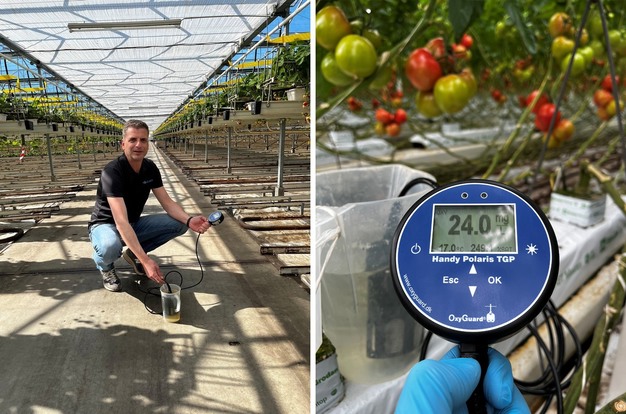 © Moleaer Harm Vogels demonstrating dissolved oxygen measurements at the plant root zone.
Root health
Harm believes root health is one of the biggest drivers of overall plant health. "That may sound obvious, but when a crop looks healthy above ground, it's easy to overlook what's happening in the substrate. Ultimately, however, problems in the roots become problems in the crop."
He explains that root cells also respire and therefore require oxygen to produce energy. "Without oxygen, nutrient uptake slows down, growth stagnates, and the plant becomes much more susceptible to pathogens. At the same time, pathogenic fungi such as pythium, fusarium, and phytophthora thrive in the oxygen-poor conditions often created by traditional irrigation systems."
Alternative to chemical water treatment
Moleaer's nanobubbles offer an alternative to chemical water treatment. "The mechanism of action is completely different, but the impact on biofilm, silo contamination, and fouling in rainwater basins can be highly effective — in a sustainable, non-chemical way."
In practice, growers working with Moleaer report higher and more stable dissolved oxygen levels compared to conventional systems. "Higher dissolved oxygen levels in irrigation water are associated with healthier roots and reduced pathogen pressure."
"Our nanobubble technology fits very well within an ICM (Integrated Crop Management) strategy," Harm continues. "As crop protection tools continue to disappear from the market, the focus needs to shift toward plant resilience. Nanobubbles contribute to healthy, vigorous roots and ultimately a more resilient crop."
Negative charge
There is also a secondary effect. "Because nanobubbles carry a strong negative charge, they attract positively charged organic particles, biofilm, and pathogens. These contaminants are then physically removed from the water, as well as from drip lines and storage tanks. Or, more simply put: the technology also helps clean irrigation infrastructure while maintaining system cleanliness over time."
Nanobubble systems are typically integrated directly into existing irrigation infrastructure. "Once the system is operating, dissolved oxygen levels can rise quickly."
Delivering oxygen to the root zone
Harm himself has many years of experience in horticulture, particularly in water management. He joined Moleaer because he sees nanobubble technology as a sustainable and future-oriented approach to water treatment. He also believes Moleaer is currently the only provider in the Dutch market producing true nanobubbles.
"Alternative aeration systems, such as venturi-based technologies, typically generate larger bubbles. Moleaer nanobubbles are capable of transporting high oxygen concentrations all the way to the root zone. That distinction is important when the goal is to deliver oxygen to the root zone consistently and over an extended period of time."
Open field production
In addition to greenhouse applications, the company is also active in open-field agriculture. "As growers look to reduce chemical inputs without sacrificing yield, irrigation water quality is becoming increasingly important. Oxygen enrichment, including nanobubbles, are being evaluated more frequently as part of that shift — not as a silver bullet, but as a way to support root health, keep systems cleaner, and improve consistency across the crop."
 For more information:
Moleaer
[email protected]
www.moleaer.com