A recent technical collaboration visit to China highlighted both the rapid development of substrate-based greenhouse systems and the growing need to better connect research with commercial production realities. The visit, conducted with PlantLogic Ltd., brought Brandan, a PhD researcher at Virginia Tech, into direct engagement with growers, technical teams, and commercial operations working with substrate-based production systems at scale.
The visits were part of PlantLogic's broader effort to stay closely connected with growers, understand evolving production challenges, and improve substrate-based systems for commercial use. Visiting customers across multiple crops and production environments provided direct insight into real-world implementation and the importance of industry–grower feedback loops.
For Brandan, the value of the trip came from seeing how production decisions translate in real greenhouse environments rather than controlled research settings.
 © VT/ Plantlogic
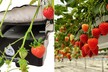
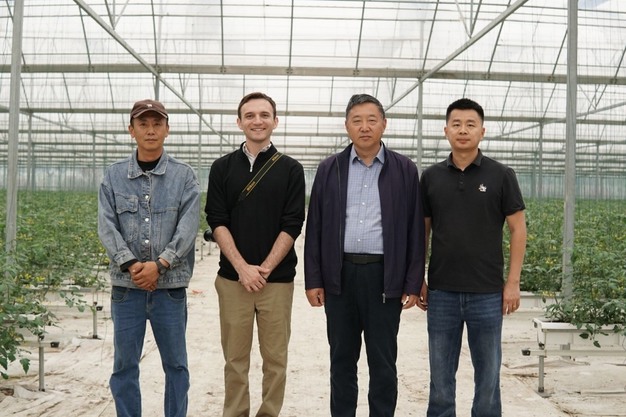
"The most valuable part of the trip was getting time to have in-depth conversations in commercial greenhouses with growers and technical teams," he says. "Across crops including strawberries, blueberries, vegetables, and caneberries, many of the same themes kept coming up: irrigation uniformity, drainage, substrate selection, labor efficiency, sanitation, rootzone health, and how system design influences day-to-day management."
 © VT/ Plantlogic
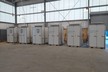
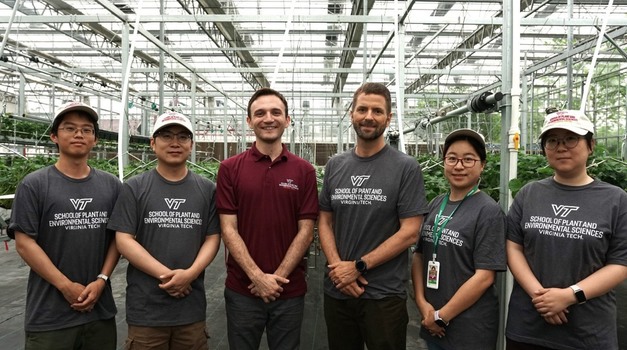
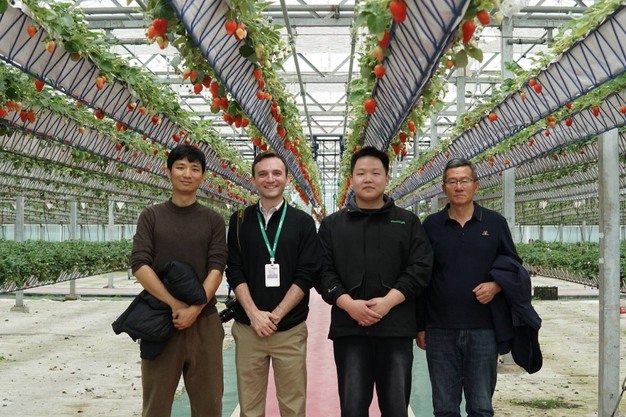
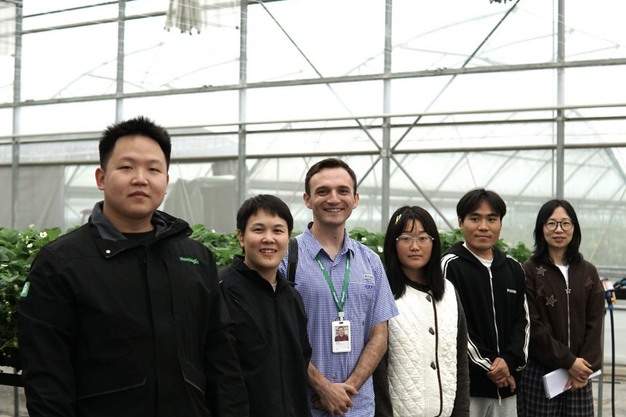
Brandan Shur (third from left), Israel Holby (Plantlogic Director, third from right), and the rest of the Plantlogic team wearing Virginia Tech merchandise in the Plantlogic research greenhouse
System integration at commercial scale
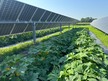
One of the clearest observations was the level of integration in substrate-based production systems.
"In many parts of the U.S., these systems are still developing or viewed as special projects," Brandan says. "In the operations I visited, substrate systems appeared much more normalized as part of commercial production."
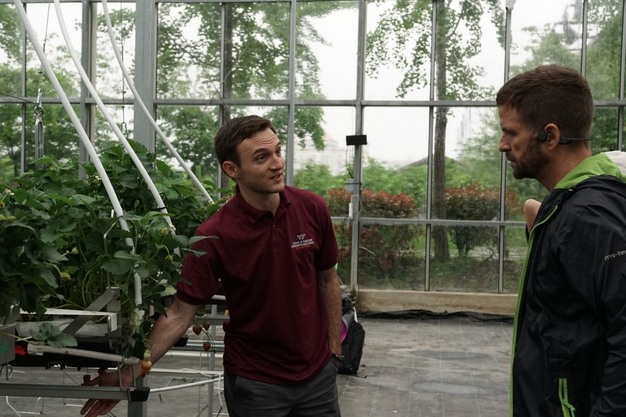
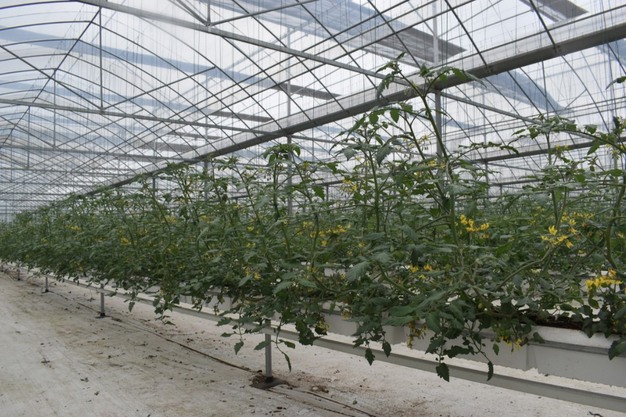
Beyond adoption, the emphasis was on system design. "These were not just production structures; they were complete management systems. The crop, container, substrate, irrigation strategy, drainage pathway, and labor workflow all have to function together."
 © VT/ Plantlogic
This system-level approach reflects a broader shift in substrate production, where infrastructure is not passive but actively shapes irrigation performance, root development, sanitation, labor access, and monitoring capability.
"Good horticultural science has to work in real production settings. It has to connect the crop, substrate, irrigation strategy, structure, people, and economic realities of the farm."
 © VT/ Plantlogic
Designing for consistency and labor efficiency
Across the visited operations, successful irrigation and drainage approaches were often defined by simplicity and repeatability rather than complexity.
"The most successful approaches were not necessarily complicated. They were designed so good management is easier to achieve every day."
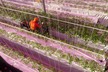
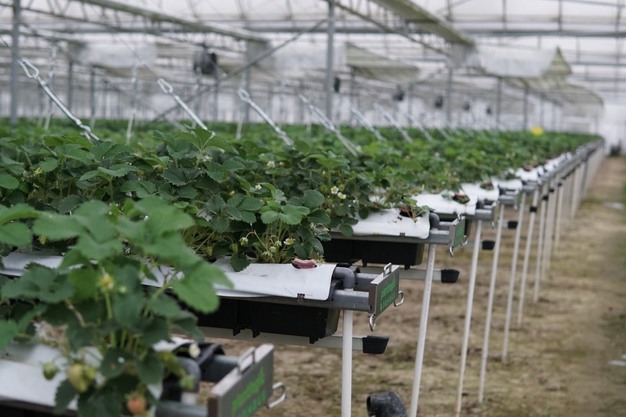
Examples included elevated growing systems to improve crop access, clearly defined drainage pathways, and layouts that support consistent observation of crop and rootzone conditions.
 © VT / Plantlogic
"In substrate systems, irrigation uniformity and drainage are closely linked. A grower can have a good substrate and still struggle if water distribution is uneven or drainage is restricted."
System design also had a direct impact on labor efficiency and decision-making. Improved access and visibility reduced physical strain and enabled faster detection of crop issues.
"Good system design reduces friction. It makes the crop easier to see, harvest, scout, irrigate, and manage consistently."
 © VT/ Plantlogic
Rootzone management as a central driver
Substrate selection remains one of the most important decisions in soilless production because it defines the rootzone environment.
"The substrate determines how water, air, and nutrients are held around the roots," Brandan says. "A good substrate is not just one that holds water or drains well. It has to match the crop, container, irrigation strategy, climate, and production cycle."
This is especially important in long-term fruiting crops such as strawberries, blueberries, caneberries, and greenhouse vegetables, where small imbalances can accumulate over time.
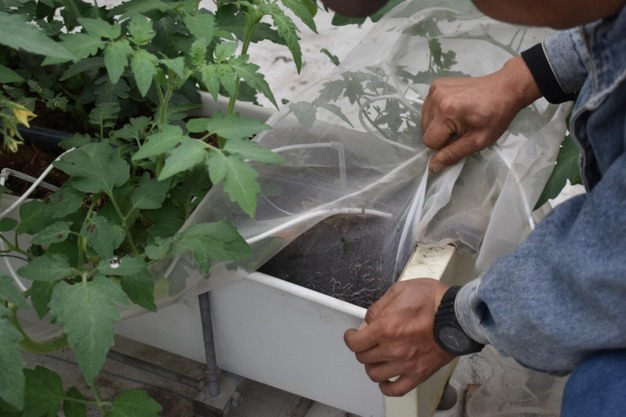
Extended substrate use also introduces additional considerations, including physical and chemical changes in the medium and potential increases in disease risk if sanitation and drainage are not carefully managed.
 © VT/ Plantlogic
"If the substrate stays too wet, drains unevenly, or lacks sufficient air-filled pore space, crops become more vulnerable to stress and disease," he says.
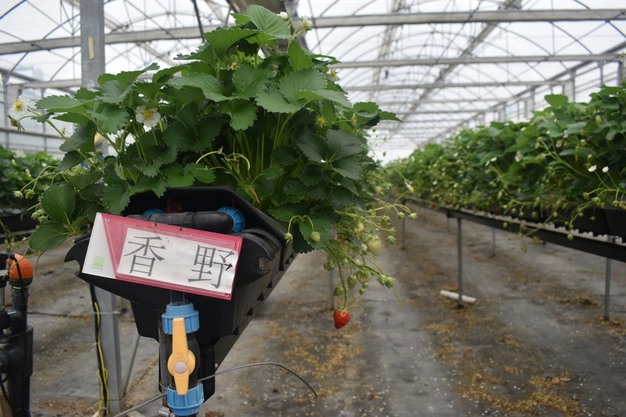
An increasing focus in substrate systems is the use of drainage and leachate data to understand rootzone dynamics over time. Metrics such as drainage volume, drainage percentage, leachate EC, and pH can provide useful insight into water and nutrient movement.
However, Brandan emphasizes that value comes from interpretation, not data alone.
"Leachate data should be evaluated alongside the irrigation recipe, substrate moisture, crop stage, environmental conditions, and crop response," he says. "The goal is not just to collect data. The goal is to turn that data into better decisions."
This is also an area of ongoing collaboration with PlantLogic, which is developing leachate monitoring tools aimed at improving how growers track and interpret rootzone conditions in commercial systems.
"The opportunity is to make rootzone monitoring more practical and more actionable. If data is too complex or disconnected from daily management, it loses its value."
 © VT/ Plantlogic
Bridging research and commercial practice
The visit also showed a persistent gap between academic research and commercial greenhouse operations.
"Research often isolates one variable at a time, while growers manage many interacting variables simultaneously," Brandan says. In practice, substrate production requires balancing irrigation, drainage, crop stage, labor, sanitation, and economics all at once. This makes collaboration between researchers, industry partners, and growers essential for meaningful progress.
 © VT/ Plantlogic
"Growers need practical interpretation: what matters, why it matters, what to watch for, and how to adjust decisions. The strongest educational resources come from that intersection."
For Brandan, the China visit showed the importance of industry partnerships like PlantLogic in translating system design and research into commercial reality.
"Seeing these systems at scale made one thing clear," he says. "The future of substrate production is not just about better crops, better substrates, or better containers by themselves. It is about how all of those pieces work together."
For more information:
Plantlogic
Israel Holby, Director
[email protected]
https://getplantlogic.com/
School of Plant and Environmental Sciences
Virginia Tech
Brandan A. Shur
[email protected]
Blacksburg, VA 24061
spes.vt.edu