Kwekerij Aarts, a cucumber and tomato grower based in Asten-Heusden in the Dutch province of Noord-Brabant, has installed a 2 MW air-to-water heat pump to heat a newly built 3.6-hectare greenhouse expansion, believed to be the largest heat pump installation of its kind in the greenhouse industry to date.
When planning the new greenhouse, owner Rens Aarts explored several heating options. Grid congestion ruled out combined heat and power (CHP) as the primary solution. A permit for shallow geothermal energy was applied for and granted, but ultimately the decision came down in favour of a heat pump. The 2 MW unit, supplied by CCR and using CO₂ as its refrigerant, has been operational since early in the current year.
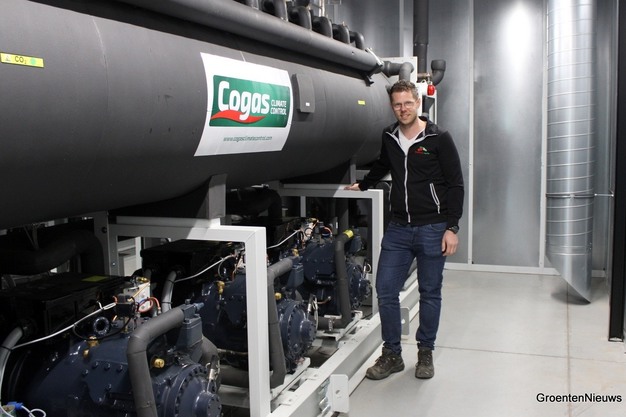 © Thijmen Tiersma | HortiDaily.comRens Aarts next to the 2 MW heat pump at Kwekerij Aarts. Kwekerij Aarts is affiliated with the producer organization Kompany.
Willingness to pioneer
"We are willing to pioneer," says Rens Aarts. "We knew we were taking a path where no one had gone before." The family business has a track record of early adoption. Aarts notes that the Aweta cucumber packing robot was developed at the nursery, and that his father was involved in the further development of cultivation gutters. Rens took over the business from his parents in 2022.
The existing operation covers 9.6 hectares, where cucumbers and autumn tomatoes are grown. Land for the expansion was purchased in 2023. Working with an advisor, Aarts calculated that the new greenhouse would require 2 MW of installed heating capacity, well beyond the 500 kW units his father initially found available on the market.
Choice of refrigerant
The choice of CO₂ as the refrigerant was deliberate. "We preferred a natural refrigerant and chose CO₂. Our first thought was that if a leak were to occur and refrigerant entered the greenhouse, CO₂ would not be harmful to the plants," Aarts explains.
Cogas Climate Control was identified as a dealer for the CCR heat pump within the greenhouse sector. A MEI subsidy, a Dutch scheme specifically supporting the market introduction of energy innovations in greenhouses, was successfully applied for with the assistance of Epiic, a subsidiary of aaff specialising in subsidy applications.
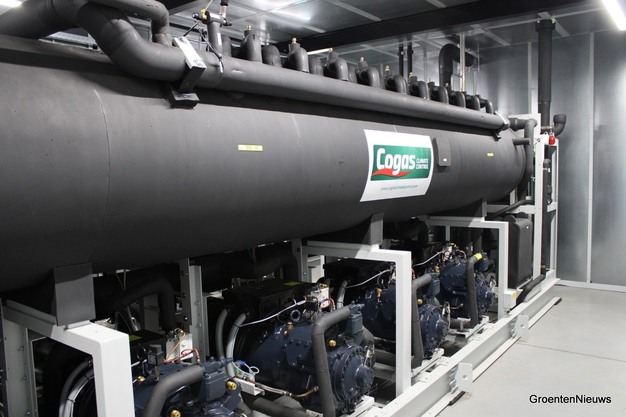 © Thijmen Tiersma | HortiDaily.com The heat pump is equipped with a total of 8 compressors, 2 of which are frequency-controlled for optimal ramping up and down.
Greenhouse design and heating infrastructure
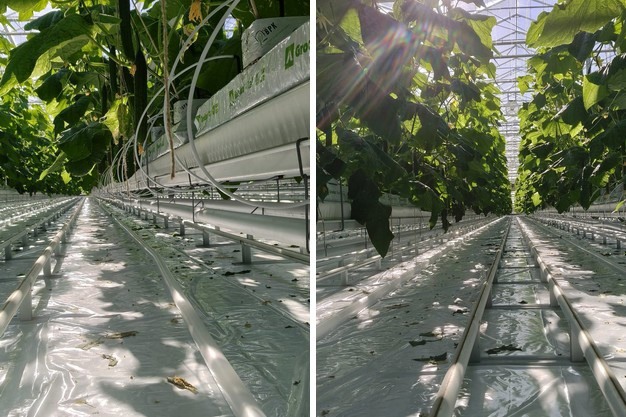
Integrating a heat pump into greenhouse operations requires specific adaptations. Kassenbouw Maurice constructed a well-insulated greenhouse fitted with two energy screens. Cogas Climate Control installed an extensive low-temperature heating system comprising a high volume of heating surface, a sub-floor heating network, a low-temperature network beneath the cultivation gutter, and an additional growth pipe.
"We can control three heating networks independently, or extend a network when we need a lower return temperature," Aarts explains. Maintaining a consistent return temperature is critical. "For the heat pump to operate efficiently, you need a constant return temperature of 30°C."
Prior to installation, the system was modelled at an inlet temperature of 30°C, an outlet temperature of 60°C, and an outdoor temperature of -5°C. "We need heat when it is cold outside," Aarts notes.
An additional advantage of the CCR CO₂ heat pump is its ability to reach an outlet temperature of 80°C from a 30°C inlet. "We can operate at three setpoints. With a 30°C inlet, we can choose 40°C, 60°C, or 80°C as the outlet temperature."
 © Kwekerij Aarts
Additional investments
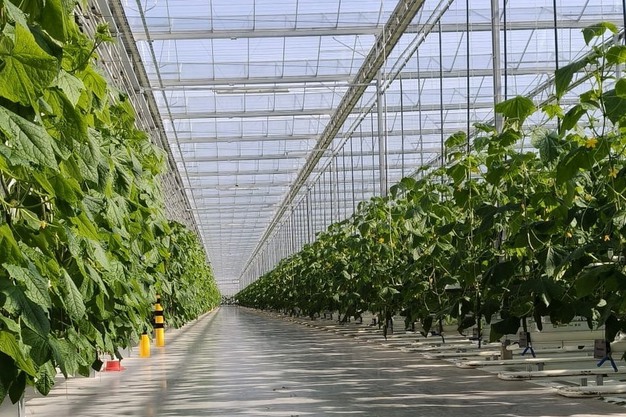
Both the new and existing greenhouses received upgrades as part of the project. A second energy screen was installed throughout for improved energy efficiency. Dehumidification in both sections is handled by Cogas Climate Control's CoVent air treatment system — Kwekerij Aarts opted for the duct-free version.
Solar panels have been installed on the barn roof. To complement the heat pump, an additional 1 MW CHP unit was also invested in. "This CHP unit responds quickly to changes in demand. It can provide backup electricity, run for CO₂ supply, or operate when electricity prices are favourable. When heat is not required, it is stored in our buffer tank," says Aarts.
Smart energy management software ties the system together. Horticoop Technical Services installed the IIVO climate computer from Hoogendoorn Growth Management to optimise control of the heat pump and all other energy assets.
 © Kwekerij Aarts
Pascal Janzen of Cogas Climate Control describes the project as particularly demanding. "We are dealing here with fluctuations in supply and return temperatures, as well as fluctuations in electricity availability. That is challenging, because you cannot simply switch a heat pump on and off. Consistency is essential." All technical systems and software have been configured to deliver that consistency at Kwekerij Aarts.
Cogas Climate Control reports increasing interest in heat pumps from the greenhouse sector. In addition to the installation at Kwekerij Aarts, the company has completed a heat pump project at Kwekerij Loos, a strawberry grower, and a further project with another vegetable grower is in the pipeline.
As a dealer for both CCR and Koning Koudetechniek, Cogas supplies CO₂ heat pumps from both manufacturers. "We select suppliers who can also provide reliable long-term service," says Janzen. "Each refrigerant has its own characteristics. In most cases, CO₂ is the best solution."
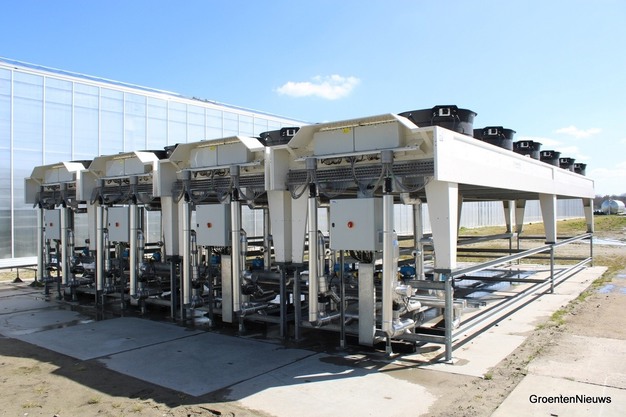 © Thijmen Tiersma | HortiDaily.com Outside between the greenhouses are the condensers
Optimizing with software
Since planting began in the new greenhouse section, the Aarts team and their partners have been fine-tuning the system and its software. With additional land already available, Kwekerij Aarts has the option to build a further 3 hectares of greenhouse in the future, at which point the experience gained with the heat pump will be directly applicable.
Since posting about the project on social media, Aarts has received numerous enquiries from fellow growers interested in the technology. His main piece of advice for growers considering a similar investment concerns the seasonal COP, the average efficiency of a heat pump calculated across a complete heating season. The COP (Coefficient of Performance) expresses how much heat (kWh) is produced per kWh of electricity consumed. The higher the COP, the more efficiently the system operates.
"Make sure you have this properly calculated under winter conditions," Aarts advises colleagues. "That is when it really matters."
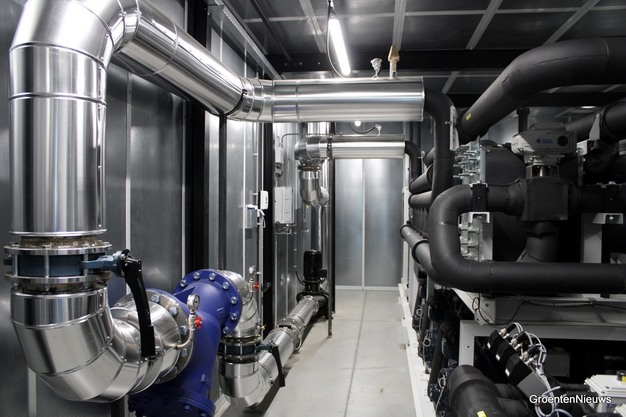 © Thijmen Tiersma | HortiDaily.com
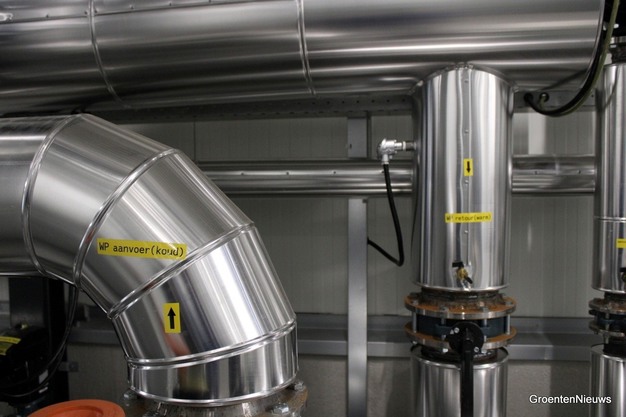
Connection of the heat pump to the greenhouse
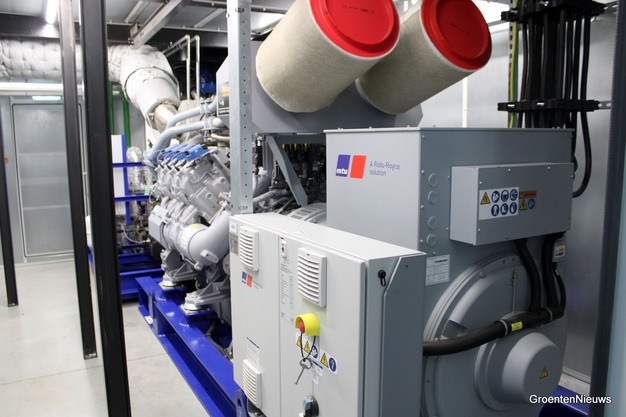 © Thijmen Tiersma | HortiDaily.com
A third CHP unit has been installed at Kwekerij Aarts, with a capacity of 1 MW. The CHP can be used to generate electricity for the heat pump, and also to produce CO₂ for the plants in the greenhouse. "During low electricity prices, we can have the heat pump buffer heat in the hot water storage tank, and then use it again later throughout the entire company," Rens explains.
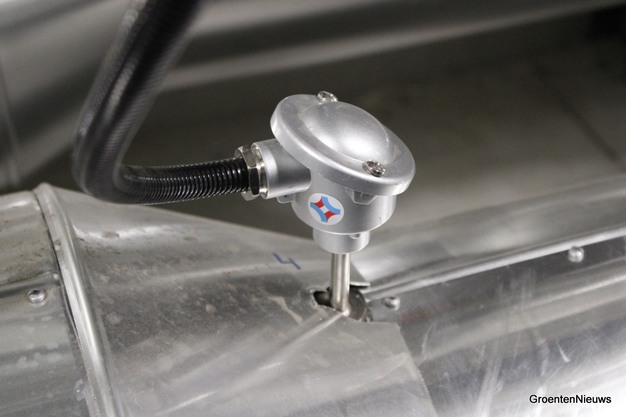 © Thijmen Tiersma | HortiDaily.com
Sensors have been placed throughout the process to monitor the temperature in the system and to control the process optimally.
 © Thijmen Tiersma | HortiDaily.com
The application of a heat pump in an existing greenhouse environment made the project extra challenging.
For more information:
Kwekerij Aarts
[email protected]
www.kwekerijaarts.nl
Cogas Climate Control
[email protected]
www.cogasclimatecontrol.com