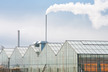
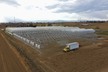
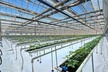
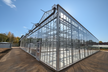
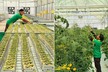
The Turkestan region remains a main hub for greenhouse vegetable production in Kazakhstan, accounting for 72% of the country's total protected cultivation area. Recent regional developments focus on transitioning from coal heating to more sustainable energy sources and improving air filtration systems to mitigate environmental impact.
Currently, the region operates 3,366 greenhouse units covering 1,006.7 hectares. In the Saryagash district specifically, there are 2,183 greenhouses. Of these, 1,223 units (551.8 hectares) utilize coal for heating, while only three units (7.5 hectares) operate on natural gas. An additional 957 units (247.9 hectares) function as unheated high tunnels.
To address emissions from coal-fired boilers, regional authorities and industry experts are advocating for the installation of smoke purification filters and a gradual transition to gas. The estimated cost for installing these filtration systems is approximately 4–5 million KZT (€7,850–€9,810) per hectare.
The state provides financial mechanisms to support these technical upgrades. Production greenhouses receive subsidies of 8.1 million KZT (€15,890) per hectare, while smaller farm-scale greenhouses are eligible for 4.8 million KZT (€9,415) per hectare. Since 2023, a mechanism has been in place to partially compensate for costs related to electricity, gas, and coal. Furthermore, low-interest loans for modernization are available through the "Auyl Amanaty" program. To date, over 100 applications have been submitted for the installation of air filtration systems.
Source: informburo.kz