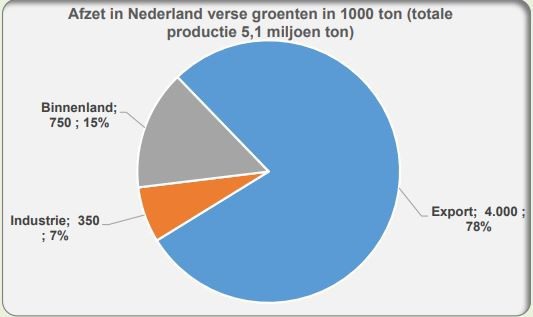
These days, fruit and vegetable supplies are vital. It provides people with healthy products. Dutch and Belgian growers produce mainly vegetables. In Belgium, farmers grow around 1.7 million tons of vegetables annually. In the Netherlands, that's about 5 million tons. Of this, 1.5 million tons are onions.
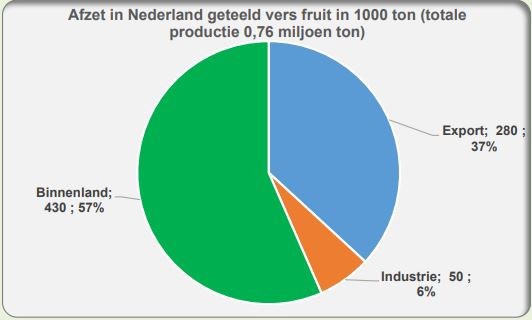
In Belgium, 150kg of vegetables is cultivated per capita. In the Netherlands, it's 300kg; excluding onions, more than 200kg. Apples and pears are the main fruits grown in these two countries. Belgium produces a total of 620,000 tons of fruit per year; the Netherlands 760,000 tons. Per inhabitant, that's 55 and 45kg, respectively.
More locally-grown vegetables; Belgium sends 1,5 million tons to the (frozen) industry
International trade is vital for Belgium; even more so for the Netherlands. Exports are the Dutch vegetable sector's primary driver. An estimated three-quarters of all vegetables grown in the Netherlands cross the border as fresh products.
In Belgium, that's thought to be 50%. For Belgian vegetables, the (frozen) industry is crucial. Every year, 1.2 million tons of vegetables go to that industry branch. A significant amount of these is, especially Dutch, imported vegetables.
Last year, Belgium exported no less than 1.55 million tons of frozen vegetables. By comparison, the Netherlands only exported just over 300,000 tons of these products. In the Netherlands, re-export plays a more critical role for vegetables. In the past year, this country sent roughly 1.2 million tons of fresh vegetables further into Europe. In contrast, in Belgium, this concerns only just under 100,000 tons.
Fruit mostly imported
In both Belgium and the Netherlands, imported products dominate the fresh fruit market. Belgium imported 2.2 million tons of fruit last year. Of this, 1.2 million tons were bananas. The Netherlands imported 5.2 million tons. Bananas made up 1.3 million tons of this.
Last year, Belgium exported 1.8 million tons of fresh fruit. Of this, 70% were re-exports. The Netherlands' fresh fruit exports amounted to 4.2 million tons last year. But not even ten percent were Dutch-grown products.
Overseas imports: The Netherlands, 60%, Belgium 45%
There are questions about where these fruit and vegetables come from. And how far away are they going to be sold. These questions seem to be becoming increasingly important. A lot of the fresh fruit and vegetables are imported from overseas.
That's true for both Belgium and the Netherlands. For Belgium, it's 45%, and for the Netherlands, 60%. Of that, Belgium imports quite a lot - 45% - from its neighboring countries. For the Netherlands, that's only 15%.
Regarding exports, Belgium sends 70% of its fresh fruit and vegetables to neighboring countries. Half of this to the Netherlands. The Netherlands exports quite a lot to Scandinavia and overseas. The latter applies to onions in particular.
Click here for the complete (Dutch) report.
For more information:
Jan Kees Boon
Fruit and Vegetable Facts
Website: www.fruitandvegetablefacts.com
Email: [email protected]