A review of the latest research on bacterial speck in tomato, led by Dr. Miryam Valenzuela of the Centro de Estudios Avanzados en Fruticultura (CEAF) in collaboration with researcher Ariel Herrera-Vasquez of UNAB, has found that the causal agent of the disease, Pseudomonas syringae pv. tomato, is evolving in ways considerably more complex than previously understood.
 © CEAF
The minireview, titled "Revisiting race 1 of Pseudomonas syringae pv. tomato: evolution, effector biology, and host resistance" and recently published in the Journal of Bacteriology, warns that so-called Race 1 of the bacterium has achieved global dominance by overcoming the genetic defenses that plant breeders have relied on for decades.
A constantly shifting genetic arsenal
The prevailing assumption was that the bacterium simply evaded tomato immunity by hiding from it. The researchers argue instead that the pathogen's success lies in what they describe as its "genomic plasticity." Through horizontal gene transfer, the bacterium acquires new attack tools from other microorganisms, allowing it not only to sidestep the plant's defenses but to actively increase its aggressiveness.
The review also reveals that the bacterium operates collectively, distributing certain tasks across the community to make colonization of the plant more efficient.
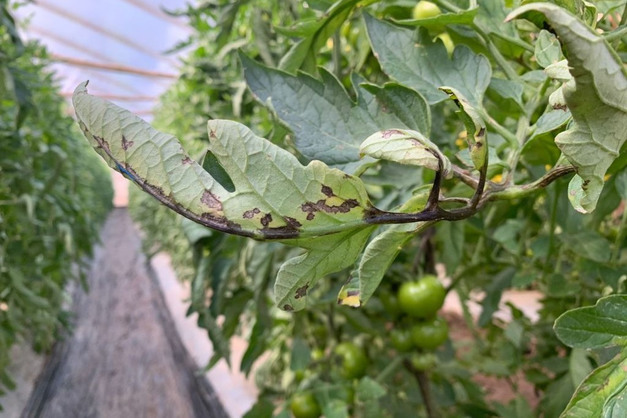
"Recent outbreaks in Chile, North America, and Europe involving highly aggressive strains suggest an increase in virulence that we need to address urgently," the research states. In Chilean fields, severe symptoms have been recorded that go beyond the typical foliar damage, including stem necrosis and seedling death.
Toward a new control strategy
The findings underline that current control strategies, built around a single resistance gene, are no match for a pathogen this adaptable. The researchers propose a paradigm shift built on two pillars:
- Genomics-based surveillance: Identifying strains in the field through their DNA to anticipate outbreaks.
- Diversified resistance: Integrating multiple sources of resistance in new tomato varieties to make it more difficult for the bacterium to "break through" all barriers simultaneously.
CEAF's Dr. Valenzuela recommends a set of immediate preventive measures. "The first step is to start with healthy seed and transplants, since in some cases the infection originates in the earliest stages of the plant. This bacterium favors moderate temperatures and high humidity, conditions that occur mainly in autumn and spring."
"High humidity inside greenhouses should be avoided by ventilating when necessary, and overcrowding through excessive fertilization or very high planting density should be prevented. If good ventilation is maintained, disease incidence is low, and plants showing symptoms can even recover once relative humidity drops," she adds.
The work is relevant well beyond the tomato industry, the authors note, serving as a model for understanding how selection pressure and genetic flexibility shape pathogen evolution and drive disease severity across crops.
 For more information:
CEAF
Camino Las Parcelas N° 882, Sector los Choapinos
Rengo, O'Higgins Region, Chile.
T. 722 810 320
https://ceaf.cl