Cox Aardbeien, a Dutch strawberry grower, is expanding its operations by converting existing greenhouse space for strawberry cultivation. A former cucumber greenhouse now houses rows of strawberry gutters, and a pepper greenhouse is scheduled for conversion in the coming winter. What sets this operation apart is the grower's choice of a specially developed gutter system, co-developed with Meteor Systems.
"For me, this system has already existed for five years," says grower Guus Cox, during a walkthrough of his greenhouse in Baarlo, in the south of the Netherlands, in early April. Cox is keen to demonstrate the system in practice, one that attentive visitors to the International Soft Fruit Conference in January had already seen in a demonstration setup.
It was Cox himself who approached Meteor Systems after a successful first season and asked them to exhibit the cultivation system at the trade show. He is convinced that cooperation is essential to advance mechanisation in strawberry growing. "Up to this point I was moving much faster on my own, but now the task is to move forward together and work out the details."
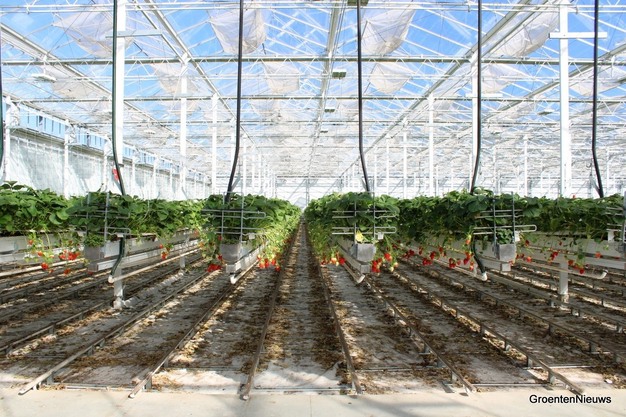 © Thijmen Tiersma | HortiDaily.comEight gutters per trellis
Two gutters
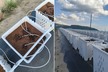
One notable feature of the system at Cox Aardbeien is the narrow gutters and the use of what is effectively a double gutter. The upper gutter contains no drain channel. It is filled with substrate and planted with strawberry plants at a density of 12 per square metre. Drain water flows through holes in the base of the upper gutter into a second, even narrower gutter below, which serves as the drain channel.
The first step toward this cultivation system came in 2020, when Cox Aardbeien built 2.5 hectares of racking for cutting propagation. From the outset, mechanisation was a central consideration, so that the system could also be applied in the greenhouse. To fill the gutters with substrate, Cox built his own filling machine. "That way I could show exactly how I wanted it done."
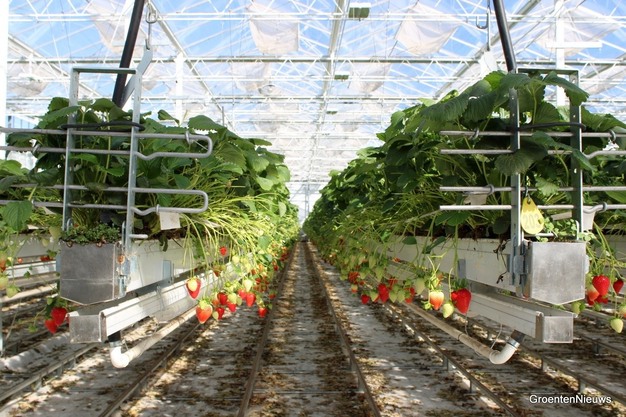 © Thijmen Tiersma | HortiDaily.com The system actually consists of two gutters underneath each other.
Uniformity helps machines
The first version of the system, also developed in collaboration with Meteor Systems, used a custom gutter profile. Sebastiaan Smeur, Sales Manager Benelux at Meteor Systems, explains that for the current system at Cox Aardbeien, an existing profile from the company's broad product range was adapted. "Our roll-forming machines are equipped with advanced roller sets. We invest in these deliberately, so we can be highly flexible in gutter specifications and dimensions per project. We design and supply a complete system, including suspension, drain water collection, irrigation, and custom tube rail supports." That bespoke approach proved valuable here as well.
In total, eight gutters are suspended in a single trellis. With mechanisation in mind, the centre-to-centre distance between gutters is consistently one meter. "That makes it possible to use machinery developed by Deto Mechanisatie across multiple sites," says Cox. "Uniformity is crucial. Mechanisation is organisation."
In many cases, strawberry growers working with standard gutter dimensions find themselves just a few centimetres short of achieving equal spacing throughout. Cox Aardbeien recovers those centimetres by using a narrower gutter, without making concessions elsewhere. A swing system is therefore not required.
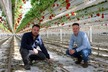
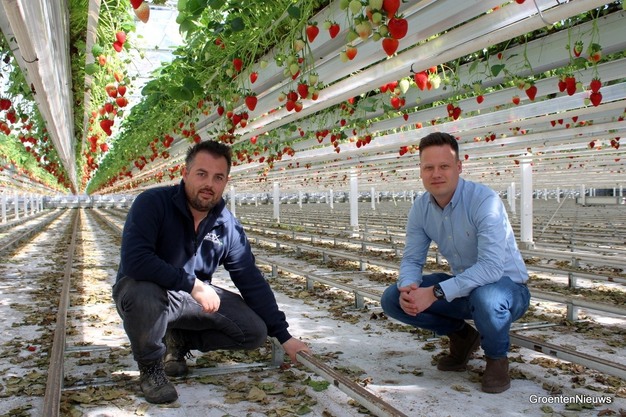 © Thijmen Tiersma | HortiDaily.com Guus Cox and Sebastiaan Smeur underneath the gutters in the greenhouse in Baarlo.
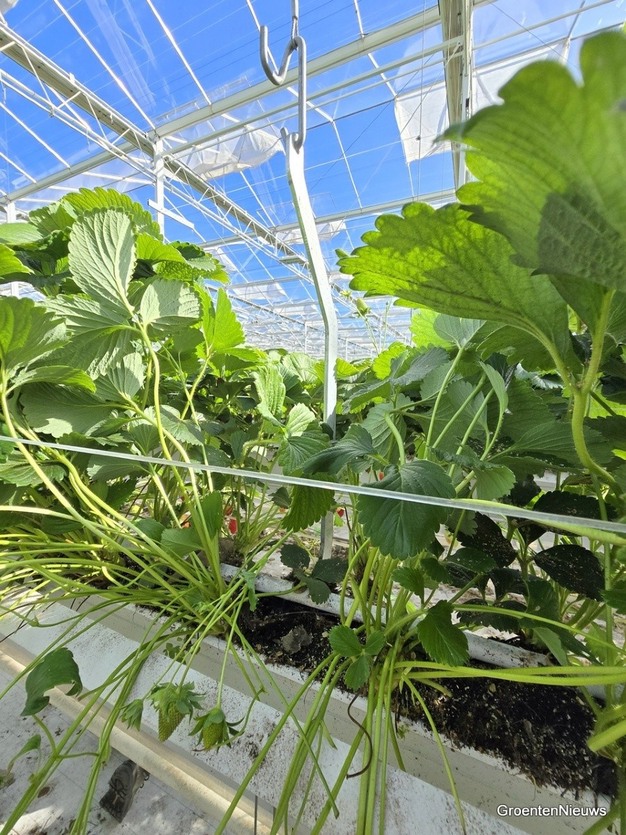 © Thijmen Tiersma | HortiDaily.com Better cultivation
The gutter holds 11.5 litres of substrate in total, which is less than the industry norm. "It makes it possible to grow slightly more generatively. It also helps to draw down plant reserves effectively during the winter period."
Since switching to the new system, Cox Aardbeien has moved from a continuous cultivation cycle with a single crop change to two fresh plantings per year. In the Baarlo greenhouse, the company grows the variety Inspire, an exclusive variety supplied by The Greenery. Normally, switching to two plantings per season would involve a significant increase in labour, but with adequate mechanisation, Cox Aardbeien is able to offset this.
Photo right: An open crop support, so that machines are not hindered by it.
Unexpected advantages
Several machines have been introduced into the working process in the strawberry greenhouse. These include a machine that fills the gutters with substrate, a machine that mows and mills in a single pass, and a machine for mechanically clearing the crop. All implements are compatible with the same undercarriage.
An unexpected benefit of the new system is that it allows Cox to reduce substrate use for the second crop while also gaining critical weeks of growing time. "We continued harvesting until 15 December and had the new crop planted again before Christmas. With this system, you extend and advance the season at the same time."
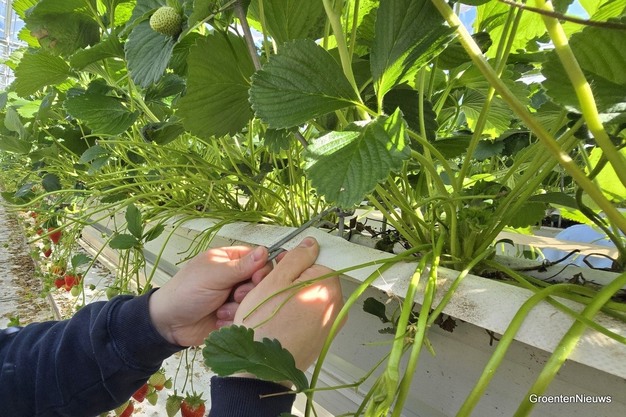 © Thijmen Tiersma | HortiDaily.comCrop support fixed in the substrate, making the support easy to remove.
From a commercial standpoint, the approach delivers higher turnover for a grower operating across multiple sites, though Cox acknowledges that not every grower immediately recognises this advantage. Mechanising the processes around a crop changeover can appear to offer only limited annual labour savings. "But the concept directly increases profitability by creating more harvest days," Cox emphasises. "In Baarlo, we ultimately had nine weeks with no product between the two crops."
When combined with the additional cultivation benefits and the potential to mechanise further processes, the picture changes significantly. Cox is focused particularly on mechanising crop maintenance operations, and is keen to take those steps together with fellow growers who also see the potential of a mechanisation-oriented gutter system.
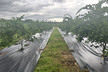
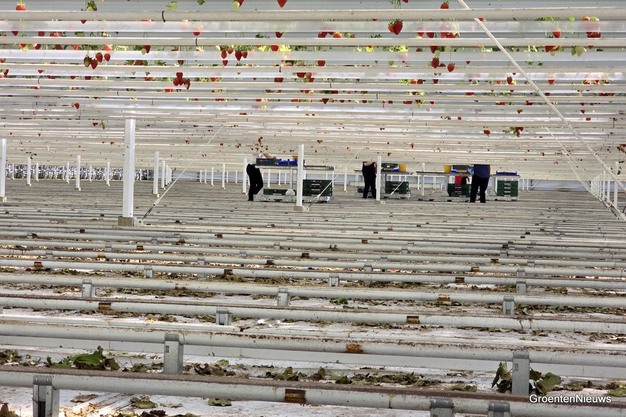 © Thijmen Tiersma | HortiDaily.comEverything was re-leveled during the greenhouse conversion so that the pipe rails lie nicely straight everywhere.
For more information:
Cox Aardbeien
[email protected]
www.coxaardbeien.nl
Meteor Systems
[email protected]
www.meteorsystems.nl