Strawberry growers pour roughly $130 million a year, nationally, into a surprisingly stubborn problem: a part of the plant that sabotages fruit production. These fast-growing offshoots – called "runners" – stretch out from the mother plant like botanical escape artists, siphoning energy that would otherwise go into plump, market-ready berries.
University of Florida doctoral student Kaitlyn Vondracek wants to help farmers solve this costly problem. She's digging deep into the genetics behind runner formation, hoping to dial down the plant's impulse to sprawl.
In nurseries, runners are a blessing. Each one produces so-called "daughter plants," the next generation of transplants that growers rely on. Once those transplants are out in the field, the story flips. Instead of boosting production, runners create new plants that drain resources and drag down berry yields.
"Growers have found that removing runners from plants in the field improves both the quality and yield of the fruits," Vondracek said. "As such, it's become a standard process for growers to trim runners from fruit-producing plants."
But without automation, that's an expensive process as it must be done by hand.
Seonghee Lee, an associate professor of horticultural sciences and Vondracek's advisor, said her project ultimately could help farmers reduce labor costs by breeding strawberries that make very few runners.
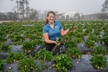
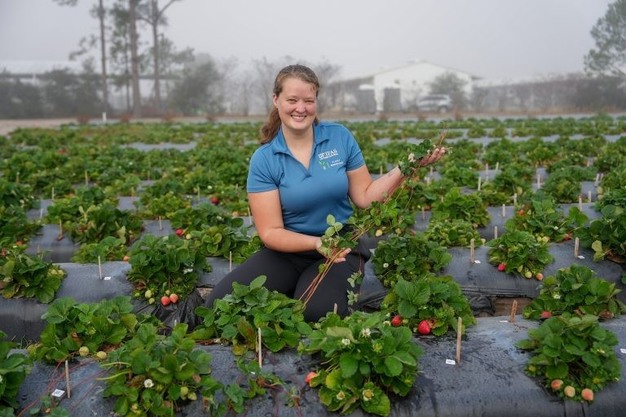 © Alice Akers, UF/IFASUF/IFAS doctoral student Kaitlyn Vondracek is using genetics to try to reduce runners in strawberries
"This would allow growers to significantly reduce the need for manual runner removal, which is becoming increasingly difficult due to labor shortages and rising wages," said Lee, a faculty member at the UF/IFAS Gulf Coast Research and Education Center, the site of the research. "Across the United States and globally, low-runner strawberry varieties have strong potential to improve sustainability, especially in regions facing similar labor constraints."
With the research, which should be complete this year, scientists seek strawberries that make few runners during fruit season in Florida, but many runners in nurseries in places like Oregon or Canada, said Vondracek, a student in the UF/IFAS Plant Breeding Ph.D. program.
"To do this, we find the parts of DNA that control runner growth," she said. "With traditional breeding, combined with DNA technology, we use simple DNA tests to pick the best breeding parents and seedlings with the variants that we know are associated with our desired trait — in this case, fewer runners. This gives both benefits: low runners in fruit fields (lower labor costs), and plenty of runners in nurseries for easy propagation."
For more information:
UF/IFAS
www.ifas.ufl.edu