Smriti Chaudhary, a graduate student in sustainable agriculture and horticulture, has had great success studying vegetable crops at Iowa State University. So much that she was awarded a 2026 Graduate Program Research Excellence Award.
With her May 2026 graduation on the horizon, Chaudhary plans to continue working in horticultural science and specialty crop production. She wants to develop research-based management strategies that help growers improve crop performance while maintaining sustainable production systems.
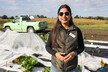
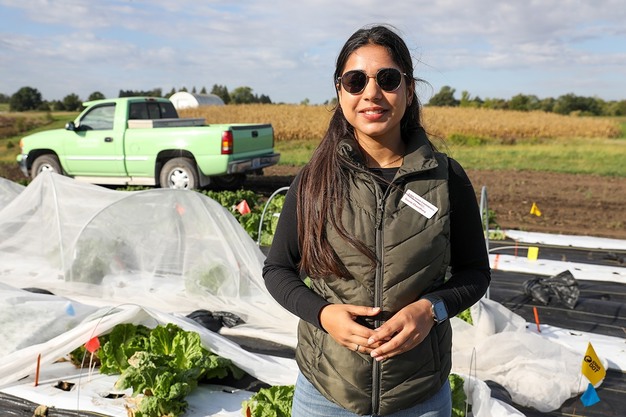 © Brandon KleinkeSmriti Chaudhary stands in a research test plot where she analyzes various vegetables
Provide a general overview of your research - what you test, how you test it, variables, etc.
My research focuses on improving organic vegetable production systems by strengthening two key stages of crop production: transplant quality and pest management. At Iowa State, I have primarily worked with specialty crops such as eggplants, napa cabbage and peppers to develop practical, research-backed solutions to help growers improve yield and crop quality.
A major part of my work examines insect exclusion systems known as mesotunnels. These structures are made from nylon mesh netting that acts as a physical barrier to prevent insect pests from reaching the crop. In replicated field experiments at the ISU Horticulture Research Station, we compared mesotunnel systems with organic insecticide programs. Our objective was to monitor insect pest populations, feeding injury and marketable yield, while also tracking environmental conditions inside these mesotunnels.
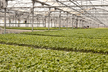
Alongside field trials, I conducted greenhouse experiments evaluating organic fertilizers and media amendment strategies for growing organic vegetable transplants. These studies help identify ways growers can produce stronger and more uniform transplants, which are critical for successful establishment and yield in organic systems.
Beyond the research itself, I have helped develop extension materials and videos with Iowa State Extension and Outreach share practical recommendations with growers and home gardeners.
What inspired you to pursue this research topic?
During my bachelor's degree at Punjab Agricultural University in India, my primary interest was soil science, and I initially expected to build my career around row crop systems. However, when I joined the sustainable agriculture and horticulture graduate program at Iowa State, I was introduced to specialty crop production in a much more hands-on way. Working closely with vegetable crops shifted my perspective because these systems require intensive management and have direct connections to growers and local food systems.
The mesotunnel project itself was originally assigned to me as part of a broader effort to expand pest management options for organic growers. What started as an assignment quickly became something I genuinely enjoyed. Designing experiments, collecting data throughout the growing season and seeing clear differences in crop performance between treatments made the work very engaging. It was especially rewarding to discuss the results with growers during field days and outreach events, because many of them were interested in practical strategies that offer alternatives to traditional pest management practices.
For the greenhouse portion of my research, I expanded on earlier work done in the sustainable vegetable production lab by evaluating organic fertilizers for vegetable transplant production. This allowed me to build on an existing research foundation while exploring questions that are directly relevant to growers who produce their own transplants.
What have been the biggest takeaways/discoveries of your research?
One of my biggest takeaways was realizing how interconnected horticultural systems really are. At the beginning of my research, I viewed pest management and transplant quality as separate components. Over time, I saw how factors such as plant vigor, soil conditions, environmental conditions and pest pressure are closely linked. Small management decisions can influence many parts of the production system at once.
From field research, I found that mesotunnels can provide effective pest suppression while maintaining strong crop performance. In our trials, the netting structures significantly reduced damage from key insect pests and helped improve crop quality while minimizing the need for repeated organic insecticide applications.
Another major takeaway came from the greenhouse work on transplant production. Early-stage nutrition and growing media management had a major impact on transplant uniformity and vigor. Some dry organic fertilizers performed comparably to and sometimes more consistently than commonly used organic fertilizer products. This highlighted the critical role of early plant development in establishing a strong crop in organic systems.
These takeaways from my thesis results added to the already existing organic vegetable production 'toolkit'. This work strengthened my interest for system-level thinking in horticultural production and for developing solutions that are both scientifically rigorous and practically useful.
What is the impact or value of this specific research?
The main impact of this research is providing practical, research-based solutions for organic vegetable growers. Organic producers often have fewer pest management options and must rely on strategies that are both effective and compliant with organic certification standards. By evaluating mesotunnels alongside traditional organic insecticide programs, this work helped identify approaches that can reduce insect damage while maintaining strong marketable yields and crop quality. One important outcome was demonstrating that preventative pest management strategies can play a major role in organic systems.
The research also contributes to improving vegetable transplant production. By identifying effective dry organic fertilizers for greenhouse-grown transplants, the work provides growers, including small-scale farmers and home gardeners, with practical options to improve transplant vigor and uniformity. Strong transplants are critical in organic systems because early plant establishment often determines how well the crop performs later in the field.
Another important aspect of the research projects has been sharing the findings with growers and the horticulture community. I have presented this work at field days, grower conferences and scientific meetings, which allows the results to move quickly from research trials to real-world farming practices.
How has this research impacted you personally and with your future career path?
This research has impacted me both professionally and personally in ways I did not anticipate when I first started graduate school. I came to Iowa State to earn a degree, but I am leaving with so much more. Through this experience, I developed not only technical research skills, but also confidence, independence and clarity about the direction I want to pursue in my career.
Working on both field and greenhouse projects helped me better understand where my true interests lie within horticultural sciences. While I valued the systems-level field research, I discovered a deeper interest in greenhouse production systems, particularly in plant nutrition and early-stage crop management. Seeing how nutrient management influences transplant vigor and long-term crop performance shaped how I think about plant production and crop management.
The experience also helped me grow as a communicator and collaborator. Presenting my work to various audiences helped me realize that I enjoy working at the intersection of research and extension, where scientific findings can translate into practical solutions for growers. Iowa State also provided valuable professional development opportunities. These experiences strengthened my ability to present research, work in teams, and prepare for future career transitions.
On a personal level, being part of such a welcoming campus community made the experience even more meaningful. Iowa State fostered both academic growth and a strong sense of belonging. This journey has shaped me into a more confident and well-rounded horticulture professional.
Source: Iowa State University