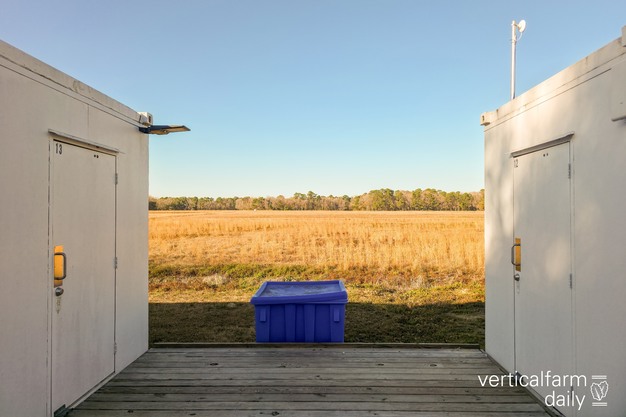
After a short drive through the picturesque Southern countryside, where Witch's Hair trees hang over swamps and dark ponds, a cluster of sixteen AmplifiedAg container farms suddenly appears along the roadside. We have arrived at the U.S. Department of Agriculture's Agricultural Research Service (ARS) in Charleston, South Carolina.
 © Rebekka Boekhout | HortiDaily.com
Moving indoors to boost outdoor growth
Following a warm welcome, we step inside what plant pathologist Dr. Kai-Shu Ling jokingly refers to as his 'second home', a research platform built around container-based vertical farming systems. The site is part of a federal research initiative launched in 2018 to better understand the role that controlled-environment agriculture could play in the future of U.S. crop production. "Our aim was to gain knowledge of the CEA space and explore where these systems make sense. By bringing together scientists from multiple locations across the country, we can investigate the technology from many different angles," he says.
The program connects researchers from thirteen ARS locations across the United States and focuses on topics ranging from crop genetics and hydroponic systems to plant health, integrated pest management, and pollinator biology. Standing among the containers, it becomes clear why the research platform was designed this way. Each unit functions as a standalone growing environment, allowing scientists to control variables and test different growing conditions side by side. "In a greenhouse or field environment, there are always external factors influencing the results. Here we can change one parameter at a time and observe exactly how plants respond," explains Kousik Shaker, Research Leader at the U.S. Vegetable Laboratory.
Click here to view the photo report.
 © Rebekka Boekhout | HortiDaily.com
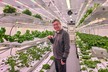
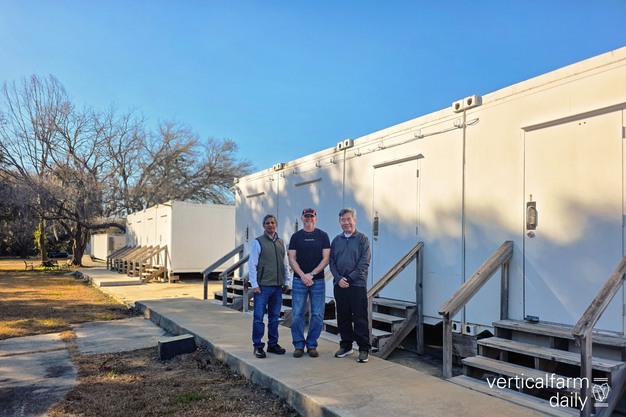
USDA researchers Kousik Shaker and Dr. Kai-Shu Ling, pictured with David Flynn of Amplified Ag in the middle
One container, two grow zones
"The Charleston site consists of sixteen container farms that were installed in phases, four containers in the first phase, another four in the second, and eight in the most recent expansion," says David Flynn, CEO of AmplifiedAg. "AmplifiedAg is a stakeholder and strong supporter of the ARS container farming research."
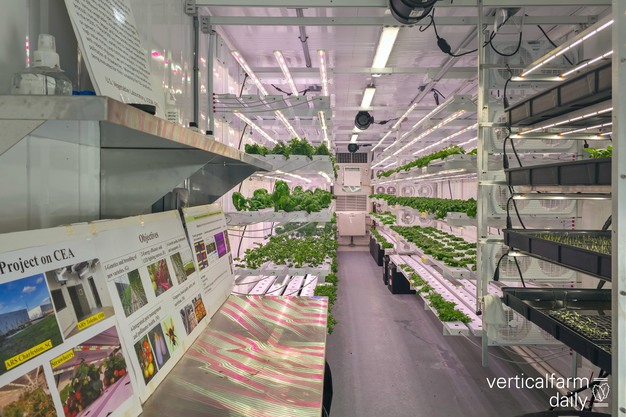
Walking through the facility, it's visible how each container is configured as a research unit. Inside, the cultivation area is divided into two zones, each with its own fertigation system. "One side acts as the control, the other side is used for the treatment under the same environmental conditions. That allows us to directly compare plant performance under two different nutrient fertigation conditions. We can easily isolate different light spectra, nutrients, or genetic traits, which is a very efficient and fun way to run experiments."
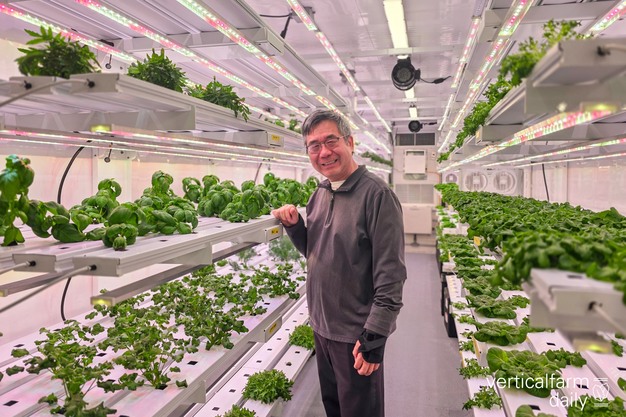 © Rebekka Boekhout | HortiDaily.comDr. Kai, in one of the R&D containers
Engineering for controlled environments
Originally focused on commercial production, AmplifiedAg has also supplied a growing number of container farms for research and development, supporting trials with new, existing, and emerging crops. Why? "Our containers are plug and play," says David. "We were growers before we were technology developers, so when we design a container farm, we think about how the system actually works day to day. Anyone can become a grower with our farms. If something needs to be replaced, you don't have to rely on proprietary parts. Everything can be serviced using standard equipment. That flexibility is important," David says. Researchers need to be able to adapt the system depending on the experimental needs."
That grower's mindset also influenced how the systems are built. Components inside the container rely on locally available hardware, allowing growers to easily source replacements if maintenance is required. Inside the units, fans circulate air through the growing space while a three-in-one HVAC system manages heating, cooling, and dehumidification. The AmpEDGE software allows growers to monitor and control the farms remotely, managing the entire production process from seed to harvest.
Click here to view the photo report.
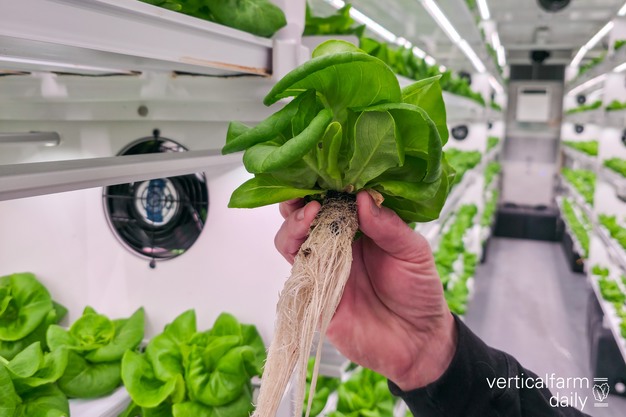 © Rebekka Boekhout | HortiDaily.com
Full head of lettuce
"The environment has to be extremely stable. If you want reliable research results, you need consistent conditions. The containers are insulated to R25-R28, helping maintain internal temperatures while reducing energy consumption. Modularity is another key element. Panels can be mounted easily, while movable irrigation lines simplify cleaning and maintenance," David explains. "We designed these systems so that the technology never becomes the bottleneck. Remote monitoring, standard parts, easy access for maintenance, the goal is always to keep the grower or researcher focused on their work, not the equipment."
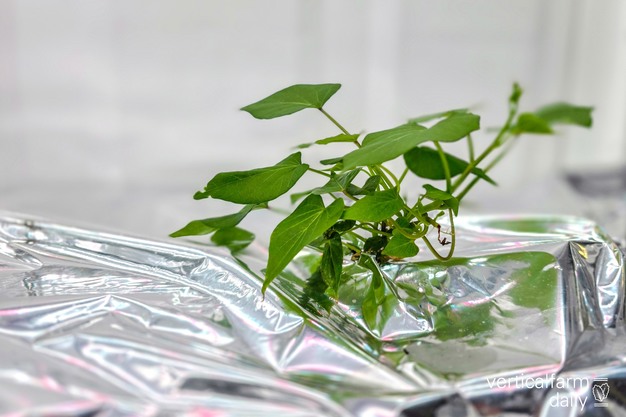 © Rebekka Boekhout | HortiDaily.com
Sweet potato young plant
Oh, sweet, sweet potato
Sweet potatoes are among the more unconventional crops under investigation. "At first, people are surprised to see sweet potatoes in a vertical farming system," Dr. Ling says, smiling; however, "we are not focusing on root production." So we cannot expect a chips production spinoff anytime soon. Instead, ARS researchers are testing whether vertical farms could serve as propagation hubs for fast nursery producing clean planting material for field growing. "We follow the full production cycle. From propagation to field harvest."
The propagation process begins with tissue culture, allowing pest-free, clean plants. After a few weeks of propagation inside the container, the young plants will be transplanted outdoors. With pride, Dr. Ling shows off his selection of sweet potatoes. The plants are grown in cocopeat-based systems, with foil coverings used to protect irrigation channels and prevent algae from growing. "We want to see how plants perform from the very beginning all the way through to the field. This helps reduce clogging and maintenance." For open-field growers, indoor farms could eventually reduce the time required to produce healthy and strong 'planting material'.
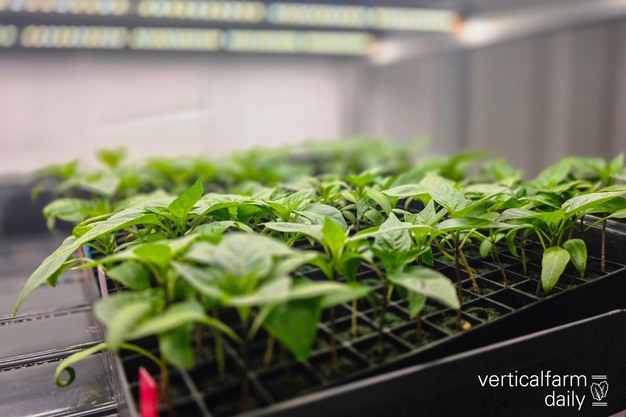 © Rebekka Boekhout | HortiDaily.com
Sweet potato seedling
Exploring genetic screening and propagation materials
"A major component of our research focuses on identifying plant varieties that perform well in controlled environments. By screening germplasm collections, we can see which traits work best indoors," Dr. Ling explains. Researchers are evaluating characteristics such as stress tolerance and plant architecture. "These traits become much more important when plants are grown in confined spaces."
Beyond crop research, the containers are also used as a testing ground for agtech in general. One example is the Nitrowater system, which generates nitrogen from the air and adds it to irrigation water. "The idea is to reduce fertilizer inputs while maintaining plant nutrition." Another container is currently rented by Zaru Systems to test microgreen production before expanding operations in North Carolina. "These collaborations allow us to test technologies under real growing conditions and expand our portfolio at the same time. Several other containers remain dedicated entirely to research and development. "AmplifiedAg works closely with researchers and growers at every stage, from early concept through to full operation. The goal is always to set growers up for success before they scale, not after."
Click here to view the photo report.
 © Rebekka Boekhout | HortiDaily.com
One of the R&D container farms
'Hand in hand'
After walking through the site, the goal becomes clear. Controlled environment agriculture, the researchers emphasize, is not intended to replace traditional farming. By studying crops indoors and then evaluating them in field trials, the team hopes to develop strategies that support both production methods. "There is still a lot to learn, but facilities like this give us the tools to explore the endless opportunities," says Dr. Ling. And with thirteen research locations collaborating across the United States, the Charleston containers may offer insights that extend far beyond this quiet patch of South Carolina countryside.
For AmplifiedAg, projects like these at the ARS research site demonstrate how container-based systems can support far more than commercial leafy green production. "Research facilities like this allow growers, researchers, and technology developers to test ideas before scaling them," David affirms.
"What excites us most about this collaboration is that we're just getting started. As more containers come online and the research program expands, we'll be generating insights that benefit growers at every level, whether you're running a container farm, a greenhouse, or an open field operation. That kind of cross-sector learning is exactly what the industry needs right now."
This article does not constitute an endorsement of AmplifiedAg products by the USDA.
For more information:
AmplifiedAg 
David Flynn, CEO
[email protected]
www.amplifiedaginc.com
USDA Agricultural Research Service (ARS)
Dr. Kai-Shu Ling, Plant Pathologist 
Kousik Shaker, Research Leader
2700 Savanna Highway, Charleston, SC 29414, USA
+1 202 720 2791
[email protected]
www.ars.usda.gov