Daniel Parson says participating in the Oxford College Organic Farm's community supported agriculture (CSA) program is "like having your own personal shopper."
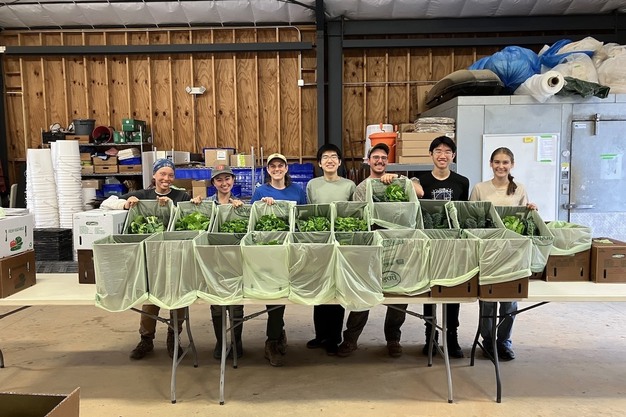
Every Thursday, starting April 23, a team of dedicated Oxford farmers will pack boxes of fresh produce for CSA subscribers to pick up and incorporate into their weekly meals. Registration for this year's CSA boxes is currently open on the farm's website.
 © Emory University
"You're getting the best of the season delivered to you, and you don't have to think about it," says Parson, the farm's lead farmer-educator. "It's really about having fun, trying new things and enjoying the food."
In addition to the Oxford Farmer's Market, pick up is also available on Emory's Atlanta campus at Kaldi's at the Depot and the Math and Science Building. Those who work for Emory Hospital can pick up their boxes in the hospital lobby.
Spring, Parson adds, is a particularly good time to sign up, as the season produces some of the farm's most exciting crops. Many of these vegetables will also be available for purchase at the annual Spring Plant Sale, held at the farm on Friday, April 10, and Saturday, April 11.
"There's an explosion of green on the farm right now," Parson says. "I was just gone for spring break, and when I came back, it was incredible to see how the grass had grown and how the cover crops sprouted a full foot. We have some of our best-tasting vegetables in the ground at the moment."
He lists beets, cabbage and an assortment of greens as his favorites.
"What makes a good CSA box is variety," he explains. "So, in the spring, you'll have your salad green, a cooking green, something crunchy, something sweet and always something fun. You're not going to get a box of just one thing. There will be five to seven items, and as soon as you open the box, you'll see different colors and textures."
Beyond the great tasting food, though, Parson says the CSA offers participants an opportunity to connect with both the Emory community and the land itself.
"We're growing these crops in the context of community and selling it in the context of community," he says. "It's a way for us at Emory to be together — and a way for people to understand and be connected to where their food comes from."
But the question Parson hears the most is, "What do I do with all these vegetables?"
Here are his top tips for making the most of a CSA box.
Make a meal the first night
The best thing about receiving a CSA box, Parson says, is the freshness of the produce. It simply can't be matched by any vegetables from the grocery store.
"When you get home, you can do a fun unboxing and separate your roots from your greens," he says. "Look at what you've got, and then make a big, fresh meal that first night to move through some of it while it's at its peak."
The freshness is the star of the show. Even the lettuce, Parson says, has a real depth of flavor.
"We harvest on Tuesday, pack the boxes on Wednesday, and it's in your kitchen by Thursday," he says. "That means all of our crops are especially fresh, but people really notice it with the lettuce.
"A CSA box works best for people who look at their ingredients and decide what to make that night based on what's fresh," he adds. "It's not the best if you're committed to following exact recipes. So have fun with it."
Learn something new
Parson encourages CSA members to embrace a sense of spontaneity when using the box's most adventurous items. "Don't be afraid to use your favorite search engine and look up how to use it," Parson says.
Sometimes, Parson will include a recipe in the box, but not always; he doesn't want to be overly prescriptive.
One spring vegetable that often trips people up, Parson says, is the kohlrabi, a member of the cabbage family. "It has the flavor of broccoli and the texture of an apple," Parson explains.
But fear not. He has a few ready-made suggestions for this unusual ingredient.
"I like to cut it into chips and dip it into hummus," Parson says. "It's also really good in kimchi, if you make your own. Roasting it is great, and it can work shredded in a slaw. But it has a great, natural flavor when eaten raw, and that's how I prefer it."
When in doubt, though, he says look it up and "don't be afraid and try new combinations."
Roast your vegetables
"I've heard many members say that once they discovered they could roast any vegetable, it really amped up their appreciation for the CSA program," Parson says.
Since kale is in the box almost every week of spring, he suggests roasting it into chips. His most popular suggestion, though, is to throw an assortment of veggies together for a sheet pan meal.
"You can do this with any of the ingredients in the box," Parson says. "I recommend radishes, turnips and kohlrabi. This carries into the fall, too, when we have carrots and the squash starts coming in. I'll just roast the veggies together on the grill or in the oven with whatever spices I have on hand. Throw in some chicken if you're a meat-eater, and that's a great meal."
Embrace the beet
Each spring, the farm plants a special heirloom variety of beet called the Chioggia, named after its home city on the northern coast of Italy.
The Chioggia beet is one of Parson's most beloved crops. He's been growing it for over 20 years, dating back to his first farming experience in Dawsonville, Georgia. It was one of the first vegetables to truly capture his imagination, and he recommends CSA members lean into its splendor.
"It fostered the discovery that within each crop there is incredible diversity," he says. The Chioggia beet has been around for more than 50 years and has been passed between generations of families and farmers.
"I like to shred it to include in a salad or steam it and enjoy it on its own," he says. "It's a candy-striped, red-and-white beet and, to me, it is the sweetest and best tasting thing we grow. And that stripe is just so visually striking."
Source: Emory University