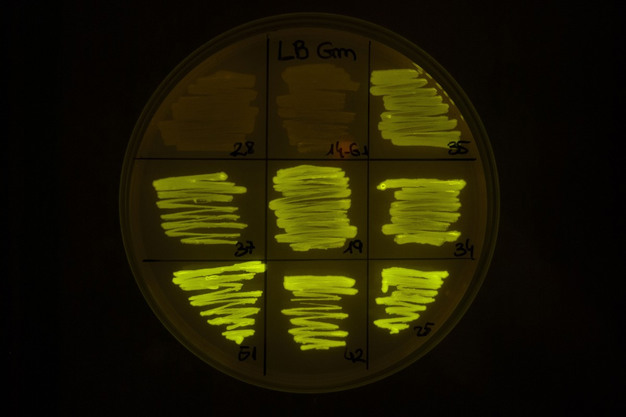
A research team from the Spanish National Research Council (CSIC), an institution affiliated with the Ministry of Science, Innovation and Universities of Spain, has identified the genetic circuit dynamics of Pseudomonas protegens, a soil bacterium with unique environmental properties for the biological control of plant pathogens. The discovery represents a key step toward using this bacterial species as a biotechnological tool in soil ecosystems, a process researchers refer to as domestication. The findings were published in Cell Systems and were obtained at the Biocomputation Laboratory of the National Biotechnology Centre (CNB-CSIC) using living computation techniques, a transdisciplinary methodology that programs bacteria using computational logic.
 © CSIC
Synthetic biology is based on modifying natural microorganisms to create new cellular functions with biotechnological applications, such as the degradation of toxic compounds or the production of substances for industrial use.
While researchers often rely on so called model bacteria that grow easily under laboratory conditions, it is increasingly important to work with microorganisms that naturally thrive in the environments where they are intended to be applied.
The study, led by Ángel Goñi Moreno, a CSIC researcher at the National Biotechnology Centre (CNB-CSIC), and carried out with the participation of the Centre for Plant Biotechnology and Genomics, describes the domestication process of Pseudomonas protegens and explains how genetic circuits operate within this species.
One of the most widely used bacteria in synthetic biology is Escherichia coli, mainly because scientists have extensive knowledge of its gene regulation systems. Other species such as Bacillus subtilis and Pseudomonas putida are also being successfully domesticated.
However, according to Goñi Moreno, results cannot simply be transferred from one species to another. "Comparisons between data from different species show that what we learn in one species cannot be directly extrapolated to others, because the cellular context of each species is important for how a given gene functions," he explains. "The same genetic sequence behaves differently depending on the regulatory elements present in each species, which is why its behavior must be tested in each organism. At the same time, this specificity can provide advantages for different applications."
A bacterium with strong environmental potential
Pseudomonas protegens is a typical soil microorganism with an extremely versatile metabolism and can be isolated from the roots of several plant species.
The bacterium has significant environmental value because it produces active compounds against various plant pathogens. In addition to effectively protecting plant roots from phytopathogenic fungi, it is also toxic to certain insects. These characteristics are the main reason researchers are interested in domesticating this species.
Using a library of genetic regulation circuits previously studied in other bacteria, the research team succeeded in characterizing how these systems behave in P. protegens.
"Using data on how different networks function in various organisms, combined with complex mathematical models, we have been able to predict the behavior of new networks and genes inserted into the system," explains Pablo Japón, a CSIC researcher at CNB.
Meanwhile, Juan Rico, also a CSIC researcher at CNB, notes: "Our work in basic research is helping develop new tools that act as a biological 'chassis' for environmental applications, such as compound production or bioremediation."
Processing information with living systems
Traditional computing focuses on processing information and transforming it into a different output. Based on that technological foundation, computers have been developed that perform logical operations using silicon chips.
However, silicon is not the only possible substrate for computation. The Biocomputation Laboratory led by Ángel Goñi Moreno aims to use living materials, specifically bacteria, to process biological information. DNA itself functions as an information storage system capable of processing data and generating responses in the surrounding environment.
Asked how bacteria can be used for computation, Goñi Moreno clarifies: "This is not about sending an email with a bacterium."
Conventional computers cannot reliably process probabilistic information, while quantum computers can, but they remain difficult to manage. Gene regulatory networks, on the other hand, naturally handle probabilistic information at room temperature and often more efficiently than conventional silicon based technologies.
Researchers argue that biological substrates may be particularly well suited for information processing tasks linked to environmental systems.
"For example, imagine using temperature as information. In a conventional setup, you capture temperature with a thermostat connected to a computer and regulate the temperature of a room," Goñi Moreno explains. "In a microorganism, you could produce a heat sensitive protein. When the environment reaches a certain temperature, that protein acts as a switch or signal that activates the production of a specific compound, indicating that a temperature change has occurred and under what conditions."
According to the researchers, the results of this study expand the potential applications of this unconventional bacterial "chassis" for use in environmental ecosystems.
Source: CNB-CSIC Communication