 © ColoradanMaximilian Knight (EnvEngr'17) was in sixth grade when he saw a documentary that changed his outlook on the world around him.
The Cove, which won the Academy Award for best documentary feature in 2010, featured an in-depth look at a small town in Japan known for capturing and selling dolphins to aquariums around the world. The film featured graphic footage and raised critical questions about dolphin hunting practices.
Knight was transfixed.
"It was a pretty tough subject, but through that film, I became more aware of things going on in the world," Knight said. "The whole community of people trying to do good in the world and trying to make the world a better place — that really inspired me and continues to."
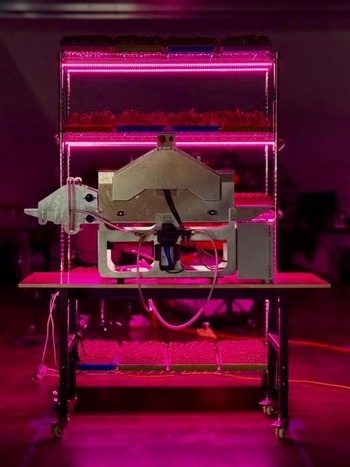
Knight took that inspiration and found his own way to improve the world. As founder and CEO of Boulder-based Rooted Robotics, Knight's mission is to provide affordable automation systems to indoor farms of all sizes.
The company, founded in 2019, offers game-changing technology to small and mid-size controlled-environment growers who can't afford industrial-sized — and industrial-priced — services.
"If we look to 50 or 100 years from now, if climate change does get significantly worse, as is largely expected, we need to be able to feed ourselves," Knight said. "We need to be able to do that at scale without having millions or billions of people starve because we can't grow as much food in the same ways that we used to."
 © Coloradan
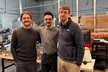
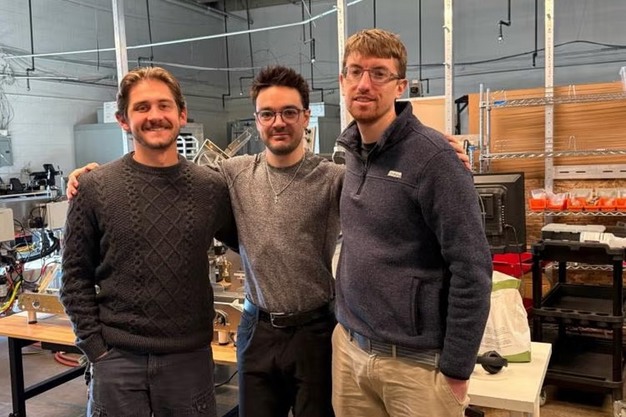
Christian Maljian (left), Sebastian Vazquez-Carson (middle) and Maximilian Knight (right)
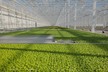
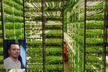
Enter controlled-environment agriculture, a term Knight explained refers to incorporating a more technology-focused approach to farming. In these environments, which often exist as vertical farms or greenhouses, growers can control everything from temperature and sunlight to humidity and nutrients, along with countless factors in between.
This flexibility allows growers to customize what they grow and when they grow it in a way traditional farmers cannot.
Rooted Robotics offers products that help farmers with seeding, harvesting and cleaning. Each system is designed with simplicity, reliability and sustainability in mind. Everything the company sells is also made to be upgradable with customized add-ons, allowing the machines to grow with the farms they support.
Knight's own expertise in the field dates back to his time in CU Boulder's College of Engineering & Applied Science, where he learned many of the technical skills he routinely applies to his work. But perhaps the biggest takeaway from his time at CU was, as he describes it, learning how to learn.
"I studied environmental engineering, which is not really what I do today," Knight said. "Even though I'm not doing water treatment engineering or sanitation engineering, I learned how to teach myself new skills."
Knight also met Rooted Robotics' chief technology officer at the school. He and Sebastian Vazquez-Carson (Phys'17) were friends as undergraduates, and the two reconnected in 2022 when Vazquez joined the company to help with a robotic system.
When Knight considered undergraduate programs, he was drawn to the community he found at CU. Today, with his company still housed in Boulder, he has kept close ties to the school. Christian Maljian (Engr'19) is co-founder and head of mechanical engineering. Of Rooted Robotics' seven part-time employees, six are students from the College of Engineering & Applied Science or the Leeds School of Business.
Rooted Robotics also hosts summer interns from CU Boulder. In addition, the company partnered with the Paul M. Rady Department of Mechanical Engineering this year to sponsor a capstone project. The senior students involved with the project are helping Rooted Robotics develop a variation of the company's seeding machine.
Knight's hope is that, through the partnership and the innovation he's brought to the company since its founding, Rooted Robotics can continue to be an inspiration and valuable resource for indoor growers.
"A beautiful vision that could exist in 50 to 100 years would be that we're growing most of our agriculture in these controlled environments," Knight said. "Because of that, nature will be able to reclaim a lot of the farmland that blankets the Earth. That can also help with reversing climate change at scale. That's part of the future that we want to create."
Source: www.colorado.edu