For the first time in program history, the Amundsen Lab's hop research program at the University of Nebraska–Lincoln has created a hop variety suitable for commercial sale.
Margie, a hop developed from a Nebraska wild variety, is "a beast in the field," much like the pitbull-German shepherd mix it's affectionately named after. Margie is notably pest resistant, has promising yield and is resilient to Nebraska's high heat and humidity. After years of vigorous testing, Margie proved successful enough to be featured in Corn Coast Brewing's Gene-ius Selection beer.
"This marks an important milestone for our program, as we are finally in a position to release one of our experimental selections," said Kristina Alas, the hop breeding program manager.
 © University of Nebraska-Lincoln
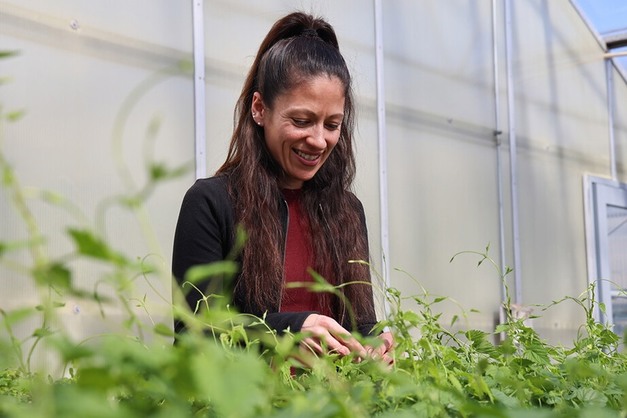
Alas is a doctoral student in plant breeding and genetics in Nebraska's Department of Agronomy and Horticulture, her third degree from the department. Alas graduated with her bachelor's degree in horticulture in 2014. When she started her master's in plant breeding at Nebraska in 2018, she began working in the hop research program and over the last eight years she has essentially built the program from the ground up.
Alas is responsible for caring for hop nurseries and greenhouses, spraying fungicides and insecticides, brewing, collecting data and conducting all research.
"There's a lot that I have to do, but it's very fun," Alas said.
Margie's success cannot be attributed to happenstance; the hop went through several years of testing and observation before finally earning its place in a 5.9% alcohol by volume West Coast pale ale.
All hops in the university breeding program start in the progeny nursery. There are three recognized species within the genus Humulus. Each year, the nursery holds 500 distinct genotypes of Humulus lupulus, common hop, that Alas observes to determine if they are female or male, if they are growing well and how much they are producing. Female hops produce the cones that brewers use, while male hops only produce pollen.
After three years of examination, a select few promising female hops are replanted in the project's high trellis nursery.
"Maybe three, at the most, of the 500 will eventually go into that nursery," Alas said.
The high trellis nursery is 18 feet tall and replicates the infrastructure hop producers use. In this stage Alas observed Margie's exceptional lateral branch growth.
"Lateral branches are where the cones are produced and they grow quite long throughout the season," Alas said. "Margie's exhibits vigorous lateral development, which supports yield potential."
After three more years of observation, Alas identifies the strongest plants and starts growing and evaluating them in different locations across the state. Margie is still in this stage of the research process alongside her sister hop genotypes, Margot and Midge, to determine whether producers like them or not.
At the same time, Alas is testing Margie's brewing qualities, taste and popularity through partnerships with local breweries.
"Just because they work well for our producers doesn't mean our brewers are necessarily going to want them," Alas said. "That's why we are working with different breweries such as Corn Coast to give us their feedback and give them an opportunity to actually use the hops in a brew. By doing that we also get feedback from the consumer."
Alas has found that Margie's brewing characteristics are similar to noble hops because it is low in alpha acids, giving Margie's brews a smooth bitterness rather than an intense flavor, and its essential oils give its brews floral and earthy aromatics.
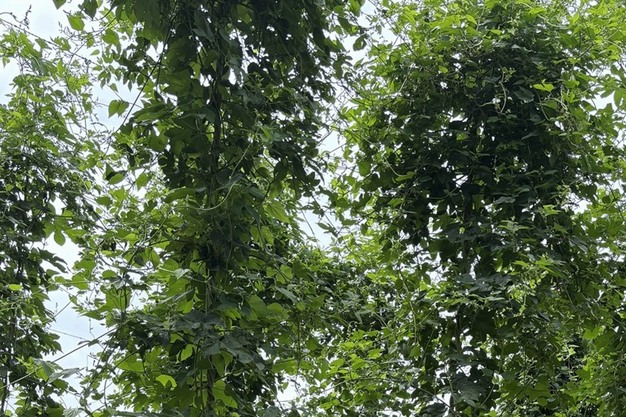 © University of Nebraska-LincolnThe hop variety, Margie, grows in a high trellis nursery in Fort Calhoun.
Throughout the research process, Alas leans on her campus partners for guidance and support. Keenan Amundsen, agronomy and horticulture professor, is the principal investigator for the hop breeding program and Andrew Rasmussen, food science and technology lecturer, assists Alas with her brewing evaluations.
Farm managers Collin Eaton and Craig Ferguson help Alas with physical labor and maintenance of the hop farms. Amit Mitra, professor of plant pathology, and Peter Mullin, plant pathology lecturer, advise Alas in her use of pesticides, insecticides and fungicides. Alas also credits her success to her dogs, Margie and Lucy, for their emotional support.
Hop production is centered in the Pacific Northwest, but when Nebraska producers tried planting hops from that region in Nebraska, they could not survive through the summer. The Nebraska hop research program was created to develop quality hops that can withstand the state's weather, but also to meet rising demand for unique Nebraska aromas and flavors.
"As the craft beer brewing industry grew here in Nebraska, it increased the demand from our brewers here for some locally sourced ingredients and also some flavors and aromas — ingredients that are unique to our region," Alas said.
The hop breeding program expects to build from the momentum Margie's success has generated to continue creating unique hop genotypes for Nebraska producers and brewers.
"It's really exciting to see it in the final product — to walk into a brewery and say 'that's my hop,'" Alas said. "It's something new for our producers, too. It'll give our producers here something unique to grow that will set them apart from the rest of the hop market, like those in Michigan, which is the second biggest hop breeding region here in the U.S. and, of course, from the Pacific Northwest, too."
Alas hopes more breweries will become interested in Margie and her program's other hops so they can be released to even more consumers. In an ideal world, Alas dreams of testing Margie's growth in locations around the country from the East Coast to the Pacific Northwest and seeing how its growth and brewing properties change in climates vastly different from Nebraska's.
Source: University of Nebraska Lincoln