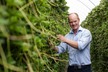
JCLM Farming strawberry propagator Jack Beattie says the decision to align with the UC Davis breeding program came down to one central question: what delivers measurable returns for growers?
"If you look globally at open-market strawberry production, UC Davis varieties would account for more than 50 per cent of plant sales annually," Beattie says. "That doesn't happen by accident. Growers choose them because they perform."
For fruit producers, he argues, the primary outcome is yield. "The first reason is yield. Generally, the varieties are very high-yielding," he says. "If you're a grower, kilos per plant matter. That's what drives your gross return."
Equally critical is crop security. "They've had, and continue to have, a very strong disease-resistance profile compared with other global genetics," he says. "That resistance profile is only getting stronger. For growers, that reduces risk. It means fewer surprises in the field."
Practically, that translates to more consistent harvests and less exposure to losses from common soil and foliar issues. "If you can combine high yield with strong disease resistance, you're improving predictability," Beattie says. "And predictability is valuable."
Logistics are another factor influencing grower choice. Because the varieties are bred in California to produce fruit to ship long distances within the United States, they are inherently suited to extended supply chains.
"A variety bred in California has to withstand shipping to the eastern seaboard of the US," he says. "Because of the tyranny of distance we have here in Australia, those genetics tend to suit us well. Growers need fruit that holds up in transit."
Shelf life and firmness are part of the commercial story, but they're not the whole of it. "They also eat well," Beattie says. "You're not sacrificing flavour to get shelf life. They tick a lot of boxes."
For growers in an annual production cycle, plant reliability is fundamental. Most Australian producers replant each year, which places pressure on nurseries to deliver uniform, high-health material.
"Even though strawberries are perennial, they're generally grown in an annual system," Beattie says. "So, fruit farmers buy a new plant every year. And they want to be confident that what they're planting is going to perform."
Beattie is from a farming family, getting his start in dairy in Tasmania. But he stepped away from that world to enter the produce universe. Now at JCLM Farming, he converts small volumes of licensed genetics into commercial-scale supply. Beattie cites the variety Eclipse as an example. "We brought six plants into quarantine from California," he says. "They spent a year in quarantine, went into our screenhouse on 1 September 2024, and we've now got about 185,000 plants from those six."
For growers, that multiplication capacity means rapid access to new genetics that have already been trialled and benchmarked internationally.
Data also plays a role in adoption. "If we want to get our money back out of our investment in genetics, we have to provide excellent data — both trial results and agronomic advice," Beattie says. "We maintain an extensive database for each variety."
And of course, no amount of theory would be worth anything without real-world practice. Commercial feedback lets him know he's on the right track. Referring to UCD Moxie from the UCD Royal Royce series, he says: "We've got customers in Victoria who really like it. In Tasmania, it's one of our customers' highest-producing varieties they've got on farm."
Ultimately, Beattie says the decision for growers is pragmatic. "If you're choosing a variety, you're looking at yield, disease resistance, shipping performance, and eating quality," he says. "UC Davis varieties consistently deliver on those outcomes. That's why growers keep coming back to them."
For more information:
Jack Beattie
JCLM Farming
Tel: +61 429 497223
[email protected]
www.jclmfarming.com.au