In the semi-arid belt of Arnetha near Kota, Keshorai Greens is using protected cultivation as a response to the area's climatic extremes. Founded by Achin Mittal, the project represents the company's first naturally ventilated greenhouse initiative, designed to function under Rajasthan's high summer temperatures, winter lows near 4°C, sharp diurnal variations, and fluctuating humidity.
According to Achin, the project aims to establish a benchmark for structured hydroponic production in a challenging environment. Cucumber was selected as the inaugural crop to demonstrate how controlled systems and crop management can stabilize performance despite external volatility.
 © Keshorai Greens
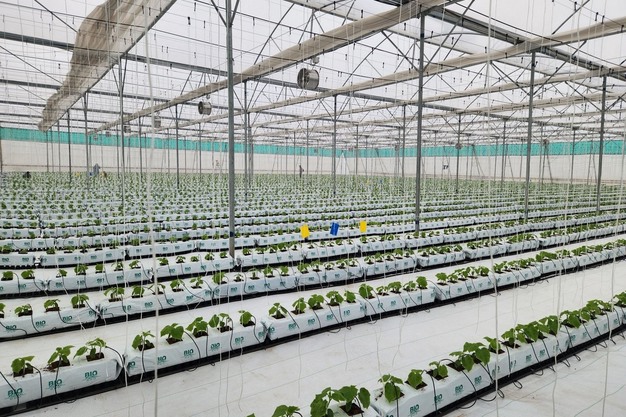
Earlier in the crop cycle
Continuous monitoring
"We implement daily monitoring systems and discipline," he shares. "We integrate precise irrigation scheduling, fertigation control, and continuous crop observation to make the systems work."
Uniformity was identified as a primary performance indicator. "From our side, we ensured that every plant received equal nutrition, equal water, and equal attention. This minimized variation across the house."
Uniform fertigation distribution, continuous EC and pH monitoring, stage-specific irrigation strategies, and consistent pruning and crop training protocols were implemented from the first sowing cycle. The result is a crop exhibiting consistent canopy structure, synchronized growth, and balanced vegetative development.
Root zone as the operational core
"Root health has been the backbone of our success," he says. Early sowing coincided with winter conditions where external temperatures sustained around 4°C. Despite this, the crop established without setback. "Even when the temperatures were low, the plants maintained a healthy root zone and showed stable growth, which clearly shows the strength of the substrate and management combination."
Stable moisture management, balanced nutrient delivery, and adequate aeration were maintained throughout the cold period. This early-stage stability translated into uniform canopy formation and improved crop balance during subsequent growth phases.
Substrate performance under stress
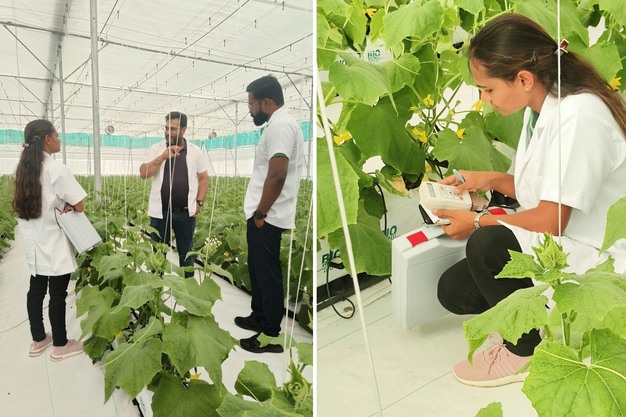
They had a recent technical visit by Biogrow Substrates India, which provided an opportunity to review system performance under real operating conditions.
"We are satisfied with the product and substrate performance, especially under fluctuating weather conditions." Observations during the visit highlighted consistent root development, balanced water-holding capacity, and sufficient oxygen availability in the root zone.
However, Achin emphasizes that substrate quality alone does not guarantee results. "While substrates play an important role, our focus has been on how we manage them. Disciplined irrigation and fertigation management made the real difference."
The combination of material performance and structured management reduced plant stress during temperature fluctuations and maintained physiological stability throughout the production cycle.
 © Keshorai Greens
The recent Biogrow visit
Preventive crop health strategy
Operating in Rajasthan's variable climate increases the risk of disease pressure, particularly under humidity shifts and temperature stress. Keshorai Greens adopted a preventive, system-based health management model.
"Rather than waiting for problems to appear, we focused on preventive crop health management," he explains.
Ventilation strategies within the project were carefully managed to regulate the internal climate. Over-irrigation and waterlogging were strictly avoided to protect root aeration. Hygiene protocols were enforced inside the polyhouse, and plant monitoring was conducted daily to detect early physiological deviations rather than reacting to visible disease symptoms.
The outcome has been a clean crop with minimal disease incidence and sustained foliage vitality.
A data-driven workflow
A defining feature of the operation is structured data tracking. He explained the workflow process during the Biogrow visit. He adds that operational discipline covers the entire production chain: sowing protocols, irrigation calibration, nutrient adjustment, canopy management, and environmental monitoring. This structured methodology has led to uniform plant morphology and consistent root zone performance across the unit.
Visitors noted the visual uniformity of plants and the well-developed root systems, which are indicators of stable substrate-water-air balance and controlled fertigation delivery.
Keshorai Greens operates with the philosophy that infrastructure must support measurable outcomes. Achin is excited to look ahead, "For a first naturally ventilated greenhouse project in one of India's most climate-stressed regions, our results show that protected cultivation in Rajasthan can meet high technical standards when supported by disciplined systems and precision monitoring."
For more information:
Keshorai Greens
Achin Mittal, Founder
[email protected]
https://keshoraigreens.com