At this year's Great Lakes Crop Summit, The Nature Conservancy in Michigan named Sklarczyk Seed Farm the recipient of its Conservation Innovation Award, recognizing the Johannesburg, Michigan-based greenhouse operation for implementing new and experimental conservation practices within a high-efficiency seed potato system.
Owned by Alison and Ben Sklarczyk, the multigenerational farm has evolved into a controlled-environment production business centered on hydroponics and tissue culture propagation.
Increasing yield through hydroponic intensification
The shift from traditional peat-based production to hydroponics has significantly altered plant performance and space-use efficiency.
"We were, before hydroponics, producing between two and five potatoes per plant," Ben shares. "Today we're producing between 25 and 35 potatoes per plant."
According to Ben, the yield increase per plant is the cornerstone of the system's environmental and economic impact.
"Hydroponics has made us very efficient with our square footage," he said. "It's made us very efficient with the fertilizer inputs and nutrient management that we use. It's also made us very efficient with our water use through the process."
By intensifying output per plant, the farm has expanded production capacity without constructing additional greenhouse area.
"Producing in hydroponics has allowed us to increase our output without increasing our greenhouse area. This fact in itself has a huge environmental impact because we are not using as much energy for heating and cooling as we would if we had more greenhouse area."
 © The Nature Conservancy
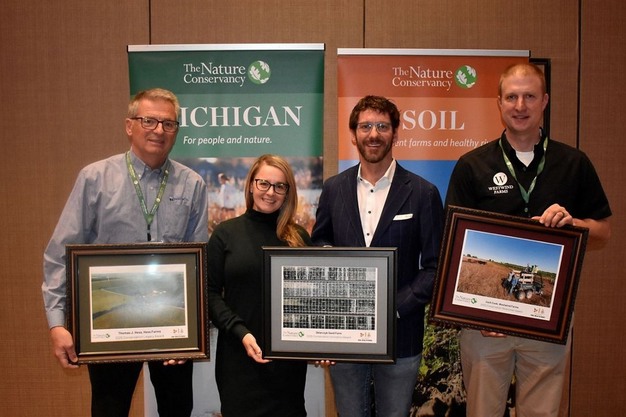
The Soil Health Hero awardees (with Alison and Ben in the middle)
Shifting cost structures and labor dynamics
While hydroponics has improved productivity and input efficiency, it has also reshaped the farm's expense profile.
"There have been changes in the expenses with hydroponic production vs. production in peat," Ben shares. "Our labor expense is dramatically increased; however, each plant is substantially more efficient with the volume of potatoes it produces now."
The higher labor input is offset by increased plant output and the avoidance of capital investment tied to greenhouse expansion. For operations evaluating similar transitions, understanding the trade-offs between labor intensity and space efficiency is critical when modeling return on investment.
LED lighting as energy investment
The farm also began focusing on energy efficiency through lighting upgrades. "LED lighting has been the largest capital investment we have made in recent years to aid in the reduction of energy we use on an annual basis," he states.
Rather than immediately replacing existing fixtures, the farm implemented a phased evaluation process.
"We started trialing LED lights and comparing their performance with HPS fixtures. Next, we determined the correct fixtures for our crop."
The side-by-side comparison enabled the team to assess crop response, light-spectrum performance, and operational savings before full deployment, thereby reducing technical and financial risk.
A measured approach to innovation
Ben attributes much of the farm's success to incremental change rather than wholesale system redesign.
"If you are looking to start implementing new practices, start small or with small changes," he advised. "We have found over the years it is better to keep to the basics and make small calculated changes vs. completely redeveloping a system that has worked for years."
That disciplined approach has guided both hydroponic development and lighting transitions, allowing innovation to be integrated without destabilizing core production systems.
Conservation in CEA
The Nature Conservancy's Soil Health Hero Awards traditionally highlight field-scale conservation practices such as reduced tillage and nutrient management. Sklarczyk Seed Farm's recognition shows that CEA can contribute to similar goals through input precision, water-use efficiency, and energy-conscious production models.
"Sustainability is a huge piece of a grower's journey," Alison Sklarczyk said in the award announcement. "We live here. We recreate here. We eat and drink everything right here. We always want to be taking care of and improving everything that we're doing and doing it the most cost- and environmentally friendly way as possible."
For more information:
Sklarczyk Seed Farm
Ben Sklarczyk, CEO
[email protected]
www.ssfseedpotatoes.com