UK greenhouse growers are taking part in a new Innovate UK–funded project to evaluate the performance of biostimulants under full commercial glasshouse conditions, supporting wider efforts to improve productivity and resilience in protected horticulture.
The project is supported through the Innovate UK ADOPT programme and is led by Flavour Fresh, a commercial grower and member of the Greenhouse Innovation Consortium (GIC). It brings together growers, researchers and product developers to generate applied evidence on biostimulant use in UK glasshouse systems.
Dr Sven Batke, Reader in Plant Sciences at Edge Hill University and Chair of the Greenhouse Innovation Consortium, said the grower-led nature of the work is central to its value for the sector. "This project is deliberately grounded in working glasshouses," he said. "By running trials under commercial conditions, we can generate evidence that is directly relevant to growers' operational and economic realities."
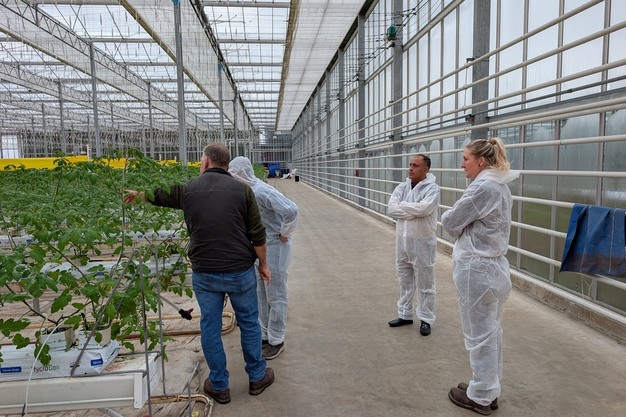 © GIC
© GIC
At Flavour Fresh's Lancashire site, the biostimulant is being trialled on tomato crops grown in soilless systems typical of UK commercial production. Parallel trials are taking place at Abbey View Produce, where the product is being tested on cucumbers and peppers within operational glasshouses. Together, the sites provide a representative spread of crops and growing environments.
The biostimulant under evaluation has been developed by Concert Bio and is designed specifically for use in soilless greenhouse systems. Rather than testing the product in isolation, the trials focus on its integration into standard crop management practices, including existing fertigation and environmental control regimes.
"Growers are not looking for solutions that require fundamental changes to their systems," Dr Sven Batke shares. "They need to know how new products perform alongside established practices, and whether they can be implemented practically at scale."
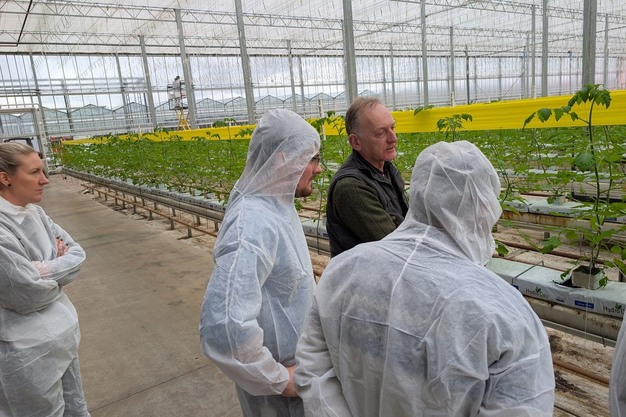 © GIC
© GIC
Running trials across multiple sites and crops is intended to produce robust, comparable datasets that reflect commercial variability. The involvement of growers who are active within collaborative networks such as the GIC is also designed to support efficient knowledge exchange across the sector.
"One of the roles of the Greenhouse Innovation Consortium is to help translate trial outcomes into shared learning. When growers are directly involved in generating the data, it builds confidence and allows results to be communicated more effectively across the industry."
Interest in biostimulants has increased as UK greenhouse producers respond to rising input costs, pressure to optimise resource use and constraints on conventional crop protection tools. However, independent data from UK commercial glasshouses remains limited, particularly for soilless systems.
"There is no shortage of claims around biostimulants," he adds. "What has been missing is credible, grower-led evidence from UK protected cropping environments. This project is about addressing that gap."
If the trials demonstrate consistent benefits, findings will be shared with growers, advisors and industry bodies to help inform wider adoption. Where responses are variable, the results are expected to contribute to a clearer understanding of where and when biostimulants may add value.
For more information:
Dr. Sven Batke, Chair of the Greenhouse Innovation Consortium
[email protected]
edgehill.ac.uk/person/sven-batke/staff/
Concert Bio © Concert Bio
James Watson
Head of Commercial
[email protected]
www.concert.bio
Flavour Fresh
[email protected]
https://flavourfresh.com/
Abbey View Produce
[email protected]
www.abbeyviewproduce.co.uk
Innovate UK
[email protected]
[email protected]
www.ukri.org