HandPicked City Farm, a rooftop farm at Kenilworth Centre mall in Cape Town, was never designed to be a high-output showcase. From the outset, it was conceived as a learning environment: a place where people could acquire practical growing skills in a controlled environment, including exposure to mistakes, constraints, and the realities of operating a farm within, or rather on, a commercial building.
"This site is primarily a training facility," says Zubayr Sydow, Operations Manager. "I was one of the first interns trained here, along with three others from the Department of Agriculture. That created a cycle of interns coming through the department, and later the Mr Price team introduced two-month and six-month internships as well. Over time, it became a structured training pipeline."
Sydow himself came through the system as part of a two-year internship programme, which is still in place today. His progression from intern to operations manager reflects how the site functions less as a static project and more as a pipeline, with skills accumulated over time rather than delivered in a single training burst.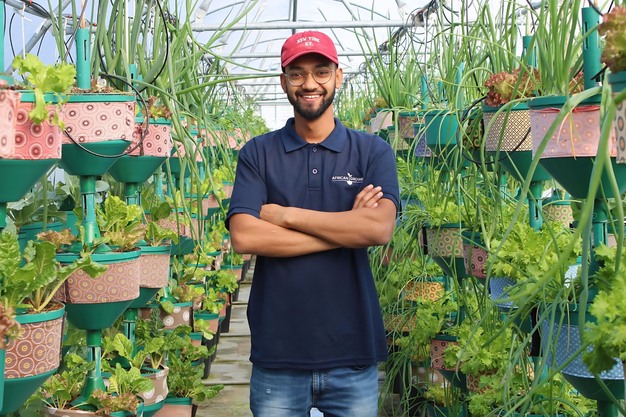 © HandPicked City Farm
A farm designed for learning, not yield
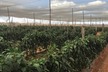
Today, the site consists of six tunnels: two measuring 20 meters by 3 meters, and four smaller tunnels measuring 6 meters by 3 meters, one of which is used as an office. Across the farm, 340 vertical towers are in use when the system is fully running, although exact numbers vary as tunnels are rotated, replanted, or taken offline for learning and maintenance.
But the numbers are not the point. "People often think a farm is just about growing," Sydow says. "What takes time is everything around it. Planning, harvesting properly, packing, coordinating orders, fixing pumps, checking water levels. That's the part people don't see."
Since its inception, the project has donated hundreds of kilograms of produce and growing systems to partner organizations and community initiatives. This reinforces its role as a training and support platform rather than a closed commercial unit, and reflects a broader emphasis on skills transfer rather than maximizing output per square meter.
The growing system and operational logic used at the site align with those deployed by Fresh Life Produce, which operates multiple low-energy hydroponic farms across Cape Town and surrounding areas. The rooftop farm functions as a pilot and training site within that network, where systems are tested in a constrained environment before being replicated elsewhere.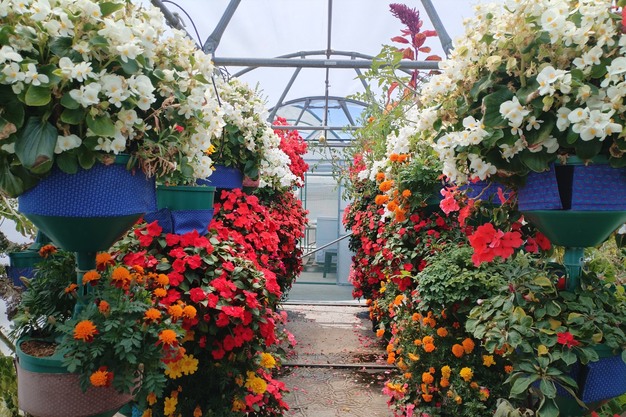 © HandPicked City Farm
The system and why simplicity matters
The African Grower system used at HandPicked is a low-input, hybrid hydroponic design that uses cocopeat as a growing medium and relies on gravity-fed watering rather than continuous pumping or fully recirculated systems. The design prioritizes simplicity, durability, and ease of use over automation or data-heavy control.
That simplicity is deliberate. The system requires minimal electricity, minimal technical calibration, and relatively short onboarding time, making it suitable for training participants with no prior farming experience. "You can't start people off with something overly complicated," Sydow says. "They need to understand the basics first, how plants respond, how water moves, how nutrients behave."
Water use reflects that philosophy. In summer, the system typically uses around two liters of water per tower per day, and closer to one liter in winter, with residual water feeding planter boxes below rather than being fully recirculated. The goal is not absolute efficiency on paper, but a system that is observable, teachable, and forgiving enough for learning environments.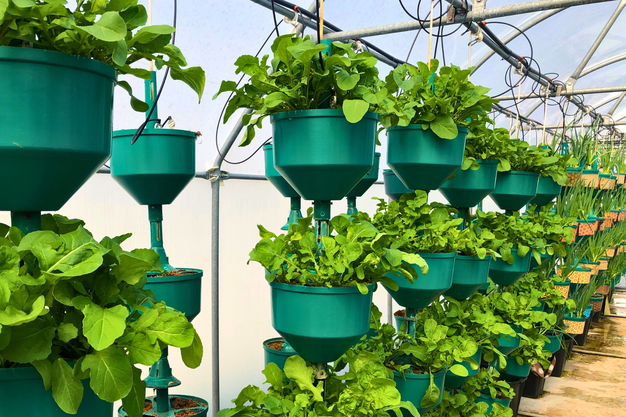 © HandPicked City Farm
What interns can and cannot learn
The internship structure is tiered. Two-month interns are introduced to the fundamentals of planting, basic hydroponic principles, feeding, harvesting, and seedling propagation. Six-month interns go further, spending more time on system management, crop planning, and operational decision-making. The two-year programme allows for deeper immersion across seasons and crop cycles. "In two months, you can teach the basics of farming," Sydow says. "What you can't really teach in that time is the administrative side. Planning cycles, managing inputs, and coordinating customers. That takes longer exposure."
Interns are evaluated continuously through weekly topics, attendance tracking, photo documentation, and progress updates shared with programme coordinators. There is also an exit evaluation at the end of each internship phase. "Everything is documented weekly," Sydow explains. "That way there's accountability, and we can actually see what people are learning, not just assume."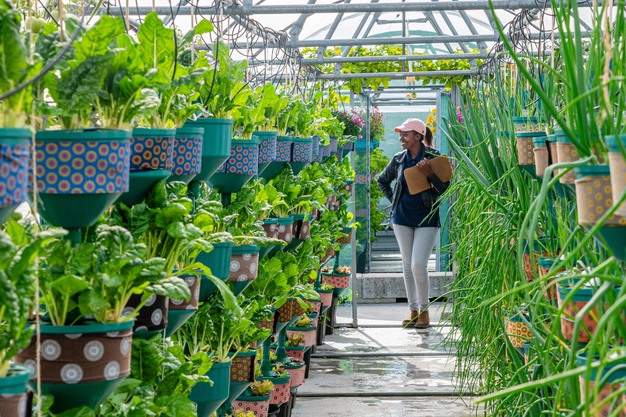 © HandPicked City Farm
Learning through mistakes
Mistakes are not hidden at HandPicked, but treated as part of the curriculum. Sydow recalls one early error during his own internship that became a defining lesson for future trainees. During extreme heat inside the tunnel, he mixed a nutrient spray at the wrong concentration and applied it at midday. "It was around 37 to 38 degrees inside the tunnel," he says. "That was probably the most expensive mistake I made. It damaged a lot of plants."
Rather than burying the incident, it became a reference point. The lesson is now passed on to new interns, not as a warning against experimentation, but as an example of how timing, dosage, and environmental conditions interact. Trial-and-error is expected, but learning is cumulative, and large, avoidable mistakes are actively discussed.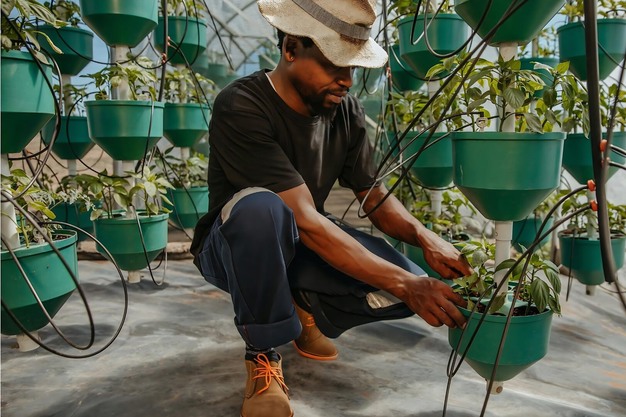 © HandPicked City Farm
Motivation, constraints, and reality
Asked what makes or breaks an initiative like this, Sydow is direct. "The main thing is having people who actually want to farm," he says. Participants receive an African Grower system at the end of their internship to support independent production, and while this created opportunities for some, it also exposed a key limitation of incentive-led models.
"We've had people who were here mainly for the incentives," he says. "Once the internship ended and they received a system, some of them never continued growing." The experience reinforced that access to equipment alone does not guarantee long-term engagement or success, making motivation and follow-through as critical as technical skill.
That lack of commitment, he says, is one of the main reasons similar projects fail. Without sustained motivation, even simple systems become neglected, and learning stops. Utility costs are another major factor. This site benefits from subsidized water and low electricity consumption, supported by solar panels installed on the mall's roof, used primarily to run pumps. "Water, electricity, inputs, staffing. Those costs add up fast," Sydow says. "We're fortunate to have this support. In other places, that's where things become very difficult."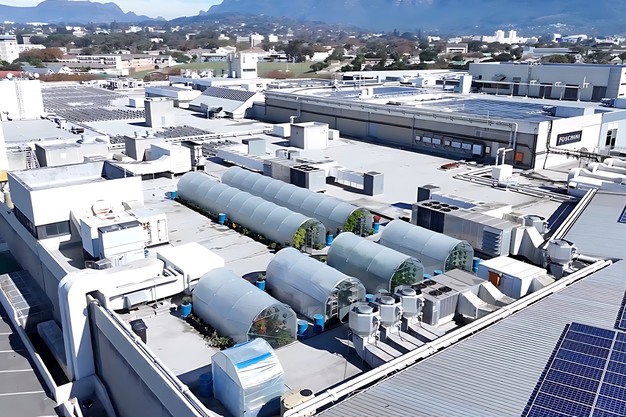 © HandPicked City Farm
A blueprint, not a finished model
HandPicked City Farm was the first site of its kind within this network, and several other farms have since been developed using it as a reference point. "This is the blueprint," Sydow says. "Everything we do here informs what happens at the other sites."
Three years in, the operation is still evolving. Systems remain deliberately simple. Observation, repetition, and seasonal experience drive decisions. Judged purely on commercial output, the farm would miss its own point, but its primary metric is not yield per square meter, but the number of capable growers it sends into the system. "This is a site for learning," Sydow says. "We're not pretending we have all the answers. We're building them, season by season."
For more information:  © HandPicked City Farm
HandPicked City Farm
Zubayr Sydow, Operations Manager
[email protected]
www.freshlifeproduce.com