A second move in less than four years. It may seem fast, but for Cesar Van der Spurt, everything has gathered momentum in recent years. In a short period, an idea developed into his own microgreens cultivation company, progressing from a sea container to a 6,000 m² greenhouse. "Then things appear to go smoothly, but those years also brought plenty of challenges," the 24-year-old entrepreneur from Flanders laughs.
 © Micro's
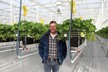
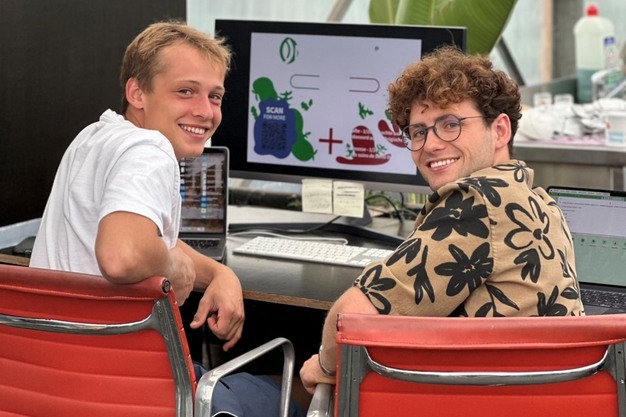
Cesar Van der Spurt and co-founder Yuval Depicker
It was in 2022 when an idea that had been simmering in Cesar's mind for some time began to feel increasingly appealing: starting his own cultivation company. Unlike many in the sector who learn the trade through family or close networks, he had to figure everything out on his own. "I have no background in horticulture, and nobody in my family was involved either," Cesar says. "So I had to work everything out myself, from machine development to cultivation and distribution. At the time, I did not even know exactly what I wanted to do, so I started researching. During that process, I quickly came across microgreens. They turned out to be a relatively low-threshold way to start something from scratch."
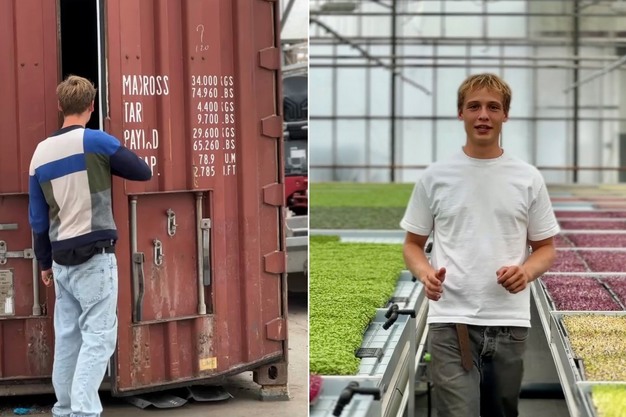
And that was how it began. "I decided to order a 40ft sea container and build a small vertical farm inside it. Before I realised it, the container was already on its way, even though I had never grown anything before. It was quite impulsive, but I was determined. Once it arrived, we insulated everything, laid a new floor, and installed electricity. The container was placed on a piece of land next to my house. For about a year, we worked there and mainly supplied restaurants in the surrounding area."
 © Micro's
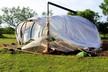
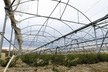
The sea container on the left and the first rented greenhouse on the right
From a sea container to a modern greenhouse
Until several challenges eventually forced the young entrepreneur to look for a new location. "We realised that microgreens are a niche product, and you cannot operate profitably at such a small scale. You cannot drive across Belgium for very small orders. The scale was simply too limited," Cesar explains. "On top of that, Stedenbouw suddenly showed up one day to inform us that the container was actually not allowed there. That was the moment we decided to take things more seriously. In the end, we found an available greenhouse. Naturally, it had to offer the option of heating, otherwise year-round production would be impossible."
"We found a site of 1,800 m², divided into three blocks of 600 m²," he continues. "From the beginning, it was clear that we needed to work with roll containers. That, therefore, became our first major investment. A roll-container system, combined with the development of the workspace. In total, we invested around EUR 150,000 and operated there for about 2.5 years. However, that location was always intended to be temporary. There was no concrete floor, and with intensive use, everything wore out quickly."
 © Micro's
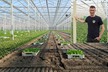
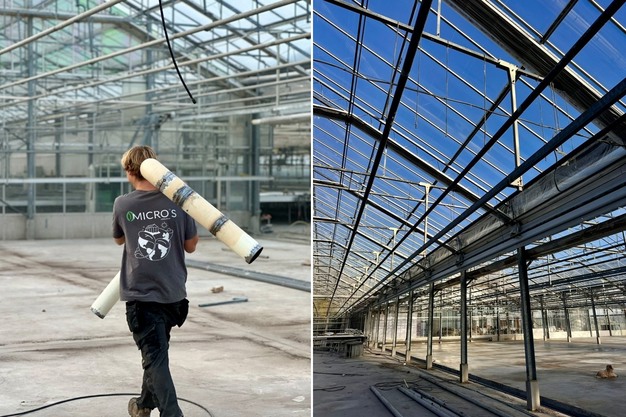
Work on the new greenhouse, soon to be occupied
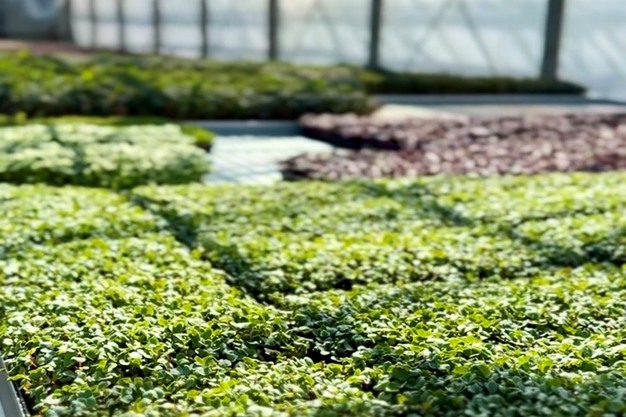
Since early 2025, they have therefore been actively searching for a new, future-proof location. "In horticulture, buying is really the only viable option, because you require so much fixed infrastructure. Even though it was financially challenging to put everything together, we eventually managed to purchase the site. The result is a greenhouse of around 6,000 m². We deliberately opted for a larger greenhouse, as smaller ones are often outdated and do not meet our requirements, such as proper insulation and a solid floor."
"Even before the purchase, we were already working on construction plans and material lists. We are now applying everything we have learned over the past few years to make the new infrastructure as efficient as possible, with as much automation as our budget allows. This year, we are expanding cultivation with additional roll containers, and with the space gained, we have sufficient room to continue growing in the future."
 © Micro's
Creating its own market
And so Micro's will soon move into its new premises, securing its future. Even so, the work is far from finished. "What sets us apart from other horticultural companies is that we have to create our own market. Microgreens do not fit into the auction system, which focuses on large volumes for supermarkets. That means we are not only a production company, but also a distribution company. You have to build your own relationships and find people willing to sell your product. That creates a lot of extra work, but we have now reached a point where we supply several catering wholesalers throughout Belgium and part of the Netherlands with the quality of our microgreens."
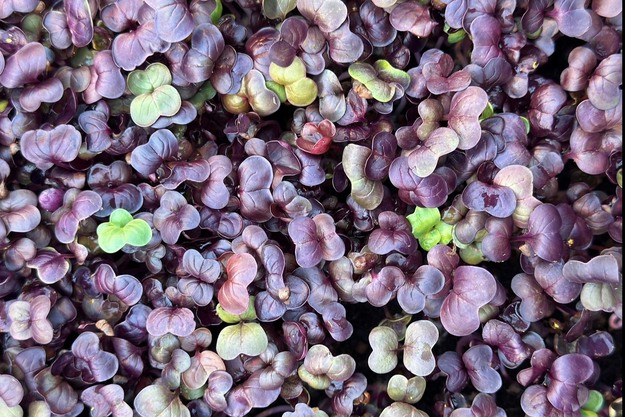
He no longer delivers directly to restaurants. "That is not logistically feasible for such a niche product. Wholesalers can deliver frequently and offer a platform where chefs can discover our products. We deliberately choose cultivation in potting soil rather than growing in water. In our view, potting soil results in better flavour and texture. We have invested a lot of time in developing our own potting-soil composition. It is relatively inexpensive and contains all the nutrients required for both short and slightly longer crops. In addition, we are working towards a circular system in which we can partially reuse the potting soil."
 © Micro's
Flowpack and pick&mix
Looking ahead, Cesar still sees strong potential for microgreens. "We continue to consciously specialise in microgreens, with the ambition to be the best at it. Going forward, we want to scale up further in Belgium and the Netherlands. However, the market for microgreens is not huge, so if you want to grow beyond that, you also have to look abroad. The main challenges there are logistics and finding reliable distribution partners, but we are optimistic about building the right relationships."
There are also several innovations planned for 2026. "One of them is packaging microgreens in a flowpack. That significantly reduces packaging costs and extends shelf life by around 25%. We are also building an automated drying room. Roughly a quarter of the harvesting process consists of drying, and we want to make that step more efficient."
"We are also exploring a pick&mix concept, where microgreens are packed by variety. Chefs can then assemble their own mixes. This makes the product more accessible and less exclusive, while allowing us to maintain our margins. In this way, microgreens can become a fully fledged alternative to traditional leafy vegetables. I am very positive about the future. It is a lot of work and sometimes exhausting, but we are close to where we want to be, and that motivates me immensely."
For more information:
Cesar Van der Spurt
Micro's
+32 499155536
[email protected]
www.micros-unilight.com