A new crop marks a new beginning. The foundation for a successful season starts with building a strong and healthy root system. When young plants are placed on the substrate, this is the moment to invest in roots that will support your crop for months to come. If the root system is not properly established early on, growing a uniform and productive crop later becomes much more challenging.
Why roots matter
Roots are more than just anchors. They secure the plant in the substrate, preventing instability and shifting. But their role goes far beyond that: roots absorb water and minerals essential for growth. They also produce hormones and excrete carbohydrates to feed the rhizobiome, creating a symbiotic environment that supports plant health and resilience.
Without a strong root system, plants struggle to take up water and nutrients efficiently, leading to uneven growth and reduced yield and quality. A well-developed root system ensures uniformity, stability, and optimal control throughout the season.
Why focus on roots at the start?
Early in the season, plants have little to no fruit load. This means assimilates—the sugars produced by photosynthesis—are directed primarily to root growth rather than stems and fruits. Once fruit development begins, assimilates are diverted away from roots, limiting further root expansion. In fact, during production, only about 15% of assimilates go to the roots. That's why the start of the season is the best time to build a robust root system.
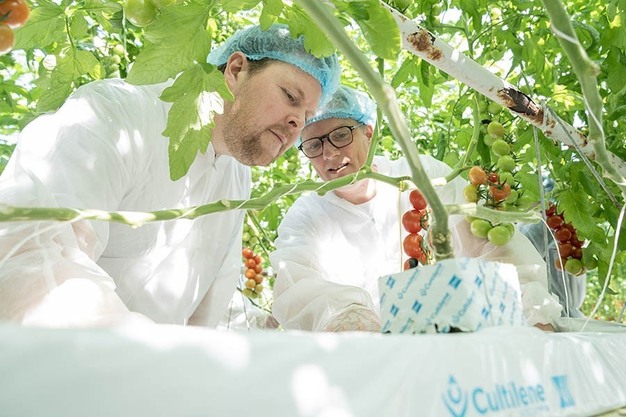 © Saint-Gobain Cultilene
What does a good root system look like?
An ideal root system is evenly distributed throughout the entire substrate—from top to bottom, left to right. This minimizes competition and optimizes growing conditions. Healthy roots are white-ish, highly branched, and full of growing tips, which are crucial for nutrient uptake. Root hairs and microbiological life around the roots further enhance absorption and protect against diseases.
How to create strong roots
Building a strong root system takes planning and steady control over time. It starts with a fully saturated substrate so young roots immediately have access to water and oxygen. After planting, short initial irrigation shots help roots penetrate the substrate instead of sitting near the surface.
Once roots are established, begin a controlled dry-back. Reduce water content gradually, around 1.5 percent per day. This slow reduction encourages roots to grow horizontally and explore the full volume of the substrate. A typical approach might be to start at about 85 percent water content, slowly reduce it to 60 percent, and hold there as long as possible. When fruits begin to swell, water content can be increased carefully to around 65 to 70 percent.
Avoid rapid changes in either direction. Drying the substrate too quickly forces roots downward, which limits distribution. Increasing water content too fast can also stress the roots and disrupt their development. Once the target water content is reached and stabilized, the root zone is set up for consistent control through the rest of the season.
The benefits
A well-managed root strategy leads to better root distribution throughout the substrate. This reduces competition for water, nutrients, and oxygen, allowing the plant to function more efficiently. Even root spread also improves uniformity, ensuring consistent access to resources across the entire root zone.
With a uniform substrate, growers gain greater control over key parameters such as water content, EC, and dry-back. This stability results in more resilient crops, supporting balanced vegetative growth, improved fruit quality, and ultimately higher yields.
Plan ahead and monitor closely
By investing in root development early, you set the stage for a balanced plant, uniform growth, and optimal control throughout the season. Use data and measurements to track water content and EC, and adjust your strategy based on real-time insights. This proactive approach ensures your crop has the best possible start.
For more information:
Saint-Gobain Cultilene
Email: [email protected]
cultilene.com