The crop protection company Globachem (Sint-Truiden, Belgium) has signed a licence agreement with UHasselt to further examine two bacterial strains for their potential against fungal diseases. This marks the first time that bacteria originating from UHasselt's plant research are being used by a company with an aim to developing a new agricultural product. "This is a very valuable recognition of our many years of research into plant–bacteria interactions, especially if it can lead to a new biological product that helps protect crops in a sustainable way," say Dr Sofie Thijs and Prof Dr Jaco Vangronsveld.
Since 2017, UHasselt and Globachem have been collaborating on research into new types of crop protection. Through research licences, Globachem has already tested more than one hundred bacterial strains from UHasselt's extensive collection. Two bacteria are now included in a commercial licence to be further evaluated—following successful greenhouse trials—through field studies for their potential to protect crops. This represents an important step towards the development of a new biological plant protection product that can be applied in agriculture.
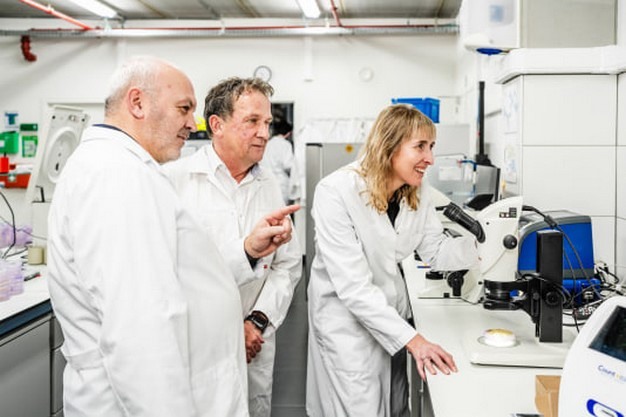
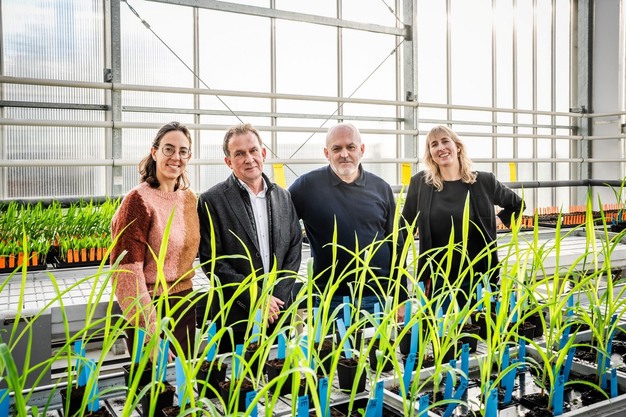 © UHasseltDr. Sofie Thijs, prof. dr. Jaco Vangronsveld, Francis Claes, Liesbeth Vogels
A database of 3,000 bacteria
Over the past decades, UHasselt has built up strong expertise in research into interactions between bacteria and plants, with a particular focus on increasing plant resilience and on their capacity to degrade polluting substances in soil and groundwater. To date, UHasselt biologists have identified more than 3,000 individual bacterial strains, originating from soil samples and from plant roots, seeds, leaves and fruits of various crop species and locations worldwide.
"In a single teaspoon of soil, there can be millions of bacteria, all living together with plants in a complex system," says Dr. Sofie Thijs. "The challenge is to identify those bacteria that make plants stronger—the so-called beneficial bacteria or plant probiotics. They support plants to cope better with stress factors such as pollution, diseases or difficult growing conditions like drought or excess water, heat or cold, and nutrient stress. Our understanding of the underlying mechanisms has formed the foundation of our research for many years."
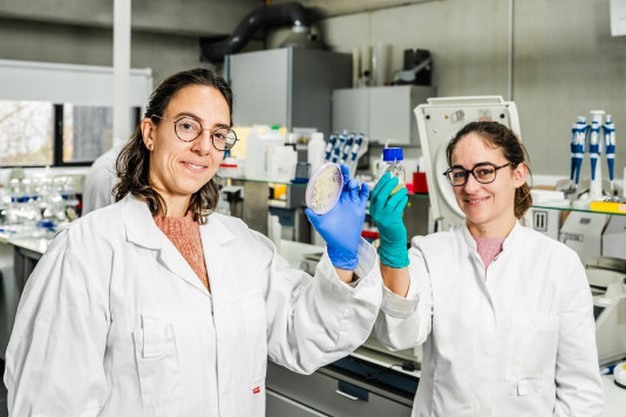 © UHasseltDr. Sofie Thijs & Elke Vanden Eynden
Broad applicability
The two bacteria included in the commercial licence were selected by Globachem based on their potential to increase plant resilience against harmful fungi. The bacteria not only strengthen the plant itself, but may also help suppress plant diseases by directly targeting harmful bacteria or fungi that come into contact with plants.
One bacterium was isolated from a soil sample in Belgium, the other in Poland, in collaboration with Dr. hab. Ewa Olenska from the University of Białystok. The fact that
both bacteria originate from different contexts and show promising results points to broad applicability. Further development will still require several years of applied research, including formulation, mode of application and validation. "If these results are confirmed, this could lead to new products that contribute to sustainable agriculture and to more resilient cropping systems in the face of changing climate conditions. This collaboration with Hasselt University therefore underlines our ambition to translate science and innovation into sustainable solutions for growers," says Francis Claes of Globachem.
 © UHasselt
Real applications
"With this commercial licence, we now see how our fundamental research can grow into real applications with social and economic relevance. It is particularly motivating to see that the knowledge we have built up over many years within our fundamental research not only results in scientific publications, but can also evolve into tangible applications and be taken up by a company that wants to work with it," says Prof. Dr. Jaco Vangronsveld.
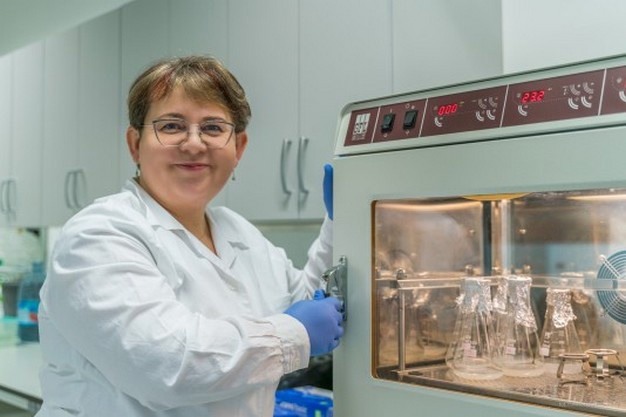 © UHasseltProf. Dr. Ewa Olenska - Universiteit Białystok
The Polish research partner shares this sense of satisfaction. "The scientific partnership between UHasselt and the University of Białystok in Poland brought us a better understanding about plant-microbe interactions that now will be innovatively transferred by Globachem to potential users. In my opinion, it is extremely important for scientists to contribute to the creation of a product that will serve the good of society" says Dr. hab. Ewa Olenska.