From May 12 to 17, 2024, Butuan City's heat index reached dangerous levels ranging from 42 to 47 degrees Celsius, data from the Philippine Atmospheric, Geophysical and Astronomical Services Administration (PAGASA) show.
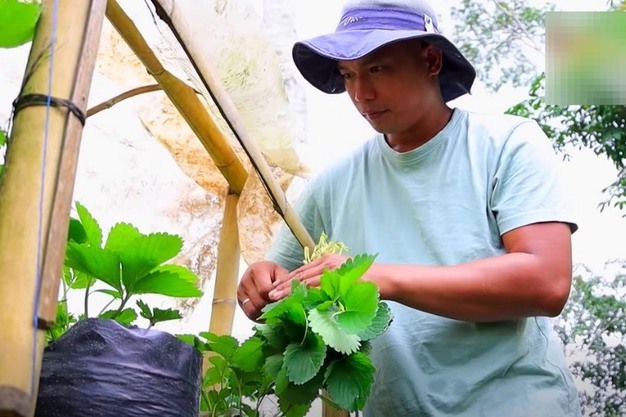
Versandear Abuzo, a resident of Barangay Anticala, a far-flung barangay in Butuan City, and a former shopping mall employee in Cagayan de Oro City, took the challenge of contributing to food security. Inspired by a book, he started planting strawberries. He did so at a time when most farmers in the community believed the effort was futile.
"I love farming. That is why I chose to cultivate strawberries because I noticed that farm products in the market are the common ones, which are in oversupply. I wanted something different but with high market demand," Abuzo said.
He started in 2022 with the help of the "Young Farmers Challenge" of the Department of Agriculture (DA)—a financial grant program that supports and empowers Filipino youth aged 18 to 30 to start or expand profitable agri-fishery businesses. The program provides capital, mentorship, and market access to promote youth involvement in agriculture and food security.
Taking advantage of their location, which is relatively cooler compared to other barangays. Initially, Abuzo planted celery and lettuce before venturing into strawberry farming, a high-demand commodity in the city where strawberries do not usually grow. He started with a capital of P50 per strawberry runner.
Abuzo shared that the strawberry variety he planted was the ever-bearing type, which produces fruit daily after about 45 days from planting. The strawberry runners are sold at P50 for pick-up and P95 for delivery, while the fruits are sold at P800 per kilo. Monthly, Abuzo earns between P15,000 and P30,000, depending on the volume of orders.
Also, today he produces other strawberry products such as juice, 'piyaya' or a spread-filled unleavened flatbread, and jams, further increasing their income.
 © Philippine Information Agency
However, like other farmers, strawberry farming is not easy and comes with several challenges. Unlike planting common vegetables such as beans and eggplant, where farmers can easily consult neighboring growers for their best practices, strawberry farming requires specialized knowledge. According to Abuzo, whenever his strawberries experience plant disease, he can only rely on his own knowledge and on the internet, discovering various means to solve it.
"You need to always monitor the growth of your strawberries, especially since they are vulnerable to plant diseases," added Abuzo. "When I started, many people did not believe in my work, especially since strawberries are commonly believed to grow only in cold areas, and Butuan is far from cold. However, the Department of Agriculture supported my idea not only through financial assistance but also through various training from financial management to product labeling. The Butuan City Agriculture and Veterinary Department (CAVD) has also extended strong support through farm inputs."
Abuzo's story highlights the growing impact of the Department of Agriculture's Young Farmers Challenge in nurturing innovative agri-entrepreneurs in the region. Through sustained support, training, and access to resources, the program continues to open opportunities for young Caraganons to transform agriculture into a viable and profitable livelihood.
Source: Philippine Information Agency