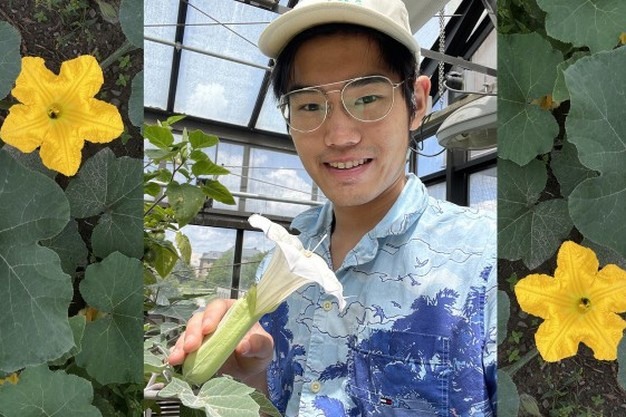
Jonathan Chai '24 worked for two years as an undergraduate research assistant in the lab of Robert Raguso, professor of neurobiology and behavior. Raguso's lab made the first discovery that insects are attracted to plants as much by humidity as by scent. Chai participated in research expanding on this work, exploring whether squash floral humidity plays a role in pollen viability and behavior of squash pollinators and floral predators.
How did you come to Cornell, and to this research?
Growing up in Georgia and California, I loved gardening in the backyard, and I built up a collection of plants, mostly carnivorous plants and orchids. So when I applied for college, I knew plant sciences is what I wanted to do. I spent a semester in the Liberty Hyde Bailey Herbarium and in the lab of Kevin Nixon [professor of plant biology in the School of Integrative Plant Science]. I then worked in the Liberty Hyde Bailey Conservatory doing a variety of things – repotting orchids, hosting tours and updating signage. One of my favorite jobs in the conservatory was pollinating the vanilla plants for an exhibit on vanilla bean production. Pollination biology is something I was always interested in. That's what prompted me to reach out to Rob in the summer before my junior year. I worked in his lab from 2022-24.
 © Cornell University
You were a co-author on recent research with Rob Raguso and several other scientists, which found that floral humidity influences insect behavior and pollen viability. Where did the idea for that work come from?
The idea for this study was spurred by previous research out of the Raguso lab, which looked at how floral humidity may act as a close-range signal to attract hawk moth pollinators in datura flowers, which open and are pollinated at night. This project is focused on diurnal, day-blooming squash flowers. Squash blossoms and datura flowers have a similar shape with a large funnel-like opening, and both have elevated floral humidity levels. We then did some preliminary studies, which showed similar patterns and humidity levels in squash compared to the datura flowers: our readings showed that humidity inside the flower is highest at the base of the flower, and is reduced at the opening of the flower. So the two main questions we were trying to investigate were: whether floral humidity also plays a role in helping to maintain the viability of pollen grains; and whether this humidity gradient acts as a signal for pollinators or a cue for antagonists of squash.
How does humidity impact pollen?
Squash pollen is super sensitive to dehydration, more so than many other plants. So we were looking at whether this environment within the flower helps to maintain the viability of these very sensitive pollen grains. We did experiments in the Corson-Mudd greenhouse on campus with 20-30 squash plants, and we had three floral treatments. One set of plants we left intact. Another, we applied petroleum jelly on the inside of the flower to block the stomata [the tiny pores through which plants take in carbon dioxide and let out oxygen and water vapor – which increases floral humidity]. The third, we removed the flower petals, exposing the pollen grains to air. And then we collected pollen from the respective treatments to see how well they germinated. Significantly less of the pollen remained viable and germinated in the treatment where we removed the petals. This provided key evidence that floral humidity aids the viability of the highly sensitive pollen grains in squash blossoms.
How does humidity influence insect behavior?
Squash are pollinated by a specialist squash bee and by generalist pollinators like honeybees and bumblebees. Squash are also preyed upon by cucurbit beetles. To examine how changes in humidity might impact insect behavior, we punched holes of a little less than an inch in diameter in the petals of some plants, which caused leakage of floral humidity. And then we looked at visitation rates of pollinators and compared those to other, intact plants. We did this work at the Homer C. Thompson Vegetable Research Farm. It was during the summer, and I sat there and watched and counted visits by insects. Sometimes there are 20-30 insects within the flower at a time, so you have to count really fast.
How might this basic research be applied?
This study, together with the previous study on datura, shows it is important to keep an open mind as to what could be considered a biological signal. Something as simple as controlling the concentration of water vapor inside flowers could provide important information for potential pollinators and is ecologically significant in terms of the reproductive success of these plants. This is especially true with squash, which is agriculturally significant. Plant breeders might also consider this information, and potentially select for varieties with a larger, funnel- shaped flower or higher humidity.
Source: Cornell University