One of the most persistent questions in horticulture is simple, yet difficult to answer: how to know whether a plant is truly healthy. Visual observations help. Uniform leaf color, steady growth, strong stems and balanced development all provide useful clues, but they do not always tell the full story. Long before visible symptoms appear, the internal balance of a plant may already be shifting. That is where Brix becomes relevant.
What is Brix?
Brix is a measure of total dissolved solids in plant sap. These dissolved solids include sugars, minerals, amino acids, proteins and plant secondary metabolites. In simple terms, Brix offers insight into the internal nutritional and energetic status of the plant. Higher Brix values generally indicate stronger cell structures, better metabolic balance and greater resilience against pests and diseases.
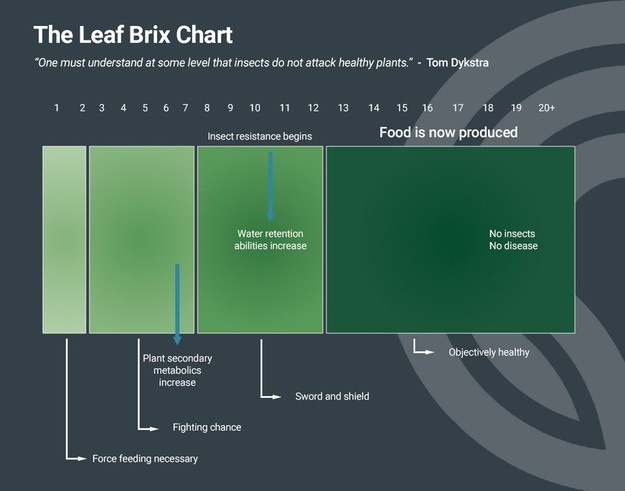
The Leaf Brix Chart
The Leaf Brix Chart, developed by Dr. Thomas Dykstra, links Brix levels to plant performance. The chart illustrates how increasing Brix values correlate with improved resistance, reduced pest pressure and better overall plant function. It also supports a key insight often shared in plant health discussions: "Insects do not attack healthy plants." At the same time, the chart raises important practical questions about how Brix should be interpreted and applied in real growing systems.
 © Plant Empowerment
Why Brix is not a simple number
Growers quickly discover that Brix is not a universal target. Optimal Brix levels differ between crops, and growth stage plays a significant role. Climate, light and nutrition all influence Brix, while microbial activity in the root zone is also crucial. For these reasons, Brix should never be used as a standalone KPI. A high number without context can be just as misleading as a low number without understanding the cause. What makes Brix valuable is not the number itself, but the trend over time and the story behind it.
From measurement to understanding
Brix measurements help growers move from reacting to visible symptoms toward understanding underlying plant processes. They encourage better questions about what is happening inside the system. Is photosynthesis limiting performance? Is nutrient uptake restricted by transpiration or root activity? Is the plant sufficiently feeding its microbial partners? Answering these questions requires more than a chart; it requires a system-level view of plant health.
Making plant health practical
At Plant Empowerment, Brix is viewed as one of several tools used to better understand plant health. For that reason, Brix is embedded within the broader framework of the Plant Health Circle, where climate, nutrition, root zone conditions, pest pressure and plant physiology are always considered together rather than in isolation.
For more information:
Plant Empowerment 
Email: [email protected]
plantempowerment.com/