A new study has examined the complex genetic control of stem diameter, a trait that plays a key role in plant vigour and crop yield, in tomato (Solanum lycopersicum L.).
Recently published in the scientific journal Scientia Horticulturae, the research focuses on stem genetics, the plant's main structural and transport organ. Using an interspecific population of recombinant inbred lines (RILs) and introgression lines (ILs) derived from a cross between the cultivated tomato 'Moneymaker' and its thin stemmed wild ancestor Solanum pimpinellifolium acc. 'TO 937', the researchers successfully mapped twelve quantitative trait loci (QTL) associated with stem diameter at different developmental stages and stem heights.
The study identified multiple loci influencing stem thickness and secondary growth. Key QTL were validated in both single and double introgression lines, showing that combining positive or negative alleles from the wild ancestor leads to significant additive effects, either increasing or reducing stem diameter.
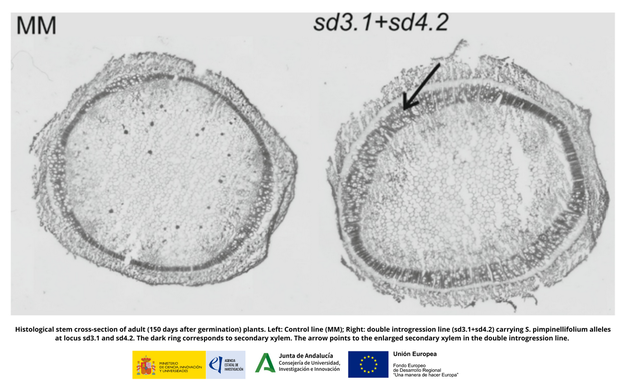
Histological analyses further revealed that specific QTL, including sd3.1, sd4.1 and sd11.1, regulate distinct internal stem structures involved in secondary growth, such as pith size, cortex area and secondary xylem development.
Led by Urrutia and Fernández Muñoz from the IHSM La Mayora institute (UMA CSIC), the research confirms that tomato stem architecture is governed by a polygenic system involving multiple loci. The findings provide a valuable foundation for future breeding programmes aimed at improving plant vigour and productivity.
 © IHSM
Source: ihsm.uma-csic.es