Sklarczyk Seed Farm (SSF), a third-generation operation based in Johannesburg, Michigan, has transitioned from traditional field potato production to a highly specialized greenhouse-based seed potato system serving international markets. Led by Ben and Alison Sklarczyk, the farm's evolution reflects long-term customer demand, increasing biosecurity requirements, and the technical advantages of controlled-environment agriculture.
Founded in 1942 by Michael and Theresa Sklarczyk, the farm initially produced potatoes and grain crops alongside livestock. Seed potato production became central to the business after early demand for planting stock highlighted the quality of its potatoes. Today, SSF produces more than 10 million Generation 0 minitubers annually, primarily through hydroponic greenhouse systems.
Moving everything to the greenhouse
SSF's expansion strategy has prioritized greenhouse operations over field potato production. "Our customers were requesting us to go in this direction and for us to put our management focus on the greenhouse operation," Ben shares. Concentrating production indoors also strengthened biosecurity. "There are a lot of operations that depend on SSF to produce a high-quality seed potato year after year."
While field potato production has ceased, SSF continues to farm approximately 1,110 acres of corn, wheat, soybeans, and oats. These row crops support broader farm management and monitoring efforts related to pest and disease pressure around the greenhouse facility.
Greenhouse design and environmental control
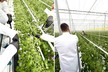
Over the past 15 years, SSF has expanded from 30,000 square feet of greenhouse space to a multi-structure operation that includes three poly-top houses and five bay gutter-connected glasshouses. Experience with both structures led the operation to standardize on glass.
"After seeing the benefits of being able to control the environment of a glasshouse range easier than a poly hoop house, we have exclusively built GGS glass top ranges." Ben noted that the single-piece glass construction improves condensation control and helps keep the crop canopy drier, an important factor in hydroponic potato production. Northern Michigan snowfall also influenced the move away from polycarbonate roofing.
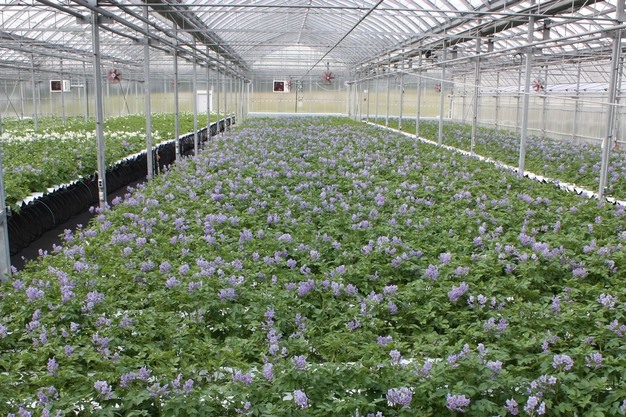 © Sklarczyk Seed Farm
Expansion during the pandemic
SSF's most recent greenhouse expansion began in fall 2019 and concluded in spring 2020. Construction occurred during the early stages of the COVID-19 pandemic, requiring operational adjustments. "I had the vision once everything started to shut down to bring in any and all supplies we might need to finish the construction," Ben says.
The farm divided staff into smaller teams to reduce exposure risks and relied on an experienced local construction crew familiar with SSF's specifications. The project proceeded without major delays.
The expansion, supported by MDARD's Food and Agriculture Investment Program and Rural Development Fund grants, added approximately 20,000 square feet of greenhouse space. This allowed SSF to increase output, expand varietal offerings, and better meet the requirements of export customers.
Hydroponics, variety management, and labor
SSF currently produces 5.5 to 6 million minitubers hydroponically each year, with total annual production exceeding 10 million. Hydroponics enables precise sizing and eliminates soil-borne disease risks. "Producing in hydroponics allows us to harvest a specific size tuber for each customer. It also eliminates any soil- or peat-borne disease."
The operation produces more than 100 potato varieties annually. Yield and quality improvements are driven by careful fertility and timing management. "With producing well over 100 different potato varieties each year, the fertility timing is key for long-term success." A dedicated lead grower maintains a growing production database to refine decision-making.
Labor remains the farm's largest cost. While some automation is used, Ben notes that full automation is limited due to the need for strict varietal separation and hands-on handling.
Sustainability and export growth
SSF has implemented sustainability measures for more than two decades, including energy-efficient motors, LED lighting, solar heat generation, geothermal cooling, and full water recycling. Excess irrigation water is captured in holding ponds and reused outdoors. Composting and recycling programs have significantly reduced waste over the past decade.
In 2019, SSF was named MDARD's Agriculture Exporter of the Year. Export sales have since grown from 24.6% of total revenue in 2016 to 60% in 2024, with shipments to markets across Europe, Asia, Africa, and the Americas. Despite this growth, Ben said the strategy remains unchanged. "We continue to focus on providing a very high-quality seed potato to our customers around the world."
All production is customer-driven, with minimal speculative growing due to the high cost of clean seed production. Looking ahead, he sees emerging technologies such as AI-based decision tools and incremental automation shaping the future of greenhouse seed production, while emphasizing measured growth and consistent quality as the foundation of international success.
For more information:
Sklarczyk Seed Farm
Ben Sklarczyk, CEO
[email protected]
www.ssfseedpotatoes.com