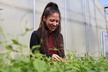
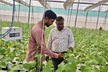
Winter greenhouse tomato production in northern climates requires precise control of light, climate and crop balance. At Häme University of Applied Sciences (HAMK) in Lepaa, the tomato season runs from August to early June, after which the greenhouse remains empty during summer while students complete internships and staff work outdoors. According to Eija Lankinen, Lecturer in Greenhouse and Vertical Farming cultivation, this break brings an unexpected benefit: "Because of the summer heat, almost all greenhouse pests are eliminated, so we rarely have pest or disease problems."
As a result, pest management relies primarily on biological control once production resumes. Autumn cultivation is typically stable, but challenges increase as winter approaches and natural light levels decline.
Light limitation and crop response in winter
The most critical constraints begin in early November. Despite hybrid lighting delivering a combined intensity of 480 µmol/m²/s from top and interlighting, light remains the main limiting factor for tomato growth. "That may sound like a lot, but it is essential for efficient winter cultivation in Finland," she explains.
Reduced light leads to a decrease in leaf area and affects pollination. Bumblebee activity becomes insufficient, requiring mechanical pollination to maintain fruit set. Even under these conditions, yield levels have remained reasonable. Loose tomatoes are grown at Lepaa, with the variety Encore currently dominant due to its flavor profile and fruit size, which align with Finnish consumer preferences.
This winter marks the third season of hybrid lighting at Lepaa. The transition to LED technology has required changes in cultivation practices, particularly higher electrical conductivity in the growing medium. Eija notes that energy savings have been substantial.
A change in substrate, driven by the discontinuation of previously used slabs, further emphasized the need for adaptability. The new growing medium required a revised irrigation strategy, reinforcing how closely linked lighting, substrate and fertigation decisions are in winter production systems.
 © HAMK
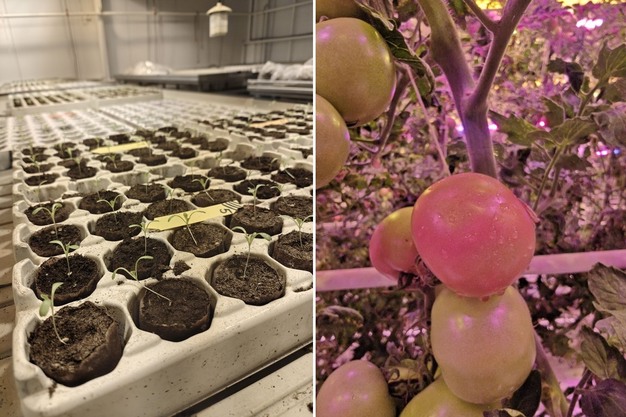
Condensation on tomatoes when humidity levels get too high inside greenhouse and it's too cold outside to open the vents
Climate control during extreme winter conditions
By February, increasing natural light begins to support bumblebee pollination again, but winter risks persist. Rapid increases in light can drive transpiration sharply upward, increasing the risk of tip burn and blossom-end rot. Cold periods pose additional challenges. "When outside temperatures drop to –24 °C and vents remain closed, humidity management becomes critical," Eija notes.
If leaf area is excessive under these conditions, transpiration can raise relative humidity to problematic levels. So far, crop quality has remained stable, supported by careful climate steering, screen management and high market prices.
According to her, successful winter cultivation depends on systematic monitoring combined with accurate data recording. "Observations alone are not enough. Without recorded data, it is impossible to compare seasons or identify cause-and-effect relationships."
At Lepaa, a Priva climate computer manages irrigation, fertilization and climate, while additional greenhouse data is collected using Aranet sensors. Cultivation observations are still recorded manually. Weekly measurements of stem thickness, growth rate, leaf area and fruit load are used to assess whether the crop is shifting in a vegetative or generative direction. These measurements guide adjustments in temperature, irrigation rhythm and substrate EC to maintain an optimal sink–source balance.
 © HAMK
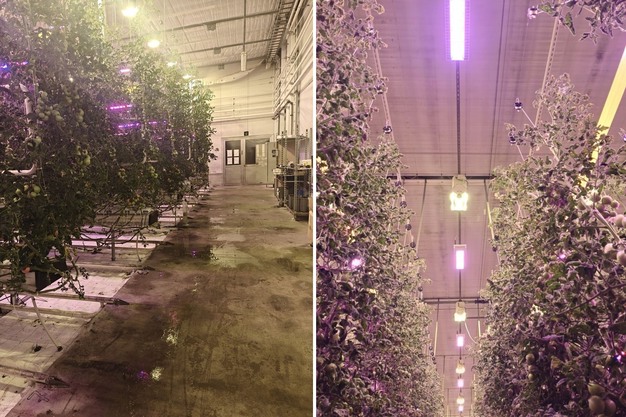
Some humidity problems after heavy rainfall
Humidity, pollination and energy screens
Humidity management plays a central role in winter tomato cultivation. "Humidity affects not only plant transpiration but also bumblebees and their pollination efficiency," Eija explains. Relative humidity should ideally remain below 80% for effective pollination. At Lepaa, humidity deficit is also monitored to assess photosynthesis efficiency.
Energy screens are used to reduce nighttime heat loss and limit condensation on plants. "Condensed water increases the risk of fungal diseases and can cause cracks in tomato fruits." Screens and lighting are adjusted gradually in the morning and evening to prevent temperature imbalances between the canopy and root zone.
Research projects and variety development
Several research initiatives are ongoing at Lepaa. A planned project aims to improve methods for monitoring pollination success. In collaboration with the Natural Resources Institute Finland (Luke), the Varttivalo project is evaluating crop responses to light using chlorophyll fluorescence measurements over a full growing season.
Additional trials focus on growing media and fertilization strategies for lettuce, as well as optimizing fertigation for strawberries and raspberries in an EU-funded project running until 2027. Tomato variety trials are also underway. "We are still looking for a variety that fits both our growing conditions and market requirements," she notes.
Practical advice for commercial growers
Drawing on recent seasons, she emphasizes gradual change. "If one growth factor changes, others will need adjustment too, but not all at once." She advises growers to make moderate, stepwise changes, supported by careful monitoring and data collection, to avoid unintended shifts in crop balance.
For more information:
Eija Lankinen, Lecturer in Greenhouse and Vertical Farming cultivation
Häme University of Applied Sciences
[email protected]
+358 50 5944114
Lepaantie 129,
14610 Lepaa
www.hamk.fi