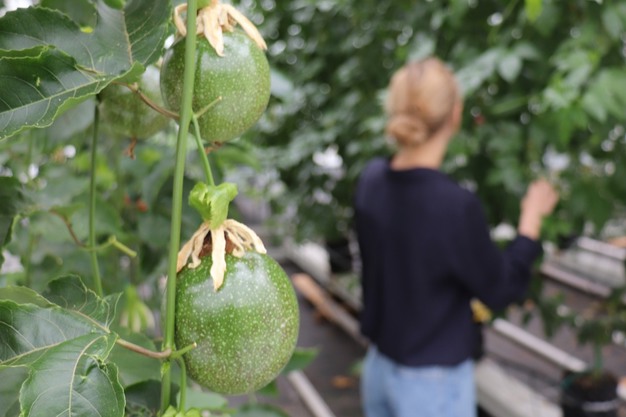
Earlier this year, Proefcentrum Hoogstraten began exploring whether passion fruit can be grown successfully in Belgium. The first fruits have already been harvested, and the early results are promising. "Our long-term goal is to follow a similar path to what we achieved with Charentais melons," says Nele Bruyndonckx of Proefcentrum Hoogstraten.
 © Proefcentrum Hoogstraten
Comparable to pepper and tomato
According to Nele, the choice of passion fruit fits naturally within the centre's ongoing research into new crops. "We have been working with Charentais melons for several years. From there, it made sense to look at other crops that might have potential in Flanders," she explains. "Passion fruit quickly stood out. It produces fruit relatively fast, and the cultivation techniques are similar to those of peppers and tomatoes, which we already studied extensively. The market also plays a role. Passion fruit is familiar to consumers, so it is not a completely new product, and that lowers the threshold."
Because the project only started in 2025, it is still in an early phase. "It is too soon to draw firm conclusions about its long-term potential," Nele says. "Right now, our focus is on identifying the most promising varieties. We are currently growing five different ones and evaluating them not only on yield, but also on vigour, flavour, and overall performance. Looking ahead to next year, we may replace some varieties, as it is already clear that a few are underperforming. By assessing each step carefully, we can gradually fine-tune the crop and determine what works best in practice."
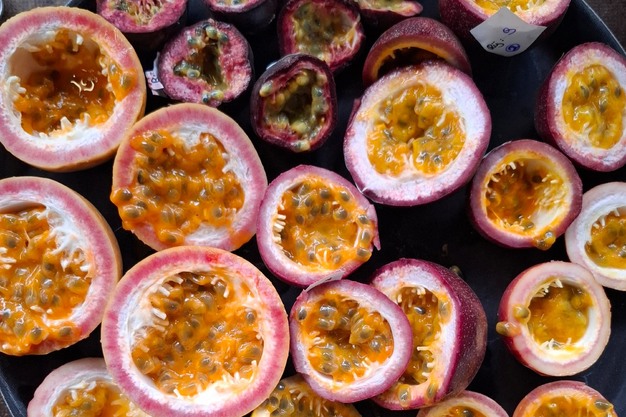 © Proefcentrum HoogstratenThe five different varieties
Five varieties
There is clear satisfaction with the first harvest. "The first fruits we picked looked particularly good and gave us confidence in the project," says Nele. "Among the five varieties, the differences are already very noticeable. One variety produces fruits that are close in size to what you usually find in stores. The other four, however, are much larger, with fruit weights of around 120 grams. By comparison, most store-bought passion fruits weigh between 50 and 60 grams. These are truly standout fruits."
According to the researcher, there is definite market interest in locally grown passion fruit. "We also see clear differences in colour," Nele explains. "Two varieties have a more reddish tone, while the others have the typical purple colour that most people associate with passion fruit. This variation makes the assortment visually attractive and offers opportunities for different market positions."
 © Proefcentrum Hoogstraten
Taste is another area where differentiation seems likely. "Here too, the differences are clear," she says. "One variety has a flavour that is very similar to the passion fruits currently available in shops. The other varieties are slightly more acidic, but at the same time have a fuller and more intense taste. That combination makes them come across as more flavourful than the standard product consumers are used to."
Building further
Are more fruit crops planned at the research centre following the success of the melons and the start of the passion fruit project? For now, the answer is no. "At the moment, our full focus is on further developing and refining the cultivation of passion fruit," she explains. "Other crops could certainly be considered in the future, but right now we are deliberately choosing to concentrate on this project and fully develop this path first."
 © Proefcentrum Hoogstraten
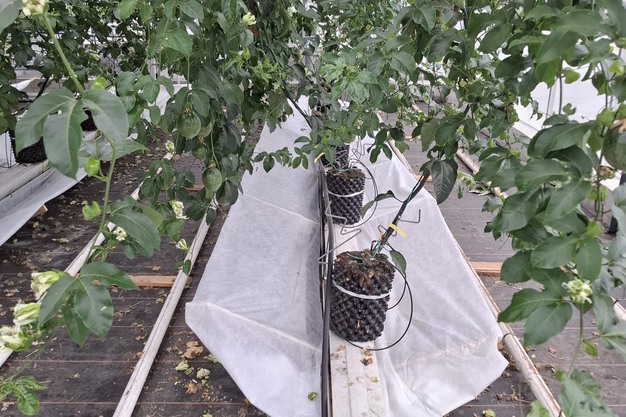
A support system had to be devised so that the fruits would not fall and break on the ground
 For more information:
Nele Bruyndonckx
Proefcentrum Hoogstraten
Voort 71,
2328 Meerle, Belgium
+32 (0) 3 315 70 52
[email protected]
www.proefcentrum.be