As we enter the height of Florida's strawberry production season, many consumers crave the taste and aroma of the fruit. That's part of what compels Mark Porter to try to enhance those qualities.
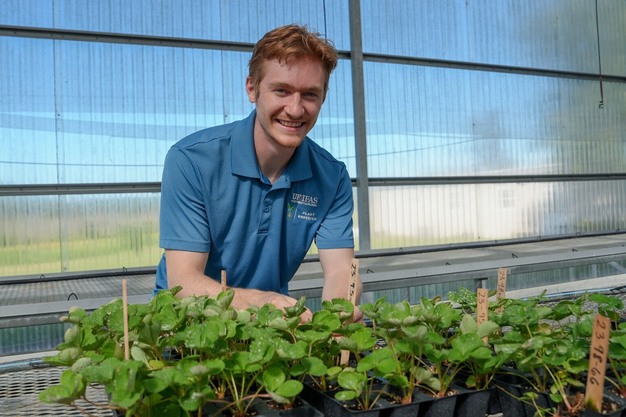
For his doctoral dissertation, Porter led novel research in which he and his faculty advisors found groups of genes that will enable them to develop the tastiest strawberries.
"The faster we – and other breeders – can find the right genes, the quicker we can get sumptuous strawberries to consumers," said Porter, who was in the first cohort of plant breeding Ph.D. students at the University of Florida College of Agricultural and Life Sciences. Porter graduated last week.
To do that, Porter and his fellow researchers went into the fields of the Gulf Coast Research and Education Center (GCREC), part of the UF Institute of Food and Agricultural Sciences (UF/IFAS). There, they tasted more than 5,000 strawberries during two growing seasons.
Scientists scored the fruit on a scale of one to five – for flavor, sweetness and sourness. Additionally, they used chemical analysis to capture the aroma from 400 varieties.
Next, they used DNA information to identify genes that control aroma. In the best case, it's like the color of your eyes; they're controlled by a single gene.
To find flavor genes, you have to examine the whole genome of a strawberry, which has about 100,000 genes.
Scientists found genes controlling peachy and caramel aromas that strawberry consumers prefer and developed DNA tests to rapidly identify those genes.
 © UF/IFAS
"That will translate to enhanced flavor and smell of strawberries," Porter said. "With this research, we can select new strawberry varieties with better aroma, using the DNA tests before they even bear fruit."
"By using DNA tests for aroma and routine flavor evaluation, we speed up development of tasty strawberry varieties for Florida growers – not to mention getting more flavorful fruit to consumers. Both are goals of the program," he said.
Seonghee Lee, an associate professor of horticultural sciences at GCREC and Porter's lead faculty advisor, recognizes the importance of Porter's research.
"Research on strawberry flavor is important to both growers and consumers because flavor is a key quality factor that satisfies market demand and consumer preferences," Lee said. "By identifying the genes responsible for flavor and sweetness early in the breeding process, we can develop superior strawberry varieties with improved flavor and better taste. Ultimately, consumers benefit from sweeter, more aromatic strawberries every time they purchase them."
For more information:
UF/IFAS
www.ifas.ufl.edu