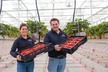
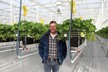
Peppers Unlimited has been using sensors to cultivate approximately 35 million bell peppers per year for some time. However, as plant losses increased over the past few years, the company sought to collect more and more accurate data. That search led them to Growficient. Co-owner Lars van den Bosch explains how they use the sensors in practice.
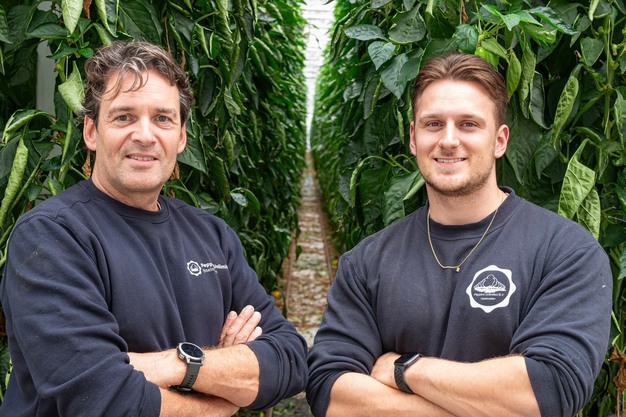
Peppers Unlimited was founded in 1989 under the name Fa. A.P. van den Bosch. That year, Lars' grandfather opened a 1.9-hectare greenhouse in Moerkapelle. After his father Wilbert took over the business, the company relocated to IJsselmuiden, expanded first to 7.5 hectares and later to 19.5 hectares, and changed its name to Peppers Unlimited. In early 2025, Lars joined the company as a partner.
 © Growficient
Increasing plant losses in bell peppers
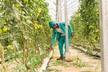
Since its founding, Peppers Unlimited has focused exclusively on bell pepper cultivation. In recent years, however, the challenges have increased. Lars explains: "We started seeing more and more plant losses. Especially in our second greenhouse, the plants in the back half were clearly weaker. At its worst, losses reached nearly 25%. Often it happened very suddenly. Before the weekend, the roots looked fine, and after the weekend it was a disaster."
A complete view of the greenhouse
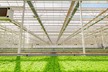
To determine whether the issue was related to their cultivation strategy, Peppers Unlimited wanted to gather more data. This led them to seek additional sensors. Lars explains: "Previously, we had three sensors across six hectares. We felt that wasn't enough. Through a sales representative, my father heard about Growficient. The plug-and-play concept really appealed to him. We decided to place a sensor at both the front and back of each irrigation zone, and an extra one in the middle of the larger zones. That way, we gained a complete overview of the entire greenhouse."
However, this did not provide the solution they had hoped for. Lars continues: "Our hypothesis was that we were over-irrigating. With Growficient's sensors, we could check this much more precisely. However, both moisture percentage and EC value were uniform across the irrigation zones. We also didn't see any other anomalies in the data that could explain the losses. So the problem wasn't solved."
Insights at a glance
As a result, Peppers Unlimited decided to start a trial greenhouse using organic substrate. This is where they are now seeing positive results. Lars explains: "Because Growficient sensors also work in organic substrate, we were able to continue using the sensors we had already purchased, which was great. There is still a learning curve, for example in interpreting moisture percentages. That's why I mainly focus on the trends I see on the Growboard. The goal is to maintain a consistent 'sawtooth' pattern in the graph. If we achieve that, we know our irrigation strategy is on point."
Lars checks the Growboard multiple times a day. He continues: "In spring, I pay particular attention to the heatmap. It gives a clear overview of the temperature distribution in the greenhouse. If I see cold spots, I can immediately check whether a screen was left slightly open or if a window is broken. Having that temperature data available at a glance is extremely useful."
He also closely monitors other parameters throughout the day: "I always keep an eye on moisture levels and EC trends. I use that data to adjust our irrigation strategy. If EC gradually increases, for example, I can reduce it during the next irrigation cycle. I also check in the morning how we ended the previous day. Based on that information, we can fine-tune the final irrigation of the day."
Fully switching over
Working with Growficient's sensors comes very naturally to Lars, so he rarely needs support. He explains: "I only contact them if I have questions or if something goes wrong, which doesn't happen often. But when I do reach out, I'm helped quickly and professionally. For example, we once had a sensor with a faulty battery, and they immediately sent us a replacement."
Next year, Peppers Unlimited will switch all greenhouses to organic substrate. Lars concludes: "In the past, greenhouse two caused most of the problems. But this year, we're also seeing increasing losses in greenhouses one and three, where we're still growing on stone wool. That's why we've decided to fully switch to organic substrate next year. We will continue using Growficient's sensors. After all, measuring is knowing."
For more information:
Growficient
[email protected]
www.growficient.com