A company that celebrates 140 years goes through good times and bad. This is certainly true for horticulture, a sector that is closely tied to economic and market conditions. Westland-based Royal Brinkman knows this well, as the Dutch family business celebrated its 140th anniversary this year, once again during a challenging period for the industry.
"We have also been there in times when things were difficult," says Bas Brinkman. "For 140 years, we have focused on improvement and sustainability in horticulture worldwide."
Bas Brinkman represents the fifth generation of the family business. In early December, we met with him and CEO Ton van Mil in the boardroom. The conversation covers the company's long history and the anniversary year, but also looks ahead to the future of Royal Brinkman and the horticultural sector. From its base in the middle of the Westland greenhouse area, the company has repeatedly shown a strong sense of where the sector is heading.
Ton recalls his first anniversary at the company, the 100-year celebration. "That was a major event for the greenhouse industry," he says. "I had just started at Brinkman and was able to attend. I clearly remember Cor and Henk Brinkman, the third generation, together with Mies Bouwman, a big name in the Dutch TV industry. That image has stayed with me."
Bas was not present at the 1985 anniversary, as he was born a year later, though he grew up surrounded by the company's history. For the 140-year anniversary, that history was brought together in a timeline displayed in the old auction hall at the head office site. "We are proud of the role we have played for so long," Ton explains. "And we want to share that story."
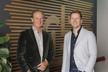
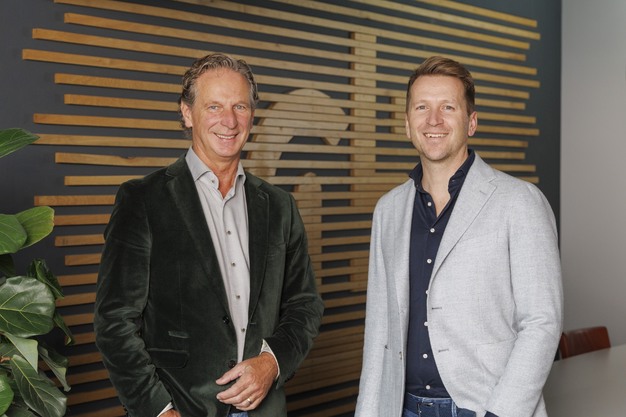 © Royal BrinkmanTon van Mil and Bas Brinkman
A family business
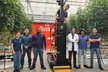
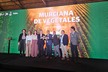
Throughout the anniversary year, Ton and Bas appeared together at several events, often standing on a Berg Hortimotive pipe rail trolley. At GreenTech in Amsterdam, they addressed a large group of partners at the Royal Brinkman stand. The anniversary was marked in different ways, but the company deliberately chose not to make it an overly large celebration.
"That didn't feel appropriate," Bas explains. "Horticulture is facing difficult times, especially when it comes to investments." Ton agrees. "This approach fits who we are. We prefer to stay grounded and focus on our work."
During the family day this year at the head office, a pipe rail trolley again served as a small stage for a short speech. "There were about 1,000 to 1,200 employees and family members," Bas recalls. "It really felt like a festival." Ton adds, "It's special to show people where you work. We value that family feeling and are proud to be a family business in a sector with many large corporates."
 © Royal BrinkmanA pioneer and a Vocom
Royal Brinkman's long history is documented on a dedicated page of its website. It highlights many key milestones. One moment that stands out for Ton is the transition from soil-based growing to substrate growing in the 1980s. "Brinkman played a pioneering role in that shift," he says.
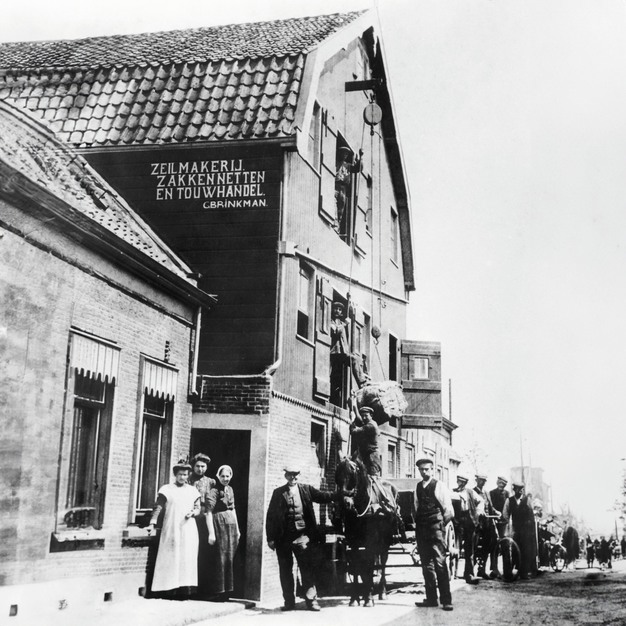
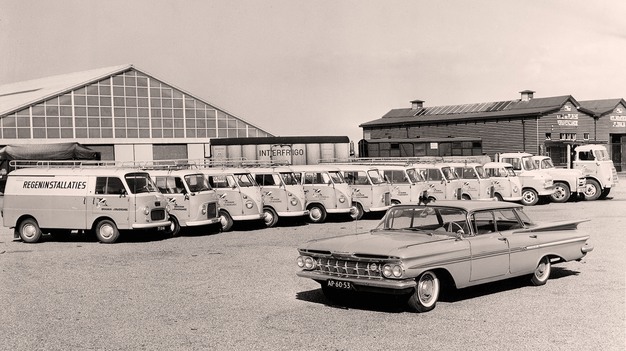
Photo right: The first location was in the Pepersteeg in 's-Gravenzande, now known as Havenstraat.
To make the step from growing in soil to growing on substrate, growers needed both rockwool slabs and a Vocom, a computer system that controls water and fertiliser dosing. "At the time, rockwool and those systems were very hard to obtain," Ton recalls. "If one grower made the switch, others wanted to follow immediately. It became a real trend." Ton saw this firsthand, as his brothers were growers themselves and also moved to rockwool and Vocom systems.
This transition is one example of Royal Brinkman recognising and responding early to new developments. Another came later, with the rise of digital business, when the company was quick to launch a webshop, becoming the first online store aimed specifically at professional growers.
The webshop
Many people know the company as a supplier, but Ton and Bas prefer not to use that word. The focus has increasingly shifted towards adding value by sharing knowledge. From the warehouse on in the middle of the Westland area, as we see later that afternoon, products are shipped all over the world. At least as important, however, is the knowledge that goes with them.
The webshop changed how growers ordered products. Instead of relying solely on advice from catalogues, growers could place orders themselves online. "That was a major breakthrough," Ton explains.
Today, a new development is central to the company's strategy: Integrated Crop Management (ICM). Royal Brinkman aims to be a front runner here as well. "We see ICM as the next accelerator for horticulture," Ton says. "It goes beyond biological crop protection. It is about building resilient plants and systems." As a knowledge partner, this is an area where the company is investing heavily. "Because we work closely with growers, we quickly see what is coming. We expect ICM to become one of our key pillars."
Continuing to invest
Royal Brinkman has always stayed close to growers. Initially, this was because the company was located in the heart of the Westland greenhouse region, where, as horticulture expanded internationally, the company expanded with it. Today, the company operates in 15 countries, allowing it to stay connected to developments worldwide.
Growth also brings challenges, Bas acknowledges. "We want to remain a family business and stay financially healthy so we can keep investing," he says. "Our slogan used to be 'Leading in horticulture'. Over time, the sector caught up, but even then we managed to stay ahead during difficult periods."
The company faced financial challenges in 2002 and 2003, which led to a return to basic principles. Another tough period followed between 2009 and 2014. "The market was difficult," Ton explains, "but we continued to invest, especially in e-commerce. Because of earlier experiences with very low margins, we were able to stay resilient and keep moving forward."
Crisis upon crisis
Since the previous anniversary in 2020, several crises have followed one another. First came COVID-19. In March 2020, uncertainty was high, and Ton recorded a video message for employees. "Looking back, I can smile," he says. "But at the time it was about showing leadership and keeping people calm. Horticulture had to keep running."
Soon after came the energy crisis. "I had never seen greenhouses intentionally left empty before," Ton says. Then came disruptions in the Suez Canal, followed by a global transport crisis and ongoing geopolitical tensions. "The pace of change keeps increasing," Ton concludes. "We deal with that reality every day."
 © Royal Brinkman
Geopolitics
As a global company, Royal Brinkman must consider developments far beyond the Netherlands. This recently became visible after an article in a Dutch newspaper about doing business with Russia. For Royal Brinkman, the approach is clear: comply with all regulations, contribute to food production, and take care of employees. "That sense of responsibility fits us as a family business," Ton explains, noting that this perspective was not fully reflected in the article.
Russia is just one example. Political uncertainty elsewhere, including statements by US President Trump, also affects global business. Markets that once seemed promising can suddenly become difficult to access. "In theory, half the world is large enough," Ton says, "but you still have to deal with reality."
Sourcing
Bas also sees opportunities in these changes. He points to China as an example. "At one point, exact copies of our pipe rail trolleys appeared there. You can see that as a compliment," he says.
China has developed into both a competitor and a sourcing market. Royal Brinkman has a local presence and increasingly sources products there. "Because China produces so much itself, it has also become an important sourcing location for us," Bas explains. "From there, we can distribute products globally." Ton adds, "That's entrepreneurship."
The company's activities in China have shifted over time. "In the 1990s, we were still building complete greenhouses there," Bas says. "Now, the focus is more on sourcing from China rather than selling into the market."
Focus on future growers
Royal Brinkman traditionally focuses on greenhouses, both glass and plastic, with an emphasis on high-tech systems. "Growers with higher investment levels tend to come to us," Ton explains. That said, emerging markets such as Africa, India, and the Middle East are not overlooked. In Africa, the company already works closely with breeding companies.
Earlier generations of the Brinkman family also saw potential in southern Spain. This resulted in a local branch and an interest in biological crop protection company Agrobío. "Here too, we focus on mid-tech and high-tech solutions," Ton says. "Focus is essential. Without it, we would not succeed in technology and innovation."
While Royal Brinkman serves many countries and offers a broad range of products, it no longer provides exactly the same service level to every grower. "We have made clear choices," Ton explains. "This allows us to offer strong, targeted support to larger growers, while still serving smaller ones well."
Bas emphasizes that the focus is not on size, but on long-term potential. "We look at which growers will still be active in 10 or 20 years," he says. "That could be a small or a large operation. Our aim is to help growers move forward by at least one generation."
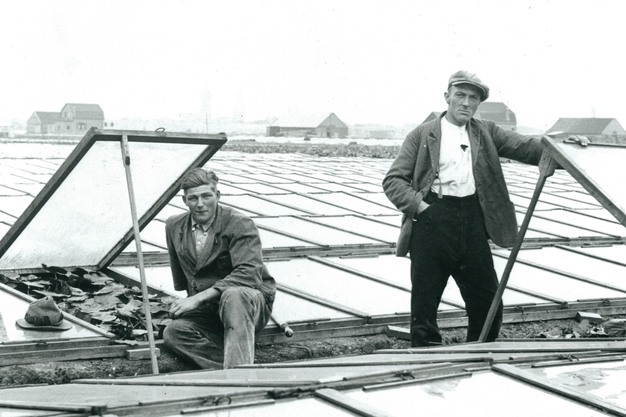 © Royal BrinkmanHotbeds were fitted with 'single frames.' Cauliflower, lettuce, and even cucumbers were grown under this flat glass during the early years of Brinkman.
New strategy
To support this long-term vision, Royal Brinkman has adjusted its strategy over the past three to four years. "We are in the middle of that transition," Ton explains. The company now operates through four divisions: ICM, trade including large-scale trade, technology, and international operations. "This structure gives us clarity and strengthens our position."
Bas adds that the company's identity has evolved. "We used to describe ourselves as trade and technology. Now we focus on Horti Essentials, technology, and ICM. The goal is to deliver real added value in each area." Ton agrees. "That's why we don't like the word supplier. We aim for added value, and we've been building on that for years. We approach the grower customer with a different focus. They're not waiting to be asked: do you need anything else? You'll be back out the door in 10 seconds." Bas adds with a laugh: "And you don't have to come back."
Not looking too far ahead
Things used to be very different. In the past, employees went from greenhouse to greenhouse asking exactly that question. During the anniversary celebrations, everyone was able to step back into that time for a moment, thanks to a journey through history with old images, sometimes even brought to life with the help of AI.
At the end of the conversation, Ton and Bas take one more journey through time, this time towards the future. How far ahead does the company look? That turns out to be difficult. "You can really only look one to three years ahead," Ton says. "Too much is changing at the same time. Within that framework, you have to run your business. What is certain is that we see potential in all four divisions. As an organisation, you need to be flexible and lean enough to keep adapting to what the market needs and wants at any given moment. I think that is the key to success."
Bas adds, "The focus growers are asking for is exactly what we are steering towards. Even growers themselves don't know what their business will look like in five years' time." Both Ton and Bas are positive about recent signals from the Dutch government that horticulture is seen as a future-proof sector. Even as an internationally operating company, the Netherlands remains crucial. "Half of what we do happens here," Ton says. "What happens politically here has a direct impact on us." Bas concludes with a smile, "And that's something we deal with every day, still with a lot of pleasure, by the way."
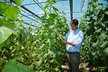
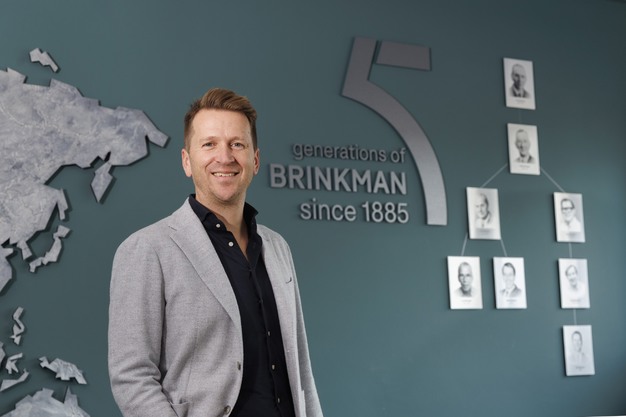 © Royal BrinkmanBas Brinkman, the 5th generation Brinkman in the family business that will celebrate 140 years in 2025
For more information:
Royal Brinkman
Tel: +31 (0)174 446 100
[email protected]
www.royalbrinkman.nl