In a moment when many traditional crops are hunting for ways to stay profitable, Spanish saffron, long defined by seasonality and intense labor demands, is stumbling into a surprisingly modern chapter. In Aragón, the Operational Group Azafarm, coordinated by FITA Aragón and made up of Grupo Tatoma and Azafrán La Carrasca, together with collaborators Campag, Tecnalia, and a handful of innovative growers and companies, has spent the last four years developing a portable module that can reproduce and force saffron flowering under fully controlled conditions. The goal is straightforward. Bring stability, ergonomics and enough productive muscle to revive the crop in areas that have lost people and agricultural activity.
 © Azafarm
Among the partners is Juan Naudin, CEO of ZGreens and a specialist in vertical farming. He has been hands on in the design and testing of the prototype. "When I got into indoor farming, I knew I wanted to try high value crops. And saffron, besides being one of the most expensive spices in the world, is a huge unknown. Its cycles look nothing like any common horticultural crop," he says.
Azafarm was born to crack that physiology. Early on, the consortium focused all its energy on understanding flowering, adjusting temperature, humidity and thermal ramps inside a small controlled space. "The first year was almost entirely about flowering tests. We needed to see how the corm reacted to different parameters. After that we moved to reproduction and the vegetative phase, which in nature happens between November and April," Naudin explains. Once the cycles were understood, the team began designing a prototype to automate the whole process.
 © Azafarm
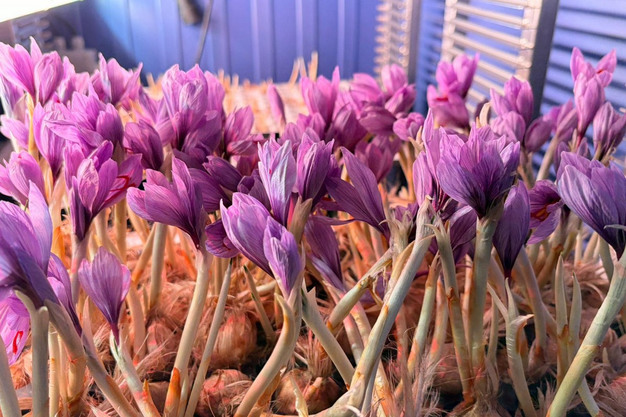
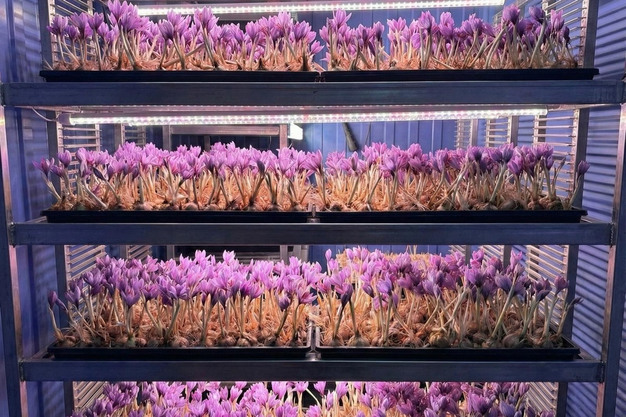
The prototype now up and running is about a cubic meter and a half in capacity. It works like a small insulated container fitted with a five level tray cart. Temperature moves between eight and twenty one degrees through different phases, always under balanced spectrum horticultural LEDs. "They are compact modules, not very large. The point was to understand the crop's behavior. The final engineering will come later and will be the one that scales this into bigger commercial models," he notes.
Despite the modest size, the results have surprised even the team. "We have achieved yields between two and a half and three times those of the field crop, and sometimes above that," says Naudin. "These numbers match the project's logic. It is about boosting productivity and giving rural growers a stable and programmable system that does not depend on a single flowering spike or the scramble to find labor during a very narrow window."
 © Azafarm
One of the most meaningful technical breakthroughs is the shortening of the full cycle. In nature saffron needs twelve months to complete its rhythm, with flowering in autumn and reproduction extending through spring. Inside the module that cycle is down to eight or nine months. "We cannot get two flowerings from the same corm because it needs its reproductive phase, but we can chain batches in different stages. That way in twenty four months you can get three cycles instead of two," he explains. "This even opens the door to a staggered production model. In theory you could have bulbs and flowers at different points of the year if you run several modules in parallel."
 © Azafarm
Beyond the tech, the project was designed as a rural revitalization tool. "In counties like Teruel, the crop has been abandoned for lack of workers. To get six kilos in the field you need to harvest about a million flowers in four or five days, often at zero degrees, bent over and picking them off the ground. It is brutal, and every year there are fewer people willing or able to do it," Naudin says. "The module changes that. You can harvest and handle everything in trays, at a comfortable height, inside a climate controlled space. It improves working conditions and removes the pressure of seasonality."
The consortium is now in its final year of testing and, according to Naudin, the environmental thresholds are essentially set. From here, engineering will determine the final commercial size and productive capacity of the module. "We know exactly how the crop behaves. Now we have to decide whether the final model will be a twenty foot container, a forty foot container or something in between," he says.
The project has a double ambition. Revive a crop that is part of the local identity and show that vertical farming can offer practical solutions beyond fast cycle greens. "If the commercial design moves ahead as planned, Aragón could become the first European region with an industrialized saffron system in controlled environment, with the potential to create new economic opportunities in areas where every hectare matters."
For more information:
Azafarm Foundation for Innovation and Agri-Food Transfer of Aragón
Avda. Montañana, 930 - 50059 Zaragoza - SPAIN
[email protected]
https://fita-aragon.es/proyecto/azafarm/
Zgreens
T. +34 609 863 762 © Azafarm[email protected]
https://zgreens.es/