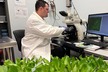
For the next five years, 11 researchers from four technological universities of the Netherlands will team up with 12 companies for an extensive research trial on developing smart technology, such as plant imaging, sensors, and advanced models to deliver exactly what a plant needs in terms of light, CO₂, and ventilation. The project aims to reduce energy consumption by 25 percent and energy costs by 35 percent without any loss of yield. The Dutch Research Council (NWO) granted the project proposal for this project named GreenControl.
"Controlled Environment Agriculture (greenhouses and vertical farms) is the most productive form of plant food production, but uses much energy. Substantial energy savings are urgently needed. We must transition to a new approach to greenhouse operation, where crops are at the center of the indoor climate control strategy. This requires breakthroughs in plant imaging, microclimate sensing, and crop-climate modelling to develop new control strategies for lighting, CO₂ dosing, and ventilation. We aim for 25% energy savings and 35% reduction in energy costs by giving plants exactly what they need and not more," says project lead professor Leo Marcelis of Wageningen University's Horticulture and Product Physiology Group.
Along with researchers from Delft University of Technology, University of Twente, and Eindhoven University of Technology, he will work with B-Mex, Growy, Heliospectra Smart LED Lighting, INFO - Digital Decoded, Jan IngenHousz Institute, KUBO Group, KWS, Ledgnd, Sigrow, Glastuinbouw Nederland, Syngenta, and Ridder on the project.
"Food production must become smarter and more sustainable as the population grows, the climate changes, and natural resources become scarce. Greenhouse horticulture is already efficient, but its energy consumption must be drastically reduced. This requires a new way of growing that puts the plant at the center of greenhouse operation. Professor Tamas Keviczky is part of GreenControl, a project that develops smart technology such as plant imaging, sensors, and advanced models to deliver exactly what a plant needs in terms of light, CO₂, and ventilation. GreenControl aims to reduce energy consumption by 25 percent and energy costs by 35 percent without any loss of yield," the official statement says.
The project is supported by the Perspectief programme. Via this programme, NWO and the Dutch Ministry of Economic Affairs have been stimulating investments in technological innovation with societal and economic impact for more than 15 years. These investments are necessary to strengthen the economic position of the Netherlands.
A second awarded project in the programme is called Unlock, and it dives into new opportunities for natural virus resistance in crops
The Unlock research project has been awarded funding through NWO's Open Technology Programme. "The project focuses on a little-studied group of resistance genes – the RDR-gamma genes – which help plants fend off viruses. We see that these genes can offer surprisingly broad protection," says researcher Richard Kormelink of the WUR Laboratory of Virology.
Earlier research showed that the Ty-1 gene from tomato is effective against harmful DNA viruses. Unlock investigates how three comparable genes from Arabidopsis function and whether they can also stop RNA viruses. Together with private partners, the team is developing tools to quickly identify Ty-1-like genes in major food crops. The goal is to deliver strong, natural resistances that help growers prevent yield losses and reduce the use of crop protection products.