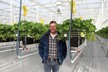
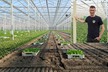
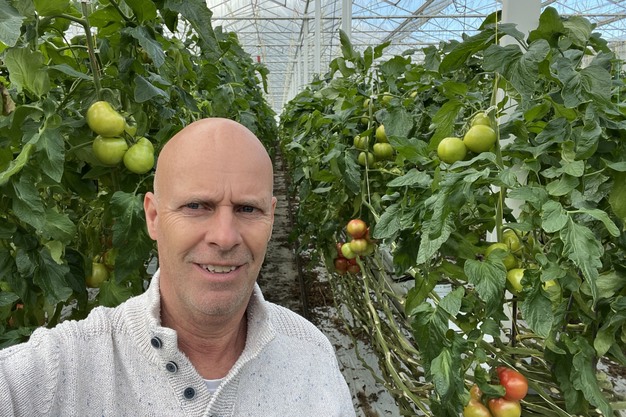
Marc Groenewegen was not facing major challenges in his tomato crop, but he was - or actually always is - curious, which is why he started working with Trutina. "With new sensors you can always take a step forward. For me, it was important that data confirmed what my gut told me. That removed doubt and gave confidence to make tougher decisions based on facts rather than feelings." According to Marc, the combination of plant data and external analysis has influenced how he approaches irrigation, crop balance, and short-interval decision-making.
Trutina is a weight measurement system that gathers data frequently (every 5 secs!) and uploads it to a smart dashboard where the operator can easily see what is happening with their plants. In addition to working with Trutina, Marc also started working with the accompanying Risk Reduction Report. "Growers don't just receive data from Trutina - they also get the guidance of our co-founder János, who interprets the numbers and translates them into clear actions during regular consultations", explains Zsolt Fábián, CEO of Gremon Systems.
 © Gremon Systems
Irrigation timing under review
When comparing Trutina to earlier tools, Marc described a shift in the way irrigation timing was interpreted. "Earlier systems often pushed us to delay irrigation in the morning to avoid being too vegetative. But Trutina showed something else: starting too late also costs growth. At first I thought the results were contradictory, but they were just different perspectives on the same process."
That shift triggered adjustments in his daily schedule. "We used to start quite late and give big shots in short succession. With Trutina, we shifted to starting earlier with longer delay times and smaller shots. It may sound like a tiny change — 15 or 30 minutes — but we saw differences in growth, root development, and flower quality."
Marc noted that discussions with János, co-founder of Gremon Systems, influenced the way he interpreted the information. "He looks at plants differently, and that helps me see the bigger picture behind the data."
Flower development and crop balance
Marc referred to a case involving sticky flowers. "We had sticky flowers where the petals don't open properly. That usually comes from too vegetative conditions early in the day. By starting irrigation a little later and letting the plant shrink slightly, the flowers opened much better. Those flowers produce fruit that is slightly smaller and less shiny, but overall the quality is higher. This is what the Risk Reduction Report does: it brings together my grower's experience, the sensor data, and János' analysis. Together we decide the best path."
 © Gremon Systems
 © Gremon Systems
 © Gremon Systems
Click to enlarge
Steering with climate data
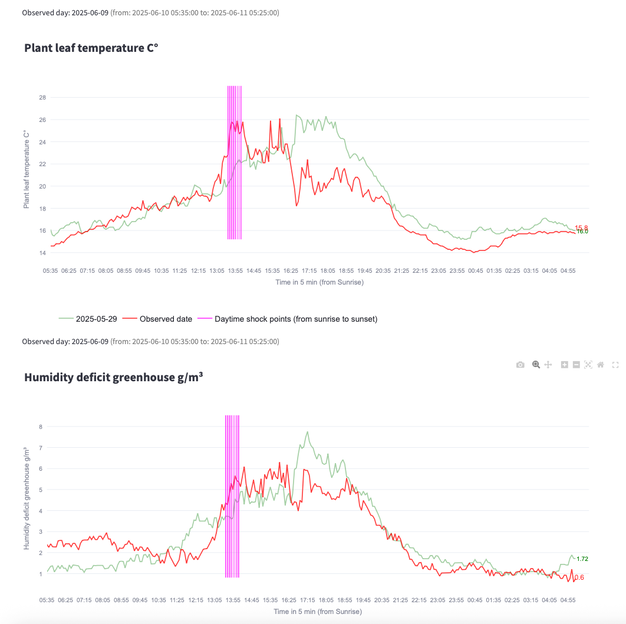
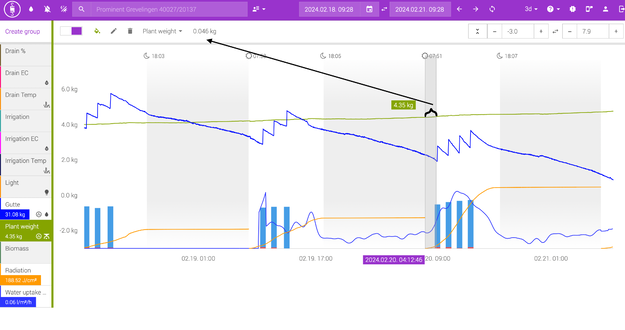
Adding climate data to the system changed the frequency and timing of interventions. Mark says, adding that it was a milestone. "Normally crop advisors visit once a week, look back and say: 'This was too late, this was too hot, fix it next time.' But by then, the moment is gone," Marc explained. "With Trutina plus climate data, we steer forward. We now make decisions every four hours, sometimes even every 15 minutes. Instead of correcting mistakes afterwards, we react in real time."
He regularly examines the dashboard throughout the day. "For the last years we already worked in four-hour cycles, but with Trutina I can now zoom in on 15 minutes. Sometimes with János we go really deep into those short timeframes. When something felt off, he analyzed it and showed me why."
 © Gremon Systems
Biomass gain as a key indicator
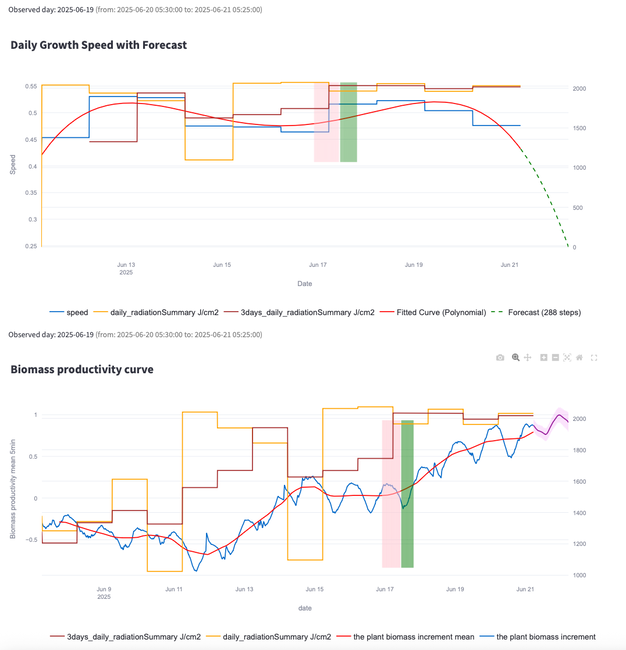
Among all data points, biomass gain stands out to him. "That's something I couldn't measure so precisely before. You can even see how a small shift in weather conditions directly affects growth. That's the difference between a manager and a grower. A manager focuses on the big picture and avoids mistakes. But a grower pays attention to every minute."
The dashboard itself requires some learning. "The dashboards are powerful, but for older growers they can feel complicated. There's so much information inside. You need time, curiosity, and the courage to experiment. Once you get comfortable, it helps you understand what's happening in your greenhouse."
When asked why other growers might consider the technology, Marc said: "You must be curious. If you are, then Trutina and the Risk Reduction Report are extremely valuable. It's not about replacing experience — it's about confirming it, sharpening it, and sometimes challenging it. That makes you a better grower."
Adoption in the Dutch market
Reflecting on his collaboration with the company, Marc pointed to three aspects: "First, János himself. He brings a refreshing perspective compared to what we usually hear in the Netherlands. Second, the openness of the conversations — every discussion is honest and constructive. And third, the reliability of the sensors."
He also addressed a common sentiment in his region. "When we first entered the greenhouse, someone asked: 'Don't we already have enough technology in the Netherlands? Why bring another one?' I understand that. In Holland we sometimes think we know everything better — but that's not true. Our climate is easier than many other places, so we're not necessarily better. We can always learn from people outside."
Installation and setup
To make these solutions even more accessible, Gremon Systems is proud to partner with HCTS, the official distributor of Trutina devices in the Netherlands. Thanks to this collaboration, Dutch growers now have access not only to the technology itself, but also to the expert support needed to turn data into confident, daily decisions.
According to Edwin from HCTS, a technician on the project, installing a Trutina system is a smooth and efficient process.
"Everything arrives in one complete box from Hungary. I coordinate with the grower to decide
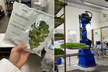
who will handle the power supply, and from there we connect and test the entire system. The setup includes a comprehensive drainage system, along with sensors measuring stem diameter, light (including UV), biomass, and the weight of each plant. There's also a drainage meter at the bottom of the gutter that measures the drainage water, the EC, and tracks how much water the plants actually absorb. Naturally, challenges can arise - such as missing internet connection or cables that turn out to be too short - but these issues are always resolved quickly."
What makes Trutina truly exceptional is its flexibility and the way it adapts to the grower's needs. As Edwin explains: "Some growers want the system to be mobile, others prefer a fixed setup. You always have to take this into account and make sure everything is neatly done."
For more information:
Tom Fleuren
HCTS B.V.
+31 6 20867820
[email protected]
www.hcts.tech