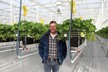
As Chief Agricultural Officer of Haven Greens, Eric Highfield is helping redefine what large-scale lettuce production can look like in Canada. Combining automation, AI-driven systems, and deep horticultural expertise, Haven Greens has built one of the country's most advanced greenhouse operations. In this Indoor Ag-Content Q&A, Eric offers a candid look at designing for efficiency, scaling responsibly in a saturated market, and staying grounded in the fundamentals that make CEA truly sustainable—insights he'll expand on during his Indoor Ag-Con 2026 panel, "Lettuce Without Limits: Scaling Responsibly in a Saturated Market."
Haven Greens has been described as one of the most technologically advanced lettuce greenhouses in Canada. What were the biggest design and technology decisions you made early on to ensure both efficiency and crop quality—and how are they performing now that you're in production?
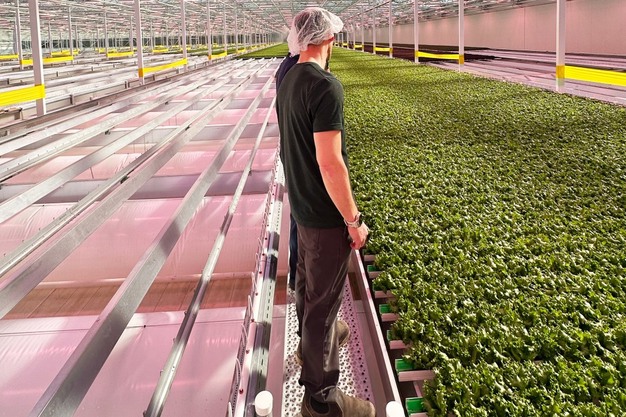
During the design process at Haven Greens, our goal was to balance technology and automation with economies of scale. This concept allowed us to maximize productivity and minimize labor without sacrificing consistency or quality. The most important design considerations were our cultivation system, climate systems, irrigation components, and packaging equipment. These four systems must seamlessly integrate for optimal performance of our facility to keep our perpetual lettuce machine running. Our mobile gulley cultivation system was central to our design process. For the business to achieve its maximum output potential, we had to provide appropriate ancillary systems to ensure consistent high-quality lettuce production, while minimizing our operational day length and labor.
 © Haven GreensA view of the pack hall from the mezzanine.
Lettuce is a cool weather crop, and providing appropriate climate 365 days a year is essential. We've incorporated conventional evaporative cooling and significant mechanical cooling to achieve a consistent climate year-round, and thus stable production. Irrigation, a known pain point for recirculating hydroponic systems — especially in high density baby leaf mobile gully systems, has the potential for catastrophic consequences. We went to great lengths with our irrigation design to minimize potential risks — adding multiple tiers of mechanical filtration, advanced fertigation dosing, sterilization and oxygenation systems, and temperature control systems. Another fundamental design parameter was ensuring we had the capability to put our product into a sellable packaged format. Our cultivation and packaging systems are intimately intertwined — neither can function if the other is inoperable. We designed our facility around a processing time of 20 seconds per gutter, which ultimately determined the size of our greenhouse — resulting in a reasonable operational day length. Our packaging line can process roughly 10,000 pounds of lettuce in an 8-hour production cycle every single day.
While it was challenging to implement these systems and operational processes simultaneously, we are happy with the resulting performance of these core systems. We have gained key insights and takeaways from our first operational phase. Ulitmately, our successes significantly outweighed our shortcomings, and we are very satisfied with the result. We recognize there is room to improve as we expand into our second phase, and I expect we will continue to evolve in our team's relentless pursuit of excellence.
Your facility features a fully automated, hands-free mobile gutter system. How do you balance automation with horticultural oversight, and where do you still see the greatest need for a "grower's touch" in a data-driven environment?
The key to integrating automation is to understand and balance these systems with economies of scale. This has been a key pursuit in the quest for desirable unit economics. Within our operation, there are many instances where a person is far more efficient than a machine. Technology is only as effective as the team that manages it, and as our operation advances and becomes more autonomous, our team becomes that much more impactful. From a horticultural perspective, you can't replace the power of human observation and a "boots on the ground" approach. Growers must directly interact with plants in order to feel, smell, and taste their product to really be in tune with their crop. The challenges we face in the world of high-tech automated greenhouse cultivation are too complex to be navigated remotely. Our team walks the entire greenhouse daily, making observations and taking data — providing an opportunity to identify and correct problems.
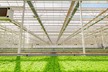
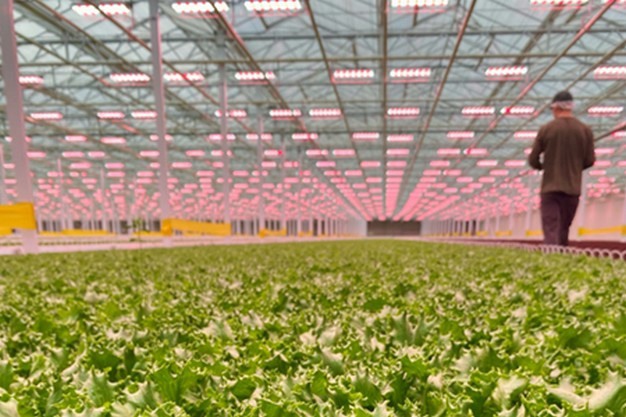 © Haven GreensCrystal green lettuce grows in the greenhouse.
Successful operators must find balance between automation and the value of having a person perform a task. There are often overlooked opportunity costs of automation such as maintenance or the effect on operations when something breaks down (and everything breaks down eventually). For example, we chose not to automate our case packing operations because of the value that comes from a person examining lettuce trays. People are able to identify problems such as mis-seals, and automated case packing equipment is notoriously finicky and unreliable with a questionable ROI. In contrast, our product harvesting, mixing, tray filling, and tray sealing are completely automated. It just depends on the specific priorities and resources of an operation as well as a realistic understanding of the maintenance requirements from both a preventative and a reactive perspective.
As you'll discuss in your upcoming Indoor Ag-Con 2026 panel, the leafy greens category has become crowded. From your perspective, what does "scaling responsibly" mean for greenhouse producers today, and how can new entrants differentiate without oversupplying the market.
The leafy greens category has become crowded in recent years, and we have seen many facilities underperform or fail for a variety of reasons. Scaling is either growing a smaller operation to a larger one at a given site or replicating a business at additional locations. What works well for a one-acre site doesn't necessarily translate to what will work best for a five- or ten-acre facility. The levels of technology must be carefully balanced with the economies of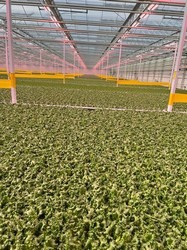 © Haven Greens scale as companies grow. It can be challenging to begin new construction while managing existing operations at the same location.
Greenhouses are very much like snowflakes — no two are identical. This makes expanding operations to a new location challenging. Unfortunately, these difficulties are often overlooked when venture capital funding is introduced and an organization grows too big too quickly. Site selection is critical when expanding operations to a new location. For a facility to be successful, one must consider the physical attributes of a site, the existing market, the market potential for their product, access to labor, logistical availability, site accessibility, proximity to competitors, climate, utility availability and costs, and availability of systems and supplies. Regulation and permitting must all be reviewed extensively on a case-by-case basis. In some locations, there is exclusivity in place to purchase a particular growing system, greenhouse, or seed variety. All of these factors must be evaluated to understand the viability of a location.
Replicating team dynamics and culture across different sites is an often-overlooked challenge. Greenhouse operations are essentially an exercise in problem solving. Having the right people in place — those who are motivated with the proper skillset and work ethic, capable of handling those challenges day in and day out — make all the difference.
Proximity to field production must also be considered. You gain a cost advantage the further you are from field-grown lettuce, as the cost to ship field-grown lettuce is directly related to the distance it has to travel. Transportation availability, and any potential setbacks, must be at the forefront of location selection.
Often, venture capital-driven operations have neglected the importance of horticultural expertise. These companies can become so enamored with the concept of disruption and sustainability that they neglect the core fundamentals of a successful CEA business, horticultural requirements, or unit economics. Others have been too focused on the importance of developing intellectual property. It's important to determine early if you are going to be an operator or a technology developer as it's highly improbable that a company will do both well. A good analogy I picked up from a friend in the industry years ago was, "John Deere makes great tractors but they don't operate farms." This resonates with what I have seen and experienced in the CEA leafy greens space in recent years.
Haven Greens positions itself as environmentally responsible—from reduced emissions to pesticide-free growing. Which sustainability practices have the greatest measurable impact, and where do you see opportunities for future improvement or collaboration within the CEA sector?
Environmental and economic sustainability are at the core of Haven Greens, and we tout the typical callouts of conserving water and nutrients via recirculating irrigation systems; remaining pesticide free through biological control, exclusion, and enhanced biosecurity programs; and reducing food miles by producing closer to the end consumer. Our unique stormwater management system with a bio-swale allows us to recycle all discharged grey water from the facility including wash water and reverse osmosis permeate. This system uses terrestrial and aquatic plants in a biological "lazy river" that feeds into an aggregate layered pond. With this system, we are able to achieve industry-leading water efficiency.
Renewable and alternative energy are a big part of our model. We are installing a 3-megawatt single axis tracker photovoltaic array and a 1-megawatt microturbine with our phase two expansion. This will provide the framework for a micro-grid, enabling the majority of our electric use to be vastly more efficient and less expensive than grid power alone. For those who are unfamiliar a microturbine, it is a small combined heat and power generator (CHP) that allows us to generate our own electricity from natural gas while using the byproducts of CO2 and waste heat to supplement our climate and growing systems. These systems have a great potential to offset energy costs in markets with limited or expensive grid power and may also qualify for government programs aiming to subsidize energy efficiencies.
You've been part of multiple CEA ventures over the years. What advice would you offer to other growers or investors looking to launch large-scale greenhouse projects—particularly around aligning technology choices with long-term business goals?
I would strongly advise investors looking to get into this space to conduct extensive due diligence. They should become experts on the specific details of the market potential and saturation for each and every location. To determine viability, the fundamental aspects of cultivation, production, and process flow must be understood and planned with excruciating attention to detail and coincide with viable unit economics. Hire an experienced grower or horticultural consultant who is experienced with the specific type of crop, growing system, and greenhouse early in the planning process. Do not try to reinvent the wheel or cut corners when it comes to critical operational components. I would also emphasize the importance of hiring talented people and budgeting appropriately for these essential roles — ensuring labor budgets are not too top heavy (overly padding executive roles) and are really focused on operations. There have been far too many facilities built in the last five years that neglected these fundamental elements, which are critical to building a successful operation. We have seen these mistakes manifested with the copious bankruptcies that have tarnished our industry.
 © Haven Greens
For growers, I would advise that you are aligned and realistic with ownership about goals, expectations, and values. Do your homework and understand the organization before you sign a contract. Ensure you have the right tools to meet your performance expectations and minimize risks to your crop.
For both investors and growers, I stress the importance of understanding the risks involved with each new venture or integrating expansion with an existing operation. Ultimately, growing food in a way that is economically viable and sustainable is extremely challenging and anyone who tells you otherwise is a big red flag.
For more information:
Haven Greens
havengreens.ca/